Home Theater Geeks 529 Transcript
Please be advised that this transcript is AI-generated and may not be word-for-word. Time codes refer to the approximate times in the ad-free version of the show.
Scott Wilkinson [00:00:00]:
In this episode of Home Theater Geeks, I answer a listener question about in ceiling speakers and Atmos. So stay tuned. Podcasts you love from people you trust. This is Twit. Hey there, Scott Wilkinson here, the home Theater geek. In this episode I answer a question from Rajesh Goel who writes I am in the process of buying a new home and the builder offers a speaker installation with five in ceiling speakers. They use Origin Acoustics D85 speakers, three in the front and two in the back. These are directional speakers aimed at the listener.
Scott Wilkinson [00:01:02]:
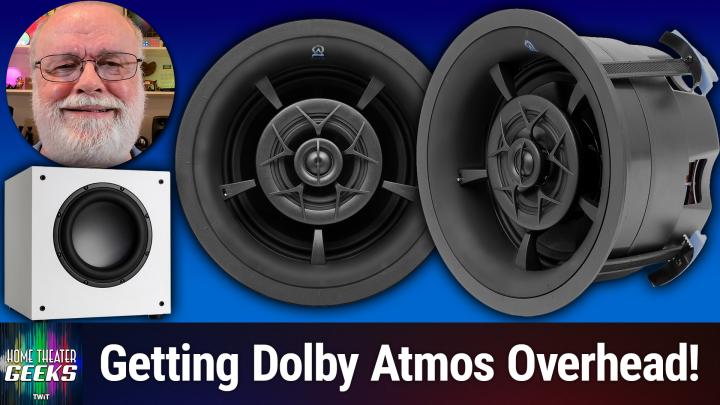
If I want an Atmos experience, what are my best options? One for quality and two with fewest changes to the builder specification. If I add two speakers very close to the wall where the TV is installed, would that give me a good Atmos experience? Other suggestions? Well, thanks Rajesh. This is a great question and it's a situation that I believe many people face. Now, Origin Acoustics makes really good what are called architectural speakers that is in wall or in ceiling. So it's a good start. And the 3 way D85 does in fact have aimable tweeter and mid range. So here we see a cup, a picture of it from straight on and there's also a picture of it sort of at an angle and you can see that EX that gets inserted into a hole in your ceiling. And the tweeter and the mid range which are in the center there can be aimed toward the listener.
Scott Wilkinson [00:02:20]:
It also has a very respectable frequency response as specified by origin, which is from 36Hz up to 20Khz, which that's. That's very low. It's got an 8 inch woofer and I'm sure that that 36Hz is not as loud. It's down some number of DBs and Origin didn't specify. I do wish that that your builder offered the option of installing in wall speakers around the tv. Having the front sound come from around the TV is much better than having it come from above. Even if the front speakers are aimable. Origin offers quite a few in wall speakers.
Scott Wilkinson [00:03:16]:
So if that's an option, I'd see if the builder can do that. Install the front, left, center and right speakers in the wall around the screen rather than in the ceiling. Now if that's not an option, I'd have the builder. Well, if you can, if the builder will do it, the best approach will be to install two more DB85s directly above the listening position. I would definitely not put them in in the wall or in the ceiling right next to the wall where the TV is. The whole point of Atmos is to have sounds that are supposed to be coming from overhead, like, say, rain or something flying over. They should sound like they're coming from directly overhead. The speakers near the TV wall would not achieve that, so I would definitely not do that.
Scott Wilkinson [00:04:22]:
So adding two DB85s to above the listening position would give you a system called 5.0.2. So that's five main speakers, no subwoofers. You didn't mention anything about subwoofers. And two directly overhead, which would be for the Atmos. Now, speaking of subwoofers, I would recommend that you think about adding one or two subwoofers to the setup. The DB85 goes down to 36Hz, which is quite remarkable, but I bet at that low frequency it's not very loud. I would want a sub to add a little extra low frequency oomph. Now, Origin does make architectural subwoofers in wall and in ceiling.
Scott Wilkinson [00:05:18]:
And in fact, I put a few pictures here. Here's a couple of in ceiling models that are these big boxes that attach to vents that are mounted in the ceiling and the sound comes out there. There's also another one that's more direct that just is like the DB85, but bigger and it goes up into the wall. However, I would say that getting standalone subwoofers would be better, and it would be much easier to install them without disturbing the builder's plan. Now, these speakers, these in wall and in ceiling speakers require an external power amp for one thing. So buying a standalone subwoofer powered subwoofer would be easier in that regard as well. And you could place them wherever they needed to be in the room to achieve optimal performance and minimize room modes. With these in wall and in ceiling speakers, they're fixed, they're where they are, and they might work or they might not.
Scott Wilkinson [00:06:35]:
Here's a couple of in wall versions. Now, they'll work, but will they work to minimize the room modes? Probably not. At least they won't be ideal. Now, of course, having a standalone subwoofer or two means having a big box sitting on the floor in the room. You or your spouse might not want that, but if you're more interested in performance, it's going to give you better performance. So Origin offers several of these as well. They offer the deep subs, what they call the deep subs that are specified down to 30 Hz, and the main differences are size and amplifier power. These are probably the ones I would consider, but I just Wanted to show you that Origin also makes some larger ones that they call the performance subs which go lower.
Scott Wilkinson [00:07:35]:
The largest one, the 12 inch, goes down to 21 hertz and they make one slim sub which is the sub S10, which has a 10 inch driver. It's spec down to 35 hertz, less than 5 inches deep. It can be freestanding or it can be mounted on the wall. Not in the wall, but hung on the wall essentially. Now what I'd recommend of these, of these Origin subs is I'd get the smallest one of the deeps or the smallest one that's appropriate to the size of your room. Even better, I'd get two small ones, say two deep eights or two tens, which lets you place them to minimize strong room modes. Now the Origin subs are pretty expensive. The sub D8, the deep eight, just under a thousand bucks and the sub D10 is around 1300.
Scott Wilkinson [00:08:42]:
Now subwoofers are. I'm not so concerned about getting them from the same company as I am the main speakers. I think you should stay with the same company in the same line, same model if possible for the main speakers and the Atmos speakers. But the subs don't matter that much. And there are a bunch of good companies. You could get good subs for less than a thousand dollars. Those companies include svs, RSL Rel, Cue Acoustics, Stark Sound and Shoe Hsu, named for the founder of the company. In particular, I would, I would draw your attention to the RSL Speedwoofer 10E.
Scott Wilkinson [00:09:31]:
It lands on a bunch of best of lists and it's only 300 bucks, which is really, really quite impressive. You could get two of those for less than the cost of one of of Origins sub D8s. Another one I would recommend is from SVS, it's the SB1000 and that's 600 bucks. And the Stark SW15 is also 600 bucks. And I love both SVS and Stark Sound as companies and their products are really, really good. So I would recommend that you look at getting ideally two of those so that you can place them where they need to be to really get great performance. They don't need to be loud, they just want. You just want them to support the low end and I think you would be really, really happy with that.
Scott Wilkinson [00:10:31]:
Then with those Atmos speakers that I talked about earlier, you'd have a 5.1.2 or a 5.2.2 system and that would be pretty awesome. So best of luck to you. Now, if you have a question for me send it on along to HTGWIT TV and I'll answer as many as I can right here on the show. And if you have a home theater that you're proud of, send me some pics, love to see them, and maybe get you on the show to talk about it. Until next time, geek out.