TWiT+ Club Shows 760 Transcript - Photo Time With Chris Marquardt #20
Please be advised that this transcript is AI-generated and may not be word-for-word. Time codes refer to the approximate times in the ad-free version of the show.
Leo Laporte [00:00:00]:
This is TWiT. Hello everybody, rock your body, photo time is here. I'm working on it, I'm workshopping it. Uh, that's Chris Marquardt, brilliant photographer, talented coach, and dear friend who joins us every month to take a look at your photos, except You and I did not submit so many photos this month. Hi, Chris.
Chris Marquardt [00:00:33]:
Hey, how are you doing?
Leo Laporte [00:00:34]:
Good to see you.
Chris Marquardt [00:00:36]:
We had a slight little announcement hiccup, so that's one of the reasons why.
Leo Laporte [00:00:41]:
It's our fault.
Chris Marquardt [00:00:41]:
And it's been, it's been heat wave and things just, you know.
Leo Laporte [00:00:44]:
It's been warm in Germany, plus there was a little bit of mourning over the World Cup, so they had to do that. You had to go through that period of mourning. Every other country except Spain and Argentina apparently is mourning. It's morning in America, but that's not what we're here to talk about. We are here to talk about the photo assignment.
Chris Marquardt [00:01:09]:
Yes.
Leo Laporte [00:01:09]:
Before we get to that, though, I do want to say we would love your questions if you're watching. Hello, everybody on Club Twits, Discord, on YouTube, on Twitch, on X.com. Hello, everybody on Facebook, on LinkedIn and Kick.
Chris Marquardt [00:01:23]:
All ears.
Leo Laporte [00:01:24]:
Welcome. We do this once a month. It then goes into the club feed for a month of darkness to all but club members, and then it's open to all. But we do want you all to participate. And if you are watching live, this is your chance. Go to— now you'll see it at the lower third if you're watching video— tfttf.com/ptq. Something you need to understand about this Chris is German and he likes acronyms.
Chris Marquardt [00:01:54]:
And that means I'm complicated.
Leo Laporte [00:01:55]:
He's complicated. Uh, it stands for Tips from the Top Floor, T-F-T-T-F, tipsfromthetopfloor.com/phototimequestions. And your questions are welcome there. You could submit them anytime before the end of the show. Actually, you can submit them anytime when they come to you, submit them. And if we can't answer them today, we'll answer them next month. How are you today, Chris?
Chris Marquardt [00:02:21]:
Oh, I'm doing very good.
Leo Laporte [00:02:23]:
We are in the same boat in some respects. Your father passed about 2 months ago. My mom passed yesterday. So we are—
Chris Marquardt [00:02:33]:
Oh my. Oh, sorry. Sorry to hear that.
Leo Laporte [00:02:35]:
Mom was 93. I know I mentioned this because I know there are people in the club who remember her from her appearances on iPad Today. She was just a pistol. She was wonderful. Uh, and she spent her, uh, final few, uh, years in a lovely home that, uh, um, my sister and my daughter and my ex found for her in Rhode Island. It's a wonderful, uh, nursing home, and she was beloved there and taken care of. And, uh, she— they had a memory ward, and after a while she started to lose, you know, she had Alzheimer's, and so she declined, but They took good care of her. They loved her.
Leo Laporte [00:03:14]:
And yesterday she got up, uh, they showered her. She had— she, she said, I'm gonna take a little nap before breakfast. She felt fine. She was in good spirits, and she just didn't wake up. And I think if I could go that way—
Chris Marquardt [00:03:27]:
That's a good way to go.
Leo Laporte [00:03:28]:
I would be—
Chris Marquardt [00:03:29]:
And she had a long, long and good life.
Leo Laporte [00:03:31]:
She had a wonderful life. She's very happy, uh, to the very end. Uh, I saw her a few months ago. Uh, still sad. Yeah, well, you know, you know what it really is? Maybe this is just me because I'm so selfish, but it makes me think about my own mortality more than anything else. We're all here for a short time, and, uh, there's nothing— no, nothing guaranteed. So this is a good time to put some love and care into your art. And for, I think, many of you watching, and certainly for me, I know for you, Chris, photography is one great outlet for Absolutely.
Leo Laporte [00:04:07]:
Our souls and our vision and our art. Our assignment this time was from the fishbowl, was the word coastal. And I confess, I never went near the coast. And I felt like I kept struggling with this concept because I didn't feel like I could come up with anything.
Chris Marquardt [00:04:26]:
Well, you know, coastal, coastal. I was hoping, I was hoping that people would be like a bit creative, maybe come up with some water. You have water at home.
Leo Laporte [00:04:38]:
Um, so we live near the coast. I could have taken—
Chris Marquardt [00:04:41]:
I live near the coast, but, but I, I admit, I admit it was, it was a bit, uh, a bit exclusive. Um, and I, I filled up one photo just to have 3, and I didn't take that in the last week, in the last month, so I cheated. So I took one from my—
Leo Laporte [00:04:58]:
Oh, I have coastal photos. I had coastal photos.
Chris Marquardt [00:05:01]:
Photos, yes.
Leo Laporte [00:05:02]:
Because the normal rule is it has to be taken fresh, but But I have some wonderful coastal photos I could add. Let me, you know what?
Chris Marquardt [00:05:09]:
Yeah. Why don't you sneak one in? Sneak one in.
Leo Laporte [00:05:11]:
Can I sneak one? Is it too late to sneak one in?
Chris Marquardt [00:05:14]:
No, no. Sneak one in. Just show one of the 3. And while I do a bit of an analysis here, you upload one.
Leo Laporte [00:05:25]:
Sounds, well, unfortunately this is the same machine. So let me just quickly, it's already, I believe, in my Flickr because almost all the photos I, I, I do, or uploaded to Flickr, so I just have to go back. Uh, we live near the Mendocino, uh, coast. It's a— we're in Sonoma County, but the next county north is Mendocino, which has an incredibly dramatic, lovely, uh, coast. So, um, I have many pictures that I'm very happy—
Chris Marquardt [00:05:57]:
Every coast is lovely, I think.
Leo Laporte [00:05:59]:
Yeah, the coast is great. Water.
Chris Marquardt [00:06:00]:
I just— it's just something about the sea. There's something about the sea. It doesn't have to be the big surf. It doesn't have to be really exciting. It's water, just water. A big body of water is all I need to be happy. So Monica and I, once a year— You know what?
Leo Laporte [00:06:23]:
This is going to be too hard for me to do at the same time as we—
Chris Marquardt [00:06:26]:
That's fine. Monica and I, once a year, no, twice a year most of the time, we go up to a small island in the North Sea, in the Wadden Sea, which is part of the North Sea that is so shallow that the sea just disappears.
Leo Laporte [00:06:42]:
Wow!
Chris Marquardt [00:06:43]:
You get all the mud and very interesting wildlife there. And then the water comes back and then it goes away again. So you could go to the sea and it's gone. So you have to time it right and still one of our favorite places.
Leo Laporte [00:06:59]:
I have a—
Chris Marquardt [00:07:00]:
So beautiful.
Leo Laporte [00:07:01]:
I do have a photo of a place up in Canada that's quite famous for its very dramatic tides. Do you need something, Lisa?
Chris Marquardt [00:07:09]:
Checking.
Leo Laporte [00:07:11]:
Oh, she's just visiting. I was gonna actually submit a photo of you in the Mendocino coastline as my coastal picture, so I should probably ask her permission. But this place is so dramatic because the tide reverses. It's such a narrow point That the tide, when it comes in, is a cataract. And then when it goes out, it's a cataract. And they've built a power plant there because it has a reversing wheel because it's such a good source of, uh, of energy. I could submit that it was a dramatic place. It's very famous.
Leo Laporte [00:07:45]:
I think it was the Bay of Fundy. I think it is. I can't remember. All right. I'm going to, um, I, I think I found 11 people favorited this, so I think this would probably be good enough to submit now.
Chris Marquardt [00:08:03]:
Check how many favorites.
Leo Laporte [00:08:04]:
Now I have to figure out how you do that.
Chris Marquardt [00:08:07]:
TG Coastal is the tag.
Leo Laporte [00:08:10]:
Okay, so this was taken with a Leica Q. Let me see this photo. Add it to a group. Okay, let's add it to the Uh, Tech Guy Group. There we go. Uh, and then I need to tag it. It isn't, it isn't tagged. Probably it's not even— oh no, it is named.
Leo Laporte [00:08:33]:
What a relief.
Chris Marquardt [00:08:34]:
I see it.
Leo Laporte [00:08:36]:
Because Kristof is TG Coastal.
Chris Marquardt [00:08:40]:
Coastal.
Leo Laporte [00:08:42]:
There we go.
Chris Marquardt [00:08:43]:
Now, now we have And now Flickr needs to update its search engine, search index. There it is. I can see it.
Leo Laporte [00:08:52]:
So let's do all 4 of them.
Chris Marquardt [00:08:55]:
How about that?
Leo Laporte [00:08:56]:
Last minute submissions. So, uh, we, we go to the fishbowl where there are a variety of lovely, um, uh, adjectives, I guess. And, uh, and you pull one every month. This month you pulled the adjective coastal and we asked people, that was our assignment. Take pictures of coastal. Which one would you like to, uh, start with?
Chris Marquardt [00:09:19]:
Yep, you choose. Not, not the, not the one with the, with the, um, bright blue and orange. Can we do LJ pics? Sure, go ahead.
Leo Laporte [00:09:28]:
I like this one.
Chris Marquardt [00:09:29]:
Any will be good.
Leo Laporte [00:09:30]:
I would, I would like to be here. That's where I would like to be.
Chris Marquardt [00:09:36]:
Yeah.
Leo Laporte [00:09:36]:
Right there.
Chris Marquardt [00:09:37]:
This is a photo—
Leo Laporte [00:09:38]:
No doubt that's a coast.
Chris Marquardt [00:09:39]:
It's, it's right, it's, it's right in the, in the in the bell curve of my taste, right in the middle. What do you mean by that? The sea, it's very sparse, it's very tidy, it's tidied up. The person is not in the middle, it's not even on a 3rd line, it's really towards the edge, which leaves a lot to— you see a lot of space in the picture. There's a little thing sticking in from the right, but that is just an indication that there is another person over there.
Leo Laporte [00:10:20]:
If there's a flaw, that's the flaw.
Chris Marquardt [00:10:22]:
That's not a flaw. It's not a flaw.
Leo Laporte [00:10:24]:
Okay.
Chris Marquardt [00:10:24]:
I think it connects the picture to the outside. And if you look at the spacing of that person towards the left edge of the frame and the bottom of the frame, it sits really nicely and evenly in that corner. It's not kind of weirdly smooshed against the corner. It has space to breathe. That person with the umbrella, with the shadow. I like it. I really like it.
Leo Laporte [00:10:52]:
The composition's great.
Chris Marquardt [00:10:54]:
It's one of those photos you could put up in a— I don't know, it's calming, it's soothing for me. It's one of those pictures that I can hear, I can smell, I can feel. I can smell the sea, I hear the sea.
Leo Laporte [00:11:06]:
Yeah, you're there. Yeah.
Chris Marquardt [00:11:07]:
It's good. It's very good.
Leo Laporte [00:11:09]:
I like it that, uh, uh, the person's not smack dab in the middle. That's a mistake a lot of us beginners, uh, make. Uh, the other thing that's interesting, uh, to me is the horizon. It is a little tilted. I would've maybe corrected that, but it's only a slight, slight, slight tilt.
Chris Marquardt [00:11:25]:
Um, I think it's straight. Uh, I don't know.
Leo Laporte [00:11:27]:
Is it?
Chris Marquardt [00:11:28]:
It doesn't matter.
Leo Laporte [00:11:29]:
Anyway, it doesn't. It's irrelevant.
Chris Marquardt [00:11:31]:
It evokes emotion.
Leo Laporte [00:11:32]:
That's it. It reminds me of— there's a movie, uh, Steven Spielberg made called The Fabelmans or something like that. about his youth and discovering filmmaking. And there's a marvelous scene in it where he— and he's a young man beginning his career in Hollywood, maybe in his early 20s— and he goes to see an esteemed director who is very gruff. Says, kid, what do you want? And he says—
Chris Marquardt [00:11:57]:
I know that scene.
Leo Laporte [00:11:58]:
Yes. You know what I'm talking about? He says, uh, I, you know, I, I don't— I can't remember his excuse, but he says, I want to know about being, you know, making film. And the guy says, look at that picture. And he goes and he looks at the picture. He says, yeah, tell me about that picture. And he, he starts to narrate the content of the picture. He says, no, no, no, where's the horizon? And the young Spielberg says, well, it's at the top of the frame. He said, yeah, now look at that other picture.
Leo Laporte [00:12:27]:
He goes over and looks at another picture. Just describe it. And the kid again starts to narrate the scene and he goes, no, no, no, where's the horizon? He says, it's at the bottom. And the guy says, right. He says, there's— what does he say? He says something like—
Chris Marquardt [00:12:44]:
Isn't it something along the lines of, if the horizon is in the middle, it's bad. If it's not in the middle, it's good.
Leo Laporte [00:12:50]:
Right. John Ford, was that who it was? John Ford, the great director of The Searchers, which I just watched.
Chris Marquardt [00:12:56]:
Now, back to this picture.
Leo Laporte [00:12:58]:
Yeah.
Chris Marquardt [00:12:59]:
The horizon is in the middle.
Leo Laporte [00:13:01]:
Yeah.
Chris Marquardt [00:13:02]:
But then the— I think the more important horizontal line is the coastline where the water breaks, where you see the foam. And it's so— yeah.
Leo Laporte [00:13:14]:
This kind of breaks the rule, but it doesn't really because you— and you know what? I love layer cake photos, which this is.
Chris Marquardt [00:13:20]:
That's a layer cake.
Leo Laporte [00:13:22]:
Yes. A good layer cake has something in the foreground, something in the middle, and something in the distance, right? And you could have more layers, but that's to me, that's what I like. Hello!
Chris Marquardt [00:13:34]:
Hello! In the end, in the end, what is important is that it feels good.
Leo Laporte [00:13:41]:
Yeah.
Chris Marquardt [00:13:41]:
And if it feels good, it does not matter where your horizon is. And if you have, I don't know, a towel sticking from the right, it's not important. It's not important. If it makes you feel good, it's a good photo. That's my rule.
Leo Laporte [00:13:55]:
You know what? That's a good rule. I've said this before, but I'll say it again. I once asked a friend who was a National Geographic photographer, he's looking at his photos, he's picking the ones he likes to say, how do you know? This has always been a trouble for me. How do you know? He says, you feel it, Leo. You feel it in your gut. That's all that matters.
Chris Marquardt [00:14:13]:
Totally.
Leo Laporte [00:14:14]:
Shall we look at Simon's submission?
Chris Marquardt [00:14:16]:
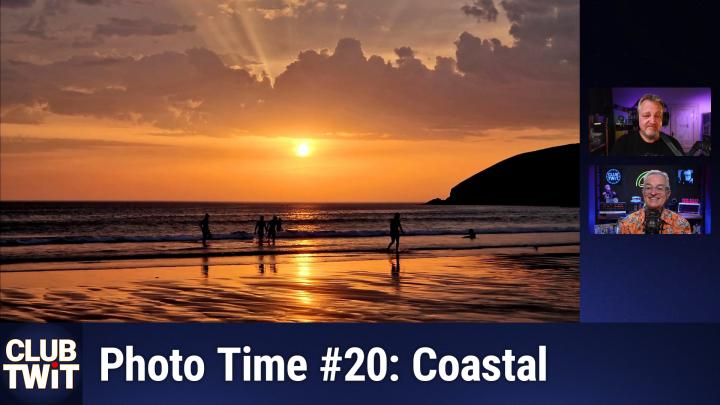
Oh yes. Oh yes. So sunset photo. Baggy Point, Groyde Bay. We are looking at— this is okay, this is cool. This is warm as a sunset should be. You see silhouettes of people in the sea playing in the water. There's reflection.
Chris Marquardt [00:14:39]:
The sun is reflecting in the water and in the wet part of the beach. You have a cloud layer. There's a hill to the right that kind of frames the picture to the right. And then you have these, the angels are singing beams going upwards.
Leo Laporte [00:14:59]:
Oh!
Chris Marquardt [00:15:01]:
That's the sound I hear when I see these beams. They are celestial God beams. But normally those go down. You see those coming down shining to the earth. It's volumetric light. There's a lot of a mist in the air, a lot of water and other particles in the air, so the sun becomes visible and makes these beams. And the fact that they do the opposite of what they usually do, it means, of course, the sun is very low, so it can do that, but also makes this very, very interesting. It's almost like the picture has a little crown on its head or something.
Leo Laporte [00:15:42]:
This is a postcard.
Chris Marquardt [00:15:44]:
It's wonderful.
Leo Laporte [00:15:45]:
And you might say, well, oh, sunsets, but sunsets are really hard. They look so good in real life. It's very rare you can get it looking good in the photo.
Chris Marquardt [00:15:57]:
It takes some skill.
Leo Laporte [00:15:58]:
Yeah. Yeah. If you—
Chris Marquardt [00:16:01]:
let me check. Is there EXIF data? Do we have EXIF data? Nope. No EXIF. That is very likely not a smartphone photo because smartphones—
Leo Laporte [00:16:14]:
No, it wouldn't do it right.
Chris Marquardt [00:16:16]:
Over HDR, these kind of photos.
Leo Laporte [00:16:19]:
Oh, this is in Britain. This is a very deliberate photo. Cryode Bay, North Devon District. Huh. This is not what you— when you look at this, you don't think the UK.
Chris Marquardt [00:16:30]:
No. Yeah.
Leo Laporte [00:16:32]:
You think Hawaii. You think the tropics.
Chris Marquardt [00:16:33]:
It has a monochrome kind of feeling, you know? Beautiful golden golden. Much—
Leo Laporte [00:16:38]:
that's why they call it the golden variation. Yeah.
Chris Marquardt [00:16:40]:
And it's, and it's kind of fun. Um, and, and it, for me, I think it makes people, uh, it makes pictures stronger if they do not have too many different colors in them. If you have a reduced color palette, and that is, that's a poster child for, for, yeah, for a reduced color palette.
Leo Laporte [00:16:58]:
And I like that the people are silhouettes. That's what happens with the sunset. Yeah. If you shoot the exposure right, that's the problem is that it's such a broad range of brightnesses. The sun is so bright and the rest is so dark. This is good. That's a good sunset.
Chris Marquardt [00:17:17]:
Yep.
Leo Laporte [00:17:18]:
All right. That's picture number 2. Now we have to get to— we have to get to the ringers, which are— were not taken Recently, I guess. We—
Chris Marquardt [00:17:33]:
I mean, we don't care. We're not picky. We can break the rules a bit, right? Yeah.
Leo Laporte [00:17:38]:
So, this is from somebody we know.
Chris Marquardt [00:17:41]:
Some weird guy from Germany.
Leo Laporte [00:17:43]:
I like this though. Look at this.
Chris Marquardt [00:17:46]:
So, so Ryan is—
Leo Laporte [00:17:47]:
Pretend it's not your picture and critique it.
Chris Marquardt [00:17:51]:
So, looking at that, the thing that catches my eye first is the reflections. of the water in the bow of the ship, which means the sun must have hit the waves just the right way.
Leo Laporte [00:18:03]:
Oh, I love that!
Chris Marquardt [00:18:06]:
That's one of my favorite things to see. And then of course you have this— and then of course you have the bright orange parts of the ship, looks like a fire ship of sorts, something official, I guess, contrasting with the green on top of the ship. Add a bit of green in the bow, just duplication of color. And then if you look closely, there are 2 birds on the rope just sitting there. This is—
Leo Laporte [00:18:36]:
this picture has a lot of hidden details and there's— yeah, it's very interesting. And I've noticed this about the photos. Your photo last time with the daisies on the scooter. Similarly, you like to find hidden details in a picture, don't you?
Chris Marquardt [00:18:56]:
It's part of how I like to tell stories. What I don't like about this picture, and I took 5 or 6 there just to get the framing right and had a vertical one, horizontal ones, and the birds were just sitting there. So I tried to frame them right and you see the right of the birds, it kind of melts with the background. It doesn't separate from the background. The first bird separates nicely from the background. So it becomes more of a subject, kind of, even though it's tiny. The second one kind of— yeah, I'm not too happy about that. But then on the other hand, hey, that's me being picky.
Chris Marquardt [00:19:35]:
I'm just happy that I saw the light. The light was what pulled me in there. And, uh, yeah, that's so nice. Fell out of the camera. Oh, by the way, this is an iPhone, right?
Leo Laporte [00:19:48]:
This is— Yeah, the colors, uh, even especially— I don't want to say you can tell, but the colors tend to be more vibrant.
Chris Marquardt [00:19:56]:
This one, this one, this one is, is actually not the, the stock camera in the iPhone. This is an app called DazzCam, D-A-Z-Z-Cam. Yeah, which is— which has lots of like camera emulations, analog film emulations kind of thing. I think it's about $5 or something, um, or more. And there is one type— it's, it's, there's like tons of cameras in there, tons of different films. And this is one of the cameras in there with one specific kind of film that boosts the colors, looks very filmic. So that's what I shot with. It's not even high, high resolution.
Chris Marquardt [00:20:34]:
I think it's 12 megapixels.
Leo Laporte [00:20:36]:
So as soon as we loosened the requirements, we got a lot of last-minute submissions. El Duderino says, I forgot to submit this to Flickr, but it's also Nice in 2019. So it's an older, it's a 7-year-old photo, but I think that's, we got, we know what we got? We got a lot of submissions of sunsets.
Chris Marquardt [00:21:01]:
It's kind of the thing, right?
Leo Laporte [00:21:03]:
Yeah, well, I guess when you're on the coast, let's see, this is Anthony Nielsen. Uh, our, our— is this a video? Oh, this is interesting. Oh, this is pretty. Anthony is of course our creative director at TWiT. He's, he's behind the scenes right now. And, uh, he is, he is more of a filmmaker, I think. This is kind of a nice monochrome.
Chris Marquardt [00:21:25]:
Yeah, this is my— I bought a, an old Blackmagic, the original Blackmagic, uh, Pocket Cinema Camera.
Leo Laporte [00:21:32]:
Oh, so this is my first, uh, like one of my first— so you just— did you just do this?
Chris Marquardt [00:21:37]:
This was back in 2020, but I I didn't share it.
Leo Laporte [00:21:39]:
Um, so this is gorgeous.
Chris Marquardt [00:21:42]:
Thanks.
Leo Laporte [00:21:42]:
Yeah, I love monochrome. And you know, it's funny because I'll show you one from the Mendocino Coast that is not—
Chris Marquardt [00:21:48]:
I like the contrast in here.
Leo Laporte [00:21:49]:
Yeah, but I like it. Yeah, especially because it's foggy and it's moody. Yeah. Um, this is, this is beautiful, Anthony. Is that slow motion or is it full speed? I, I shot it at 30 but slowed it to 24, so it's slightly slow. Yeah, yeah, a lot. You know what, I like that. It's very cinematic when you do that.
Leo Laporte [00:22:12]:
Look at that pull. That's really nice, Anthony. You know what's interesting about horizons?
Chris Marquardt [00:22:20]:
Speaking, speaking of horizons, Mr. Laporte, there's one photo left.
Leo Laporte [00:22:25]:
Oh yeah, we should go back to Flickr.
Chris Marquardt [00:22:28]:
We should, we should go back to Flickr.
Leo Laporte [00:22:30]:
There is somebody else snuck a photo in at the very last minute.
Chris Marquardt [00:22:34]:
Mm-hmm. Now let's all look at that horizon and marvel over it. It's tilty.
Leo Laporte [00:22:38]:
I didn't— I just took the first picture I found.
Chris Marquardt [00:22:41]:
It's the water running out to the right.
Leo Laporte [00:22:44]:
I would have fixed it had I submitted this for real, because, you know, it bugs me when the— and it isn't even the best photo from this shoot.
Chris Marquardt [00:22:52]:
I just picked literally as I was in our house. You know, the thing is, you primed us on the horizons earlier. I would—
Leo Laporte [00:22:58]:
I set it up for my own I would have probably ignored it if— No, but it bugs me. It always bugs me to see that.
Chris Marquardt [00:23:06]:
With water, it's kind of, yeah, it's easy to notice.
Leo Laporte [00:23:10]:
It's running off the screen.
Chris Marquardt [00:23:12]:
Yeah, your desk is getting wet. It's easy, even half a degree off is easy to spot with water. It feels wrong. You might not be able to name it, but— you might be able to see this.
Leo Laporte [00:23:26]:
This is from a Leica Q, the original Q28.
Chris Marquardt [00:23:31]:
But the picture is— the picture is— I like the picture. I like the colors. I like the simplicity. There's the seagull flying.
Leo Laporte [00:23:38]:
I would have liked the bird a little farther along.
Chris Marquardt [00:23:40]:
A whole lot of churn in the water. Again, reduced color palette. You have the blue in the water. You have the brown of the rock in the front.
Leo Laporte [00:23:49]:
So fun, the tilting, the Horizon, you busted me.
Chris Marquardt [00:23:53]:
I've just tilted my head. It's all good.
Leo Laporte [00:23:55]:
I'm busted!
Chris Marquardt [00:23:57]:
It's all fine.
Leo Laporte [00:23:59]:
Uh, I, you know, my flicker thing is, uh, I don't really— it's kind of automated, so I don't— although since I named this one, I must have paid some attention.
Chris Marquardt [00:24:08]:
Some effort has gone into this for sure.
Leo Laporte [00:24:10]:
Some effort. Let's see, what else do we have? We have—
Chris Marquardt [00:24:13]:
And, and, and one of the commenters says, so dynamic, I'm Yeah, I'm— I feel the salty spray. Um, it— I would say it, it, it's, it's, uh, it, it makes the whole ocean feeling stronger. You could be in a ship, you know, with the horizon going like this.
Leo Laporte [00:24:35]:
Lisa and I like to go up to the Mendocino Coast, and we often, uh, and I always bring my, uh, my best cameras, uh, with me because it's such a natural place to take—
Chris Marquardt [00:24:45]:
It lends itself to that for sure.
Leo Laporte [00:24:47]:
So I have quite a few of these. That was just the first one that came across. Let me see if I can find a better one with a straight horizon.
Chris Marquardt [00:24:56]:
Yeah.
Leo Laporte [00:24:57]:
Oh yeah, there's quite a few actually. Let me find one that I like. It's such a beautiful coast. I'll just, I'll show you just to prove that I can take A straight horizon.
Chris Marquardt [00:25:15]:
There we go. There we go. That is— even though, even though if you have these, these slightly angled coastlines going into the picture, yeah, it sometimes feels like it's off even though it isn't.
Leo Laporte [00:25:29]:
Yeah, so that's right. Yeah, and I might have, might have— if I'd taken—
Chris Marquardt [00:25:33]:
But that is—
Leo Laporte [00:25:34]:
what a beautiful spot. Yeah, that's probably the one I should have submitted.
Chris Marquardt [00:25:38]:
Beautiful spot.
Leo Laporte [00:25:40]:
It really, it's so, it's a beautiful coast.
Chris Marquardt [00:25:42]:
Yeah.
Leo Laporte [00:25:43]:
All right. Well, you know what this means? See, we managed to find a number of wonderful images. Here we go. Thank you everybody for submitting. And now what we're gonna do is we're gonna come up with a new word for you. And so for all of you who feel guilty that you did not submit, you have 4 weeks to take new pictures. And the word is, oh, Rugged. I'd like to submit, uh, this picture for rugged.
Chris Marquardt [00:26:14]:
Too late.
Leo Laporte [00:26:15]:
I, I like that. Rugged. Wow, that's good. That's good. So, uh, what we're gonna do now is, uh, give you a chance to, uh, take pictures. The whole idea really, and this is the reason we ask for new pictures, is that you will, uh, use this as an opportunity to, to go out and You know, start taking some pictures. Go out whenever you go out and look for rugged. Now, rugged— now, don't get, don't get, uh, all in your head about coastlines, because rugged could be a lot of things.
Leo Laporte [00:26:47]:
Um, so go for something that illustrates the idea or the concept rugged. And then once you find one, you could do one a week. Okay. So once you find, once you take a picture in the next 4 weeks and you go, oh, this is perfect, you straighten the horizon.
Chris Marquardt [00:27:08]:
Yeah, no, I think—
Leo Laporte [00:27:10]:
Do whatever.
Chris Marquardt [00:27:11]:
You know, you know, the horizon, if it's over a certain angle, it is deliberate, right?
Leo Laporte [00:27:17]:
It's touched. Yeah. It's the one that's only a little off.
Chris Marquardt [00:27:21]:
1 degree is an accident. 5 degrees is on purpose.
Leo Laporte [00:27:25]:
So rugged, by the way, it could be, somebody's pointing out, it doesn't have to be rugged, it could be rugged.
Chris Marquardt [00:27:30]:
I would, let's leave it open.
Leo Laporte [00:27:33]:
I inadvertently applied some meaning to it.
Chris Marquardt [00:27:37]:
A bit of Big Lebowski in there, sure.
Leo Laporte [00:27:41]:
So, upload it to Flickr. That's the first thing to do. It's free, flickr.com. If you don't have an account, make a free account. You can upload it to Flickr, and then the key on Flickr is it's all about tagging your photos. In this case, we want you to tag it TG rugged or TG rugged, which could be about wigs. I don't know, it could be about toupees. TG rugged and, uh, all one word.
Leo Laporte [00:28:06]:
And the reason TG is for Tech Guy, so we know it's, you know, a submission to the Tech Guy group. And then submit it to the Tech Guy group. You have to join the group, but that's easy. Our lovely moderator Renee Silverman will welcome you to the group if you're not already a member and take your photo and say thank you for your submission and add it to the Rugged group. And then in 4 weeks, we will have another photo time, and maybe your picture will, will get the eagle eye.
Chris Marquardt [00:28:33]:
And this time, by the way, we have a date already. It's the 21st.
Leo Laporte [00:28:36]:
The 21st of August.
Chris Marquardt [00:28:39]:
Of August.
Leo Laporte [00:28:40]:
Oh my God, how did we get to August? Or as one might say, August.
Chris Marquardt [00:28:48]:
Rugged. Rugged.
Leo Laporte [00:28:49]:
Rugged.
Chris Marquardt [00:28:50]:
Okay.
Leo Laporte [00:28:50]:
Rugged. This is— this— does this count as rugged? I think it's pretty rugged. Or rugged. I might have her rugged as well. I don't know.
Chris Marquardt [00:28:59]:
But the point— the point is to go out and take a fresh picture.
Leo Laporte [00:29:02]:
Right.
Chris Marquardt [00:29:02]:
This week was a bit outside of the rules, but—
Leo Laporte [00:29:05]:
We're not gonna do that again. Don't count on that. Now, let's talk about some photo news. We got half an hour left. A reminder, we are gonna end sharply at 2 because Micah Sargent is waiting in the wings For our second media group. And the, uh, and we invite you to stick around because the, uh, topic is the movie The Matrix.
Chris Marquardt [00:29:28]:
Oh, Matrix.
Leo Laporte [00:29:30]:
So, uh, there will be lots of conversation about The Matrix. Should be, should be interesting. And yes, uh, Paul says, can the Mars rover submit a rugged picture of the surface of Mars? Indeed. We will welcome, but it has to be new.
Chris Marquardt [00:29:48]:
That one submits pictures all the time.
Leo Laporte [00:29:52]:
I know, it's terrible. Mr. Marquardt, what's in the photo news this week?
Chris Marquardt [00:29:58]:
So there is a cosmic movie being shot and it just officially started. The Vera C. Rubin Observatory officially begins capturing now.
Leo Laporte [00:30:10]:
It's so exciting.
Chris Marquardt [00:30:12]:
The project is the LSST, the Legacy Survey of Space and Time. It's a 10-year project. It's northern Chile. They have 300 clear nights per year, and they need that because what they want to do is they want to shoot a movie of the southern hemisphere. The entire southern sky gets imaged every few nights. And if you know telescopes, normally they shoot They take a capture from somewhere and then they point somewhere else and they point somewhere else. This one is the same picture every few nights. It's going to be a time-lapse.
Chris Marquardt [00:30:51]:
And they shoot it with the world's largest digital camera. If you search for LSST camera, find pictures of the LSST camera, it's a 3.2 gigapixel camera. And it takes one image every 40 seconds.
Leo Laporte [00:31:10]:
It's how many megapixels?
Chris Marquardt [00:31:12]:
3,200 megapixels, 3.2 gigapixels.
Leo Laporte [00:31:17]:
It's a gigapixel?
Chris Marquardt [00:31:19]:
Search LSST camera. There you go.
Leo Laporte [00:31:22]:
Holy moly.
Chris Marquardt [00:31:23]:
It's huge. And by creating that time-lapse, they plan to study dark matter, dark energy, supernovae, black holes, galaxy evolution, And it is also the world's most powerful asteroid and comet discovery telescope that was ever built. Because if you take a time-lapse of the night sky, you can see things that move if you play that in succession. And in 6 weeks of early operation, they discovered 11,000 previously unknown asteroids.
Leo Laporte [00:32:03]:
Wow.
Chris Marquardt [00:32:04]:
11,000 in 6 weeks, which includes 33 near-Earth objects. So I'm just saying this thing is already yielding huge results because a lot of the things in the past, we just didn't see them because we didn't take movies, time-lapse movies of the night sky.
Leo Laporte [00:32:25]:
I'm just glad they bought the RAM for this thing last year.
Chris Marquardt [00:32:29]:
That camera produces 10 terabytes every night.
Leo Laporte [00:32:34]:
What?
Chris Marquardt [00:32:36]:
They produce— I wrote these numbers down because I couldn't believe it— 10 terabytes every night, up to 7 million astronomical alerts per night. And by the end, they will just have collected billions of objects, trillions of measurements. It's just a really amazing project.
Leo Laporte [00:32:54]:
This makes me proud to be human. I swear, this is incredible.
Chris Marquardt [00:32:58]:
And I've seen some YouTube videos of YouTubers going there. The whole thing, the whole telescope rotation thing sits on an oil bearing of sorts.
Leo Laporte [00:33:11]:
Yeah, you don't want it to move.
Chris Marquardt [00:33:14]:
Which you can move with your bare hand. You can just push it.
Leo Laporte [00:33:18]:
Oh, you do want it to move. That's why it's on an oil bearing.
Chris Marquardt [00:33:20]:
Oh, you have to move it because you want— the camera doesn't capture the entire sky, so they have to— again, one image every 40 seconds, then it moves, it takes the next image, it moves. So it's like stitching together this entire Southern Hemisphere sky every few nights, every 3 to 4 nights, I think.
Leo Laporte [00:33:45]:
It's in the Andes, right?
Chris Marquardt [00:33:48]:
Yes.
Leo Laporte [00:33:48]:
So it's high, high up in Chile.
Chris Marquardt [00:33:51]:
They have 300 clear nights per year. They have really dark skies. They are at a high altitude. They have very dry and very stable conditions.
Leo Laporte [00:33:59]:
So this is ideal for So I mean, we have space telescopes, of course, but—
Chris Marquardt [00:34:07]:
We do?
Leo Laporte [00:34:08]:
This is— But this is a different beast.
Chris Marquardt [00:34:11]:
This is a different beast.
Leo Laporte [00:34:13]:
You can't send a 3-gigapixel camera to space.
Chris Marquardt [00:34:17]:
It's just a camera. It looks like a big lens, a big DSLR that you could have at home. It's just as tall as a human being.
Leo Laporte [00:34:27]:
Named after Vera Rubin, a brilliant astronomer.
Chris Marquardt [00:34:30]:
Yes.
Leo Laporte [00:34:32]:
And you can read about that also on the LSST.
Chris Marquardt [00:34:35]:
So that's a different kind of photography.
Leo Laporte [00:34:37]:
She gathered evidence for the proof of dark matter. My college roommate is a physicist who specializes in dark matter. So I imagine he'll be very excited to see what the Vera C. Rubin Observatory comes up with. That's a camera, kids.
Chris Marquardt [00:34:58]:
That's it, that's it, that's a camera.
Leo Laporte [00:35:00]:
That's a camera.
Chris Marquardt [00:35:01]:
It's not, it's not really good for street photography.
Leo Laporte [00:35:04]:
No, no, no.
Chris Marquardt [00:35:06]:
All right, one, one more piece of news that I found interesting. Um, have you heard of the Vesuvius Challenge?
Leo Laporte [00:35:17]:
Uh, no, what's that?
Chris Marquardt [00:35:18]:
So Vesuvius erupted—
Leo Laporte [00:35:19]:
I do know about this because, yes, This is fascinating too. This is an AI story.
Chris Marquardt [00:35:25]:
It is an AI imaging kind of story. So Vesuvius erupted in 79 AD, and in Herculaneum, a library of hundreds of scrolls with philosophical texts was pretty much burnt to charcoal. So you have these scrolls, they are charcoal, and the problem is how do you read them?
Leo Laporte [00:35:49]:
They're all rolled up.
Chris Marquardt [00:35:51]:
They're rolled up, but if you unroll them, they crumble. They're charcoal, right? So it's papyrus, it's fried into charcoal, and there were efforts to open them in the past over the last several hundred years, and they were never really that successful. So in 2023, someone launched the Vesuvius Challenge, which was— I think they had a million dollars or millions of dollars in prize money to crowdsource a solution for reading the unopened Herculaneum scrolls.
Leo Laporte [00:36:23]:
So you're starting with this burnt—
Chris Marquardt [00:36:28]:
It looks like a burrito, right? A charcoal burrito.
Leo Laporte [00:36:31]:
It was buried under ash and lava from the Vesuvius eruption in 79 AD.
Chris Marquardt [00:36:38]:
Exactly. So it's rolled up, it's squished, it's charcoal. And the next problem is that the The ink that was written on it is a coal-based ink.
Leo Laporte [00:36:54]:
Oh, no.
Chris Marquardt [00:36:55]:
So they are trying to find text from coal-based ink on now coal charcoal.
Leo Laporte [00:37:01]:
They call them butt carvers.
Chris Marquardt [00:37:05]:
And they have now, back in 2023, they had the first 2,000 characters revealed.
Leo Laporte [00:37:10]:
They can X-ray it, right? They're looking—
Chris Marquardt [00:37:13]:
It's a very high-powered synchrotron X-ray scan with an accelerator behind it. There's some 3D reconstruction. They need to virtually flatten that thing. Lots of machine learning on board. And then they need to be able to detect the carbon-based ink on the carbonized papyrus. And now they have a breakthrough. They have deciphered the first entire roll without opening it.
Leo Laporte [00:37:38]:
And used AI. to analyze it.
Chris Marquardt [00:37:42]:
A lot of AI. They have developed new AI models. They had to develop new methods. And it is a lost philosophical text.
Leo Laporte [00:37:52]:
Oh, is it? You know, it's funny, I covered this story, but I didn't think to ask what they read.
Chris Marquardt [00:38:01]:
They say on the website, it's a 2nd century BC Stoic treatise on ethics discussing human nature, virtue, and moral progress, with references linking it to the philosopher Aristocreon, a student of Chrysippus.
Leo Laporte [00:38:21]:
Interesting. So it really is more of a kind of history of philosophy.
Chris Marquardt [00:38:27]:
It is. It is. And now we'll see. I mean, it's not that they have a process that is now cookie cutter, just do the next one. It's really hard work. The X-ray time is expensive because it's a big synchrotron that they need to use, so they have to pay for the time there. But in general, I mean, what a feat.
Leo Laporte [00:38:52]:
Amazing. High tech.
Chris Marquardt [00:38:56]:
Right. Okay, one more.
Leo Laporte [00:38:59]:
One piece of news.
Chris Marquardt [00:39:02]:
Uno más. Here's a— okay, so I'm not trying to advertise this, rather the opposite. It's a Kickstarter project. It's called Benny. It's a camera robot or maybe a pet. I don't really know. They have within days, they've gotten $1.8 million out of the $45 they asked for or something.
Leo Laporte [00:39:26]:
It can go up to 18 miles an hour.
Chris Marquardt [00:39:28]:
So the thing is—
Leo Laporte [00:39:30]:
You can jump 10-inch obstacles. What the hell is this?
Chris Marquardt [00:39:33]:
It's not a lifestyle drone. You know, these drones that never really delivered, these autonomous drones that take movies of you while you are living your happy life with your happy friends.
Leo Laporte [00:39:45]:
Yeah.
Chris Marquardt [00:39:46]:
This one does it by rolling on the ground. It's a little, very, very cute little robot, 2 wheels, has a face, has a 4K camera. They claim that it automatically follows you and it can jump up a few inches over Obstacles. Um, now the thing is, it shoots, it shoots ground perspective.
Leo Laporte [00:40:14]:
Yeah, it's looking up at you.
Chris Marquardt [00:40:15]:
Yeah, the good thing about it is, um, that it doesn't have any rotor noise.
Leo Laporte [00:40:21]:
Yeah, because drones are—
Chris Marquardt [00:40:23]:
Yeah, it doesn't have the annoyance factor of a drone. Um, and I was, I was really wondering, why did this make people want to spend money? We're talking Final price, $800. Early bird, $550. So—
Leo Laporte [00:40:39]:
I'll be honest with you, I've been burned so many times on Kickstarter, I would not have put any money.
Chris Marquardt [00:40:45]:
Me neither. Me neither. But they pull all the cutesy levers. You can put a hat on it. It does— it blinks with its eyes. It is— it's like a pet. And They sell through emotion, right? It's purely emotional.
Leo Laporte [00:41:06]:
In years gone by, I would have absolutely plunked down and then regretted plunking down money on this, but I have been burned.
Chris Marquardt [00:41:13]:
It moves like a pet. It jumps. The camera specs are so— they don't even tell you what camera is in there, what sensor. It's 4K. It does 30 to 60 frames per second. It's not even like No tech specs. So they sell on pure emotion there. And of course, open questions.
Chris Marquardt [00:41:34]:
How good is the tracking? How good will it be on rough terrain? How loud are the motors? Good, important question. Yes, it's not a drone, but those motors can be quite loud. We didn't hear the sound of it. Will it survive a year or will it break down?
Leo Laporte [00:41:52]:
It looks kind of fragile, I'll be honest. Now you said something I want to kind of dig back into. You said those drones that follow you don't work very well. Well, I've been tempted. I think I like that idea.
Chris Marquardt [00:42:08]:
They will. I have no doubts that they can follow you. With don't work very well, I mean, how many of those have you seen around when you are out and about? Never, right? So there must be a reason why people do not use them.
Leo Laporte [00:42:24]:
Never. You see some GoPro videos. But I think a lot of times, I don't know, I have the 360 camera on a long, long stick, which to me is probably better because I can just hold it as I'm doing all my skateboard tricks.
Chris Marquardt [00:42:39]:
Those look like drone shots, right?
Leo Laporte [00:42:40]:
And they look just like drone shots, yeah.
Chris Marquardt [00:42:44]:
I've just been too self-conscious flying one of these around me and my friends. It's an annoyance. And I've never seen any of those lifestyle drones in the wild. And there must be reasons for that. Either they don't work well or people are too embarrassed to use them, which might as well be the reason.
Leo Laporte [00:43:07]:
And you can't put a hat on it.
Chris Marquardt [00:43:09]:
And you can't put a hat on it. No, it doesn't purr. It doesn't— it's not cute. This one could be in a Disney movie. It's a WALL-E.
Leo Laporte [00:43:18]:
I think that's probably the main reason they raised $1.8 million is because it's cute.
Chris Marquardt [00:43:22]:
$1.8 million.
Leo Laporte [00:43:24]:
Yeah, that seems a little—
Chris Marquardt [00:43:24]:
Thousands of—
Leo Laporte [00:43:25]:
They only wanted 50,000.
Chris Marquardt [00:43:28]:
Yeah, well, that's— I mean, of course what they're doing is they're using Kickstarter as a marketing vehicle.
Leo Laporte [00:43:33]:
Right. And it worked. We did the story. Beni, B-E-N-I. Yeah, it's still open. So not going to recommend it. Do you have any questions? And we have a few more minutes, 10 more minutes.
Chris Marquardt [00:43:48]:
Um, we do have, uh, questions. We have one question. Let's do one listener question, which I found interesting because this is from Michael Casey. He submitted this for the last episode, but we didn't get to it. He writes, I'm curious if either of you have found a way to preserve digital photos for your kids or future generations. I've got several thousand—
Leo Laporte [00:44:18]:
I don't think they're going to want them.
Chris Marquardt [00:44:19]:
images that are sitting across several platforms. My HDs backed up, of course, Flickr, Google Photos, Apple Photos. Of course, once you stop paying for those services, the images get deleted. Do you have any tips on how best to manage a large collection to ensure its availability for my kids? Thanks. So I have a few thoughts on that, of course.
Leo Laporte [00:44:42]:
Okay.
Chris Marquardt [00:44:43]:
First thing is, Do not dump this entire collection on your kids. Curate it. Curate it. Your kids don't want 100,000 photos. Maybe 500. Maybe maximum.
Leo Laporte [00:44:57]:
You know what I will say that I think the insight I got on this was you dilute the power of the image by having 20 copies of a similar image.
Chris Marquardt [00:45:10]:
I just wrote that chapter in my book.
Leo Laporte [00:45:13]:
Yeah.
Chris Marquardt [00:45:13]:
In the manuscript, just that dilution is never a good idea. You want to boil it down like a good soup. You want to not add water, you want to take the water out.
Leo Laporte [00:45:24]:
Yeah. So, it's very easy because they're all your babies. Nobody wants to, you know, kill their babies. But at the same time, you are in a way because you're diluting the impact of that great photo by 100 not so great photos.
Chris Marquardt [00:45:41]:
Yes.
Leo Laporte [00:45:41]:
So you do have to do some editorial.
Chris Marquardt [00:45:43]:
But let's assume that he finds 500 pictures out of the thousands he has.
Leo Laporte [00:45:51]:
How should he save them?
Chris Marquardt [00:45:54]:
Second idea. No, first of all, what you want to do is you want to add context. Names, places, dates, stories. Those are more valuable than the photos themselves. I have I speak from experience. I got an old photo collection from the 1940s from a family member and I scanned them, I digitized them, I put them online for the family and 2/3 of the photos, no idea who's on them. So they don't really mean anything.
Leo Laporte [00:46:28]:
That's a problem.
Chris Marquardt [00:46:29]:
Ask my parents. We went through them. It's like, oh, that could be great-great-granduncle Larry, that could be— but we're not sure. sure. We recognize, maybe recognize one or two of the locations, but that's it. So add context, important. Next tip from me is print the important ones.
Leo Laporte [00:46:50]:
That's what I would say, yeah.
Chris Marquardt [00:46:52]:
On paper. Get good photo books, make archival prints. Those will survive technology changes so much better than a lot of the digital formats. Even if you trust in JPEG being the thing or TIFF being the thing that survives, I've spoken with an archivist who does that professionally. That person claimed that we live in the least well-documented century. Seen from the future, they will look back at us and go, Yeah, there's not much left here.
Leo Laporte [00:47:32]:
Think about it. If 10 years ago they said put it on a zip drive, and can you read a zip drive today? No.
Chris Marquardt [00:47:41]:
And last but not least, leave instructions. Make sure your family knows where the archive is, how to access it, because otherwise it might as well not exist.
Leo Laporte [00:47:53]:
Yes, I agree.
Chris Marquardt [00:47:55]:
There we are.
Leo Laporte [00:47:57]:
I have converted all of my I was, you know, I have several strategies for preservation, but, and it moves around. And I'm sure you, like I, for many years stored everything in Lightroom libraries.
Chris Marquardt [00:48:15]:
Still do.
Leo Laporte [00:48:15]:
Which you then would, you know, back up onto a NAS or maybe put on a CD and send to, you know, send to France or something. But, Lately, all my stuff's in the cloud, so I decided to use Apple Photos and everything I take just goes to Apple Photos. And then I back it up because I have Amazon Prime to— I don't know how it is in Germany, but in the US, an Amazon Prime account gives you unlimited backup of still photos. So that's the backup. But lately I've been running a local server on my NAS because it all gets backed up also to the NAS, to a local hard drive. And I've been running something called Immich, I-M-M-I-C-H, which is a well-known self-hosted image server that has a lot of really— it basically has the features of Google Photos or Apple Photos. It makes albums. It will map all the places that you've been and put those all together.
Leo Laporte [00:49:14]:
It does people. So if I, as I have been lately, been looking through pictures of my mom, And it did this all automatically. I had to recognize a few and then it went through the album and found the rest. It also can automatically upload. So I really, and it makes albums as well. So I've been pretty happy with this as the local storage, but it doesn't solve the thing that you were talking about.
Chris Marquardt [00:49:39]:
What about in 10 years, right? Is Image still gonna run? Will the hardware still be around? Will the image formats, the picture formats still be there?
Leo Laporte [00:49:46]:
So you still need to do that one change. which is to make decisions, which is the hardest, about what to save. Maybe then put some text associated with them when you print it out so that people know when you're gone who those people are.
Chris Marquardt [00:50:03]:
And curation is important because the pictures that are important to you, they're not gonna be as important to others than they are to you. 'Cause you were there, you took them. You were there, you had the experience of being there. You felt the breeze, you smelled the flowers, The others didn't. They only have a 2-dimensional picture and that is not as impactful for them as it is for you.
Leo Laporte [00:50:29]:
Do you have a preferred photo books place?
Chris Marquardt [00:50:35]:
Not really. I do photo books just for giveaways and things like that.
Leo Laporte [00:50:42]:
I loved the mini zine thing you showed last month, by the way. I've been meaning to make a bunch of those. Those are so cool. They're not archival. But they're fun.
Chris Marquardt [00:50:51]:
They're a good way to hand out photos to someone else.
Leo Laporte [00:50:53]:
Yeah. Yeah. So, but Shutterfly does this, Walmart does this. Um, I think I would look for something that puts it on archival paper, which I'm sure neither of those offer. Maybe they do, I don't know. Um, you know, I should make that— Apple used to have a very good photo book service, uh, attached to Photos. They don't anymore. They stopped doing that.
Leo Laporte [00:51:17]:
So I don't know what the best one is. That might be worth a little research.
Chris Marquardt [00:51:20]:
I used one here in Germany. You can still attach a photo service to Apple Photos, like by downloading the app and connecting it somehow. I used one that I think it's called MiMio, but that might, MiMio, that might just be a European thing. So probably not helpful.
Leo Laporte [00:51:39]:
I don't know. And I have made, I should have, had I known we were gonna talk about it, I would've brought 'em over here. They're down the hall in the library, but I have a number of photo books, and I— and those photos I get, I see more often than any, even if they're not— but every time we took a trip, I used to make photo books.
Chris Marquardt [00:51:54]:
Yes.
Leo Laporte [00:51:54]:
Yeah, yeah. We're going to do a big trip to Southeast Asia in the fall, and that I will make a photo book of it. That's a nice way to relive, uh, travels. Uh, and I'm— and I've already promised my family that I would do a photo album of, uh, Mom. And now that you mention it, I think I will print it. I think that's a very good idea. Yeah, do that for sure. Chris Marquardt is at chrismarquardt.com.
Leo Laporte [00:52:19]:
You got anything going on? Discover the Top Floor, or are the places— that's the place to go for his—
Chris Marquardt [00:52:25]:
Nothing in English right now, but I'm finishing a manuscript, so there might be a book in fall.
Leo Laporte [00:52:29]:
Hopefully— You mentioned the book that you're writing a chapter. What's this book going to be about?
Chris Marquardt [00:52:34]:
Well, imagine you go out with someone else and they see photos that you don't. Why is that? Why do you not see the pictures?
Leo Laporte [00:52:41]:
Oh, so you're gonna really delve into this. That's good.
Chris Marquardt [00:52:44]:
This is, this is about what— this is not about the camera. This is about you. This is a book about you. This is a book about what happens before you take the picture.
Leo Laporte [00:52:53]:
That is a worthy topic.
Chris Marquardt [00:52:57]:
It is.
Leo Laporte [00:52:57]:
Um, and it also ties into this question because I imagine as part of that, it's also not just what pictures you decide to take, but what pictures you decide to keep. And it's a short step from that to what pictures you decide to put in a book for your family.
Chris Marquardt [00:53:12]:
Now everyone go to Rocky Nook and ask them if they want to translate my book.
Leo Laporte [00:53:19]:
It's German only?
Chris Marquardt [00:53:22]:
Initially, initially. I have high hopes that someone will pick it up.
Leo Laporte [00:53:25]:
But your English is so good. So you write these in Germany, in German, but you don't— you could easily translate it. You don't want to do that?
Chris Marquardt [00:53:34]:
I could, but it's— I'd rather write the book and not spend time translating it. No, it needs a publisher. So the publisher is the one who then makes a decision. I can help with the translation for sure.
Leo Laporte [00:53:46]:
So is Rocky Nook not the publisher?
Chris Marquardt [00:53:49]:
No, they published the other books that I wrote in English, but they still need to make a decision.
Leo Laporte [00:53:57]:
They're thinking about it.
Chris Marquardt [00:53:58]:
I don't think they have even been offered the book yet. So they probably don't know that it will exist.
Leo Laporte [00:54:02]:
Is there a publisher in Germany?
Chris Marquardt [00:54:05]:
Sorry?
Leo Laporte [00:54:06]:
Is there a German publisher?
Chris Marquardt [00:54:07]:
Yes, Die Punkt. Die Punkt is the name of them. They make a lot of photo books and they have published many books in Germany.
Leo Laporte [00:54:14]:
discoverthetopfloor.com, chrismarkwart.com. And in the fall, we will talk about your book and we will show it. And you can read some selections in German, which will be wonderful.
Chris Marquardt [00:54:25]:
No worries.
Leo Laporte [00:54:26]:
Chris Markhorst, you're the best. Thank you. Don't forget, folks, our assignment for the next— the next show is August 21st. Our assignment is rugged or rugged. I should just spell it R-U-G-G-E-D. Yep. You can ask questions and we will answer them at tfttf.com/ptq. We'd love to get some more questions for the show.
Leo Laporte [00:54:51]:
But don't forget, the thing we love the best is when you take pictures Get out there and do it, whether you submit them or not. Get out there and express yourself. Thank you, Mr. Marquardt.
Chris Marquardt [00:55:04]:
Thank you.