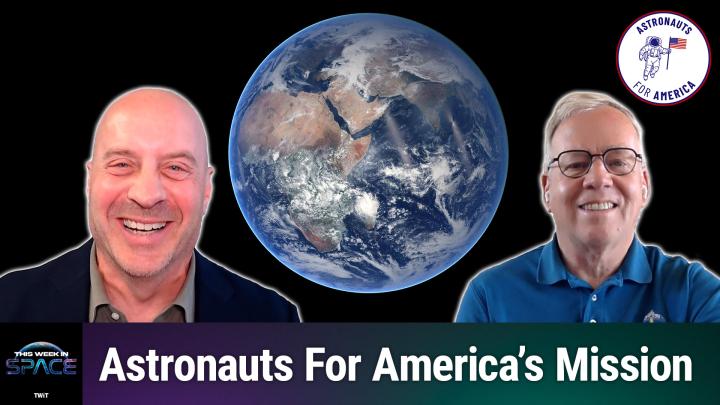
This Week in Space 209 Transcript
Please be advised that this transcript is AI-generated and may not be word-for-word. Time codes refer to the approximate times in the ad-free version of the show.
Tariq Malik [00:00:00]:
Coming up on This Week in Space, the Trump administration releases the UFO files. Woo!
Tariq Malik [00:00:05]:
The Curiosity rover has some wonky wheels and it got its hand caught on a rock. And we get down to business with Astronauts for America, where Rod and I find out from astronauts Steve Lindsey and Garrett Reisman why more than 100 have banded together in a new nonpartisan group to tone down the political talk in our country. Check it out.
Rod Pyle [00:00:32]:
This is This Week in Space, episode number 209, recorded on May 8, 2026: Astronauts for America. Hello and welcome to another episode This Week in Space, the Astronauts for America edition. We're very excited about this one, so hang in there with us for this first section because it's going to be a humdinger. Pyle Editor chief, Badass magazine. And I'm here with Tariq Malik, who you just heard squeaking of Space.com. hello, buddy.
Tariq Malik [00:01:04]:
Squeaking. I was serenading everybody. Hello, Rod. How's it going? Happy Friday.
Rod Pyle [00:01:08]:
Good. This week we have the distinct honor of speaking with Garrett Reisman and Steve Lindsay, two astronauts who co founded Astronauts for America, a group of over 100 retired astronauts whose mission it is to counter political polarization and foster public confidence democracy, similar to the teamwork required in successful spaceflight. And, you know, if you're going to talk about this stuff, hearing it from for people like this really makes a difference and they come from all political stripes is a completely nonpartisan. So you don't have to worry about being offended because they're going to play it right down the middle. We're going to skip our space joke today because we've got a lot to cover and this is pretty serious stuff. But our attempts at cosmic mirth will be back next week. So without further ado, let's go to Headline News.
Rod Pyle [00:02:05]:
Well, what a special day it is because I know.
Tariq Malik [00:02:08]:
Oh, wait, where's my. Where's my hat?
Rod Pyle [00:02:10]:
The Pentagon is going to release more UFO files, so we'll get to see more stuff. We probably already knew Trump called for this a while ago. Questions coming in for people. Is this a disclosure or a distraction? Open question. Former exec of the All Domain Anomaly Resolution Office, Sean Kirkpatrick, felt it was a distraction and said so in the press. But who knows, you know, maybe there will be something different, exciting, unique there. What do you think?
Tariq Malik [00:02:42]:
It's not that they're going to release it. They did. They built a whole website all for it. John, I just put. I. Oh, that's right.
Rod Pyle [00:02:49]:
It's got. It's got period font and everything, right?
Tariq Malik [00:02:51]:
It's. It's. It's. It's. It's/ UFOs. War.gov UFO, which is like a phrase I never thought I'd be saying at all. But it's just like a bunch of pictures of sightings of things, so we don't know what they are. We don't know.
Tariq Malik [00:03:11]:
And there's like, usually some captions and. Swamp gas thing.
Rod Pyle [00:03:14]:
It's swamp gas.
Tariq Malik [00:03:15]:
There are images from the moonwalks of Apollo 12. That's an artist illustration. That one that you. That you just put up there. There, I saw that, too. And I'm like, what is that? And it's basically. It's a picture that someone took, and then they put in a CG representation of a description of something that someone saw.
Rod Pyle [00:03:33]:
Thank you for clicking.
Tariq Malik [00:03:34]:
There's photos. There's photos from Apollo 12 where they've got, like, zoom in and enhance of things way on the horizon of the moon. And this weird text.
Rod Pyle [00:03:44]:
The three stars. Right?
Tariq Malik [00:03:46]:
Yeah, well, but it's more than that, too. There's like five or six different Apollo 12 pictures in there. It's very weird. And like, like you said, like, the font is very much like 1980s redacted X files, you know, from the. From the 90s. From the 90s kind of thing. And so, I mean, I just kind of perused it a bit because it literally came out, like, about four hours before we sat down to record. And.
Tariq Malik [00:04:11]:
And so we're going to see what it happens. This is something that the Trump administration announced back in February that they were going. When we saw the Artemis 2 astronauts with the President last week as we're recording this. He brought it up then, too, that there's, like, really good stuff in there, he said, or some. That's like a Nixon interpretation. I don't know why I said that. So, but, but, but it's out there. If you want to go and see all this stuff.
Tariq Malik [00:04:38]:
You know, there's been a lot of people pushing to get, like, the transparency on all this stuff since they had the, the, the. The. The Defense Department or the War Department, I guess, investigation into this a couple years back. And the same thing when NASA had their big panel that ended up coming up with nothing either. People kind of, I guess, don't believe that. So here's all the stuff.
Rod Pyle [00:04:59]:
We've given this story way more time than it needs.
Tariq Malik [00:05:01]:
All right, let's move on.
Rod Pyle [00:05:03]:
I'm just saying The Webb Space Telescopes gets personal for the first time.
Tariq Malik [00:05:07]:
You like this one? Yeah.
Rod Pyle [00:05:08]:
The JWST. Yes. Has gotten within social viewing distance, sort of LHS 3844B which sounds like the destination in, in Forbidden Planet, but it's a super Earth about 50 years away, about 30% larger than our planet.
Tariq Malik [00:05:29]:
50 light years away. I think it'll take you more than 50 years to get there.
Rod Pyle [00:05:32]:
Yeah, yeah, sorry, 50 light years. And they looked at it in infrared because that's what the web does, and got measurements from the surface, which is pretty amazing since it's probably, I don't know, half a pixel wide or something.
Tariq Malik [00:05:46]:
Yeah.
Rod Pyle [00:05:46]:
But they characterize it as a hot, barren rock devoid of any atmosphere in an 11 hour orbit around a red dwarf and tidally locked, which means there probably aren't creatures there. But what they were really looking for was the existence of water. And apparently it's very much more like Mercury or the moon than it is like Earth.
Tariq Malik [00:06:05]:
Yeah, yeah. Which is disappointing I guess. Like you, you get this first like big direct like image and, and it ends up being like another rock in space. You know, like being at the beach and like looking out and what's over here? Oh, more sand, you know. More sand. Yeah.
Rod Pyle [00:06:19]:
You know, if, if, if you're of a religious bent, I guess it would, it would cause me to think, you know, why were so many planets created with so little stuff on them? I mean we have since the 60s learned that the rest of our solar system is kind of a Kentucky trailer park, no offense to Kentucky. And now we're seeing these other solar systems and it's like, guys, give us some hope here, give us some water, give us some tropical light, misty rainstorms and the smell of grandkapani in the night or something. But no.
Tariq Malik [00:06:52]:
Well, when we do a habitable observatories episode, I think we're going to get into the bulk of that. What's interesting though, from my perspective of this story is that this is not like brand new discovery that Webb has done. This is a planet that we've known about since 2019, LHS 3844B. But the fact that they're, they're looking at it because, you know, I know it's just, just, just like, like butter. Right, right. And, and, and, and we know that the, the, it gets pretty hot, 1340 degrees in the daytime. And so the, the part that really stands out to me is that they, they, they are able now to use Webb to target planets that they think are there or that they know are there, like this one and say like we are going to go in and get like the best picture yet of, of these exoplanets, this cool red dwarf star. Red dwarf stars are really great targets for potentially life sustaining planets because their stars are older.
Tariq Malik [00:07:50]:
They think that like life might have had a longer time to take hold. You know, our sun is, is like a bit of, bit of a middle of the road type star, you know, in the middle of its life. Hopefully it doesn't go through a midlife crisis like, like I'm sure I'm doing right now, you know, but, but, but I think that's really, it's really an interesting use of what is the most powerful telescope that we have right now to get these things. And now we can move on. We know maybe we can say all, all, all things that, that look like this are ones that we're not going to find life on. And if that's our, our study, look at a different thing now. And I think it really sets some. Is that a, like bars or measurements like rail guards for the search for life.
Rod Pyle [00:08:29]:
Guardrails.
Tariq Malik [00:08:30]:
Guardrails. There you go.
Rod Pyle [00:08:32]:
Okay, and next up, filler up. And I think I'm the last generation that even actually knows what that means, but hey, poor old curiosity. Our Martian rover JPL released a video clip of six years of wheel wear on the six wheeled rover. And it's pretty severe, but not as bad as it could be. So when you see these images, or in this case the video clip, it looks terrifying. It looks like the wheels are completely shredded and ready to go. But if you see the wheel inside, not looking at the surface, you realize that the parts that are all chewed up are the very thin metal between the cleats or the gores, whatever you want to call them. There's a couple of different terms for them, but the gripping part of the surface, which is directly connected to three aluminum rims that go around the inside of the wheel.
Rod Pyle [00:09:23]:
And those are directly connected to support struts that go to the axle. So even if that wheel basically got shredded and fell off, the thing could still drive. It'd just be like a bicycle going on rims instead of tires. Yeah, but you know, this is 20 miles of driving on very harsh surface and up the side of a mountain. It's a shallow incline, but still they've been going upstairs. So given that it's not too bad, Perseverance is doing better because it had a wheel, a wheel redesign. The Gores were much closer together because
Tariq Malik [00:09:56]:
of this, because Of Curiosity.
Rod Pyle [00:09:58]:
Yeah.
Tariq Malik [00:09:58]:
You know, that was like one of the big learnings about how to make a rover hardier was from watching what happened to Curiosity. Because this, this video or this animation, it covers 2020 to 2026. Well, we made it a video. It's a time compressed. Yeah, time compressor. Time lapse. Time lapse is what it is. Covers 2020 to 2026.
Tariq Malik [00:10:17]:
But of course, Curiosity had been on Mars since 2012. Right. And so, so that's eight other years of it driving around. So it's all pitted. And that was one of the first big surprises when they're driving around was like, wow, the rocks on Mars are chewing up these aluminum wheels. We got to make them better for perseverance. And I think Curiosity was the one that had the special Morse code message that spelled out Jet Propulsion Laboratory on the, on the wheels or jpl, which
Rod Pyle [00:10:45]:
was a great story. I remember talking to Brody about it at the time because, because I, you know, it hadn't really gotten out yet when we were there for landing, that, that, that was Morse code for jpl because they had originally I guess looked at doing a wheel that, that said. So these are for measuring how many turns of the wheel there's been. So you know how much distance you've done. So they're going to leave an imprint of JPL on the marsh's soil. NASA headquarters went, hey, that's not cool. They said, okay. So they put these multiple little square holes in it that instead were Morse code for jpl.
Rod Pyle [00:11:20]:
I don't think they got that cleared. That was the version of the story I got. Anyway, what did you hear?
Tariq Malik [00:11:26]:
I just heard that it was a big surprise for all of us and they didn't do it on perseverance, so that might tell the tale for you. But this wasn't the only thing that happened to Curiosity, by the way, this week. This is like a little bit of, okay, it's old and not too busted, but look what Mars does to these wheels and they can use it to design better rovers in the future. There was something really weird that happened to Perseverance and it's on the next line, John. And you know when you like walk into your workplace and you use the restroom and you walk out of the restroom and you've stepped in something like toilet paper and you're dragging it around and it's so embarrassing. Well, that's what happened to the Curiosity rover where it was trying a long
Rod Pyle [00:12:12]:
stroll for that much of a punch. My God.
Tariq Malik [00:12:14]:
It was, it was trying, it was trying to Drill. It was trying to drill into a rock and it, to sample it and it picks it up and it doesn't, it doesn't remove itself from the rock. You can see in this animation, it picks the entire rock up and it won't get off. And this animation, it looks funny, right? You've got the, got the, this big rock on the end of the robot arm and it just seems like it's stuck there. This is like a nearly 30 pound rock on Mars. And it took six days for the rover to shake it off. Can you imagine six days of walking around with like your foot stuck in something or whatever? But that's just, it's like only on Mars, man. Only on Mars can you find that.
Rod Pyle [00:12:56]:
Actually my analogy, more like stepping in dog mess and you're walking into the office shaking your foot the whole way for six days. And friend of the show, Rob Manning is the guy that installed that drill bit.
Tariq Malik [00:13:08]:
Yeah, that's right. Well, well, well done. You know, they could have just put that in this little collector. I guess maybe that's a good way to collect rocks in the future. Just pick it up with a drill and shake it off. Yeah, so it's like, it's like poking things on the beach, you know, to clean up the beachfront. So.
Rod Pyle [00:13:24]:
Well, hopefully trash and not, not beach life. Okay.
Tariq Malik [00:13:26]:
But it's, it's a new skill, new skill for the rover.
Rod Pyle [00:13:29]:
Okay, we will be back in just a moment to talk about Astronauts for America. So don't go anywhere. And we are back with astronauts Garrett Reisman and Steve Lindsey of Astronauts for America. Just a couple of brief bios. Garrett flew the space shuttle to the ISS twice and served 107 days on the ISS which is a really long time to be in a big tin can. And spent time in Los Angeles where I live. Getting his PhD at Caltech and he has worked at SpaceX and Vast and is a professor at USC.
Tariq Malik [00:14:01]:
Welcome. Hey, fight on. Fight on. Welcome.
Garrett Reisman [00:14:05]:
There you go.
Rod Pyle [00:14:05]:
Stop. Stop me before I strike again. Steve Lindsay, as a retired colonel from the United States Air Force, former Chief of the Astronaut office, that's got to be a heck of a job. Flew five shuttle missions, I bet twice as pilot and three times as a commander. Also a heck of a job. And is from Arcadia, California. Represent, and perhaps most importantly, an Eagle Scout always. And what's the test pilot school.
Rod Pyle [00:14:34]:
So welcome both of you and thank you from the bottom of our hearts for joining us. As I think I was mentioning before we started recording when I saw the announcement for astronaut for America. Astronauts for America. It was like a breath of fresh air blowing through my life. It's been a tumultuous few months, year, period of time. And to see a group of folks like yourselves and the hundred plus other astronauts that have joined with you in this to come forward and talk about their concerns about democratic process and government has really been very gratifying. So thank you from all of us for what you're doing. I'm sure it's a big commitment.
Rod Pyle [00:15:17]:
So Tariq has a question he always likes to ask before we get rolling, so I'll turn it over to him.
Tariq Malik [00:15:21]:
Yeah, this is like, I know you probably have heard this like a million times, Steven Garrett. You know, one of the questions that we try to let our readers know kind of who are, who our folks are, about how everyone has a path to space. And usually we don't have astronauts on the podcast. So this is like a real special treat.
Rod Pyle [00:15:42]:
So normally we hear people say, I want to be an astronaut when I was a kid, but I couldn't do it.
Tariq Malik [00:15:47]:
Today's a little different.
Garrett Reisman [00:15:49]:
Exactly.
Tariq Malik [00:15:50]:
And so that's kind of what I'd like to start with, is just kind of ask, you know, if there's a specific turning point that that happened on your word of space, if it was something when you were a kid that set that stage up, or if it was something that came up, as with others in the past, where it was an opportunity, you know, later, you know, either after you'd started in the military or and pursued your studies, you know, at Caltech, that sort of thing.
Steve Lindsey [00:16:20]:
I'll go first, I guess. Or you want to go first, Garrett?
Garrett Reisman [00:16:23]:
Go ahead, Steve. Okay.
Steve Lindsey [00:16:25]:
So for me, I grew up in the Apollo era. I remember watching Neil and Buzz step out on the moon on a little black and white tv. And I think as kids, we all wanted to be astronauts because it was so cool. But really, I went off. For me, from as long as I could remember, I wanted to fly airplanes. I just wanted to fly. And my father was an engineer, so I really loved math and science and I wanted to pursue that. And I got introduced in high school to a place called the Air Force Academy on a field trip, and I'd never heard of it before.
Steve Lindsey [00:17:04]:
And I looked at the school and said, gosh, if I go there and if I can make it through, I can not only get an engineering degree, but then I have an opportunity to maybe be able to be a pilot. And so I went off to the Air Force Academy, did both of those things, ended up a Fighter pilot in the Air Force, and then later on, a test pilot. And what I really loved was, particularly as a test pilot, was the ability to combine math and science, which I love with flying. And so as far as the dream of being an astronaut, I wasn't really thinking about it. I was a test pilot for a while. I had a bunch of friends flying, and I got to thinking about it, said, well, what kind of job would that be to be an astronaut? I thought, well, gosh, I could combine math and science, which I love, with flying. Combine those together just a little bit faster and a little bit higher is all. And so I decided to apply to become an astronaut.
Steve Lindsey [00:17:58]:
Was fortunate enough to get selected. So my path was really about following what I was passionate about. And it led me to the opportunity to become an astronaut. So that's kind of how I ended up where I was.
Tariq Malik [00:18:11]:
That's awesome. That's awesome. Was it similar for you, Gareth, then, or is it a different.
Garrett Reisman [00:18:16]:
It was different. It was different. I also was watching films of the Apollo missions and was really captivated. I wanted to really want to be an astronaut. Just like you said that most of your guests had that same feeling as kids that you want to be an astronaut. But I didn't think it was possible because when I was watching those films of those Apollo missions, all those guys were test pilots like Steve, you know, And I had a mom who was scared of flying. And I don't mean, like, scared of flying on, like, an X15 or. Or, you know, or an F35 or something.
Garrett Reisman [00:18:50]:
She was scared of flying, unlike United, okay? So there was no way she was gonna let me go off and become a test pilot like Steve. It was just not gonna happen. So I took that to mean that I can't do this. And I thought, well, I'll be an engineer or something and I'll contribute in some way. But I didn't think I was going to fly myself. But what happened was when I was an undergraduate, near the end of my undergraduate years, I got a hold of some of the bios of some of the astronauts that had just been selected for shuttle missions. Actually, I remember seeing Leroy Chow in there and Ellen Ochoa. So it was like, about that time frame, and I saw people like Leroy and Ellen that were not test pilots.
Garrett Reisman [00:19:31]:
And I realized that, wow, you know, this might be within the realm of possibility. You could be a scientist, you could be an engineer, you could be a physician and get to fly. And that's when a little. That was my eureka moment. That's When I realized that, hey, this is possible, and I should, at a minimum, fill out the paperwork and give it a shot.
Tariq Malik [00:19:50]:
Yeah.
Rod Pyle [00:19:50]:
Nice. So can I ask just a. This is a personal question, but in 1984, I was invited to go to Space Camp with the first group of adult journalists to go to Space Camp. And we slept in little bunks and ate Chili Mac and all that kind of stuff. But one of the things they let us do was climb into a Gemini trainer. And so I climbed in there and sat with this instrument panel about a foot and a half away from my face. And if somebody else was next to me, our shoulders would have practically been touching. And I thought, two guys sat in this thing for 14 days once without opening the hatches at all.
Rod Pyle [00:20:26]:
And right at that moment, the handler said, okay, here's what it's like with the hatch closed and put the hatch down. And I instantly panicked because it's very small in there. How. I mean, are astronauts just of a genetic breed that doesn't have claustrophobia or do you kind of talk yourself out of it? Is there an adaptation? I mean, how does that work?
Garrett Reisman [00:20:50]:
Well, they test us.
Steve Lindsey [00:20:51]:
Yeah, yeah, they do. Go ahead.
Garrett Reisman [00:20:55]:
Yeah, they put us. So they developed this, you guys might know about this. They developed this beach ball sized thing called the personal rescue sphere. And the idea was that if you only had two spacesuits on the shuttle and you had to somehow get the entire crew into a pressurized environment and carry them somehow to safety, I don't know exactly how they thought this was going to work actually.
Rod Pyle [00:21:17]:
But just roll you out of the hatch. Yeah, yeah.
Garrett Reisman [00:21:20]:
And they're just like, kick you like a soccer ball over to another space shuttle or something. So they developed these things that have a bladder layer and a restraint layer, and it's about the size of a big beach ball. And the only thing they've ever ended up using them for is testing us for claustrophobia. So what they do is they stick you in one of those, and they give you a headset and a microphone and they're monitoring your pulse and, and they zip you up inside, they pressurize it, and you're curled up like a little ball in there. And it's inside one of those soundproof rooms like they use for audio testing. And then they close the door to that room. They, you're zipped up in the ball, they turn off all the lights and they don't tell you when they're coming back. And they just wait and see what happens with your, with your pulse and if you're, if you start freaking out, well, then, then that's a problem.
Garrett Reisman [00:22:11]:
But if you don't, then you pass the test.
Steve Lindsey [00:22:15]:
So a little bit more about it. They also put a heart monitor on you, so they're monitoring your heart rate. And it's like sensory deprivation kind of thing. And I thought it was really interesting because I got out of that after the test, and by the way, I had a nice nap in there. Very comfortable. It's nice and cool. And I woke up when they were unzipping the thing and, and I was coming out and I asked the people given the test, I said, well, how long you've been doing this test? And they said, we've done it for every selection group, basically since the shuttle program, since they selected the first shuttle class. And I said, well, how many people have you eliminated based on this test? And they said, none.
Steve Lindsey [00:23:00]:
Wow, I thought that was really interesting. Back to your comment about the Gemini. So they were locked in there for 14 days. Very small space. But one thing that people don't often realize about space is. And you know, the shuttle cockpit was small, too. The space station is huge, but the shuttle cockpit was also small. If you fly in a Soyuz, it's very small, too.
Steve Lindsey [00:23:22]:
But what people don't realize is that once you get into zero g, once you get into space, you no longer measure your space like we think of on Earth, in terms of square footage. You're now measuring your space in volume. And if you watch, the Artemis crew just flew the moon and back. They were in a small capsule. But once you're in zero g, you have the ceiling and the walls and all of that space in between. So actually the space in space, can I say that actually gets bigger in your perception because you realize now you can move in three dimensions and you couldn't before.
Rod Pyle [00:23:58]:
So I've heard that many times. But Tariq and I were at Johnson for the Artemis II mission and we got a look at that, at the Orion capsule. And, you know, the wide angle camera makes it look pretty big. But by the time you get this, the spacesuits stowed away and the seats stowed away and all that, it's still not very big. So I appreciate what you're saying, but you're right.
Steve Lindsey [00:24:18]:
You're right.
Rod Pyle [00:24:19]:
Special people. Yeah.
Steve Lindsey [00:24:20]:
Yeah.
Rod Pyle [00:24:21]:
All right, well, let's. Let's go to break, and then we'll come back and get to the meat of it. We'll be right back. So stand by. So let's get to Astronauts for America. So part of your mission statement is to counter political polarization and foster public confidence in democracy, similar to teamwork required in spaceflight, which makes a lot of sense. But it's also unusual for astronauts to step forward in a political fashion. So maybe you guys could talk about the mission of your group and the motivations and what it took to make this happen.
Rod Pyle [00:24:52]:
Why don't we start with Garrett?
Garrett Reisman [00:24:55]:
Okay, well, so Astronauts for America is a nonpartisan group of over 100 former NASA astronauts that have come together at this moment in time to speak out about the state of our constitutional democracy. And, you know, for a lot of us, we've. We've had concerns about how things have been going for quite a long time now. So this isn't just about what's happening in the immediate timeframe, but something that goes back over decades. And as we started talking amongst each other, what we found was that a lot of us had very similar concerns. And we decided to come together as a group now to speak out about it because we were worried about the direction our country was going in. It was really the foundational values of our country that create this land of opportunity that all of us as astronauts benefited from. I mean, in one form or another, we all got to live the American dream.
Garrett Reisman [00:25:53]:
And so we want that to continue. And we're afraid that it might not continue, but we want that for our kids and our grandkids. And that's what motivated us to come together, find common ground and talk about what's going on with our country with regard to constitutional values and the rule of law. That's our primary focus. But we also are concerned about just how we are dealing with each other and how our politicians, how our leaders deal with each other, with a lack of civil discourse, with a lack of respect. And, you know, as astronauts, if we had that mode of communication, we would never accomplish our mission. Right. That's very divisive.
Garrett Reisman [00:26:34]:
So we want to see what we can do about that. And then finally, just as astronauts, as engineers and scientists and pilots, we respect data and science and the scientific method, and we see that drifting away. And so we want to call attention to just the benefits of looking at the data and following the evidence and using that to make your decisions.
Rod Pyle [00:26:58]:
Steve, before you answer, I just wanted to add to the question. I mean, when you're an astronaut, there's a certain level of decorum when you're an active astronaut that, you know, you need to display, and certain topics that I assume are things that are sort of not addressed in public. But in addition to that, You're a military man. So was there this additional level when you were considering how to get involved and how to engage here? Was there an additional level sort of of, hmm, you know, I have to think this through, or was it just a snap decision for you?
Steve Lindsey [00:27:34]:
Well, let me give you my own story on it. Obviously, flying missions and executing complex and sometimes dangerous missions, there's no place for politics in the cockpit. We all have different views on issues and we're from all the different parties, different political spectrums, but we brought our differences together to get things done. And we learned in NASA that if you didn't do that as part of teams, we could not accomplish our mission. And so we learned to put aside those differences or bring those differences together to get things done. One of the things we have common, both military and as NASA astronauts, is we all took an oath to support and defend the Constitution of the United States. And we believe that oath still applies to us today, even though we're, you know, I'm no longer in the military and we're no longer working on NASA, so that that principle holds for us. But my own personal story, how I've been worried about this for probably 30 years now, and where it started was, believe it or not, I was on my second flight in Space Shuttle.
Steve Lindsey [00:28:43]:
I was a pilot on STS 95. That was a mission where John Glenn went back up into space. And so I got to fly with John, which was a great experience, a great American. So I was in a long simulator, like an on orbit simulator with John almost 30 years ago now. And we were talking during the sim, and I said to John, and he'd been, he was 24 years in the Senate, he was getting ready to retire. And I said, so, John, why are you retiring? You know, you've served your country, you've done a great job in the Senate, and why are you choosing now to leave? And he said, he gave me some reasons, but one of the reasons that really stuck out with me was he said, steve, I cannot take the polarization anymore, the partisanship. He said, when I first joined the Senate, which I think was in 1974, even though we would fight for our positions and our party positions and what we wanted to do with policy, we could work across the aisles to get things done. He said, we can no longer do that.
Steve Lindsey [00:29:49]:
Our parties don't let us work with each other and to get things done. He said, I'm tired of the divisiveness and I'm tired of the polarization. And that's one of the Big reasons that I'm leaving. Well, that stuck with me for 30 years. And for 30 years I've been thinking about it, and I've been watching us again, over decades, get more and more polarized to the point where we've reached a point where Congress doesn't get anything done because they can't work across the aisles to get anything done, even though our country is more or less 50, 50 Republican, Democrat, you know, maybe 52, 48, but it goes back and forth. And so I've been looking for 30 years, how can I get involved? And watching the polarization increase dramatically. And Garrett and a couple other folks started thinking about this last fall. They wrote me in pretty quickly, and I thought, wow, why don't we approach this from a nonpartisan perspective, since we're all.
Steve Lindsey [00:30:47]:
We all have different views anyway, and focus on those things that we have in common, which is the Constitution, the rule of law, and work to support leaders in the future that can actually work across their differences to get things done, just as we had to do working for NASA and executing missions. And so that's why I'm involved, and I felt strongly about this for a long time, and now's the time to act.
Garrett Reisman [00:31:12]:
So, Rod, if I can add, one thing we should point out is that I'm a registered Democrat, Steve's a registered Republican, and inside our membership of Astronauts for America, we have Republicans, we have Democrats, we have Independents, and, you know, if we talk amongst ourselves, we'd realize that on specific issues, we have wide disagreements about what we should do with immigration, about abortion, about these specific issues. But what we have in common is much more important. And then the more we talk to each other across these differences, we realize that we all love this country. We all are patriots. We all believe in this idea of America as a beacon of democracy, as a place where you have life, liberty, and the pursuit of happiness as guarantees. And we are all concerned about losing that. So that commonality, our ability to. To put these differences aside on individual issues and come together for the common good is exactly what our founders wanted our government to do.
Garrett Reisman [00:32:14]:
And it's also something that is innately obvious to all of us who are astronauts, who have been up in space and have looked back at the Earth and realized that all those things that unite us are so much more important than what divides us. And if we just focus on what we have in common, then we could do a lot. And that's exactly what we hope to encourage our leaders to do.
Tariq Malik [00:32:36]:
You know, I wanted to ask about, like, the the, the ability to kind of form a group like Astronauts for America now, because I, I would assume that, you know, as a, as a, as an active astronaut or, or even like a member of Congress, like Senator Mark Kelly is right now, like, there's, there's, like, there's things you can get involved in as a private citizen, but there's things that you probably can't say because you're a employee of the federal government there. And I'm curious what types of freedoms you know, you two and your, Your colleagues as, as former astronauts have now to be able to kind of combine your efforts in that civil space now that, that civilian space, I think is what. I mean, sorry to, to be able to. To kind of bring these ideas to the public in, in such a transparent way there.
Steve Lindsey [00:33:29]:
Yeah, well, we, you know, we. Turk, as you know, we have, you know, we have the freedom of speech. And, and when you're in civil service or when you're in the military, you can't really advocate for a political group or do anything like that. You're bound. Because you're supposed to be nonpartisan, working your job. You can't go out. But once we leave NASA or once you leave the military, then you have the freedom to do that. So the other thing that's important to know is that within our group, there are no active astronauts.
Steve Lindsey [00:34:05]:
Active astronauts that are under the oath that they took are not part of this, nor any former astronauts that are either seeking political office or currently in political office. Because we're really, really serious. We are nonpartisan. We're going to focus on that. We're not supporting one party or the other. In fact, we will support leaders from any party who support the Constitution, the rule of law, and the freedoms for all Americans. To add on to what Garrett said about why we're doing that, focusing on things we have in common, we believe that probably the majority, or no doubt the majority of Americans think the same way we do, and they're looking for a way to get involved and to. This is a government of the people, by the people and for the people, and it should be serving them.
Steve Lindsey [00:34:58]:
It should not be serving political parties. It should be serving them. And there is nothing wrong with being partisan and having your own views and supporting your views and fighting for your views. But we should all want to work together to make this a better place. And we're doing this for our kids and our grandkids. We are not doing this for us, but we want, you know, we're at our 250th anniversary of this Republic. We want to see it go another 250 years. And that's not going to happen unless we continue to support and defend the Constitution of the United States.
Rod Pyle [00:35:34]:
Garrett, you have anything you want to add?
Garrett Reisman [00:35:36]:
Yeah, just to say that, you know, as Steve pointed out, these concerns go back a long way. Steve told the story about his conversation with Senator John Glenn. I've been worried about the state of our democracy and whether or not we really are achieving the consent of the govern that our founders thought was so important, and in particular in the role of money in politics. I remember when I was at SpaceX, I would have to go occasionally and spend a day or two as a lobbyist, and I'd walk around the halls of Congress and talk to people. And I remember going to a debt reduction dinner for Marco Rubio. So when he was elected Senator from Florida, you need so much money to run a campaign, especially for statewide office, that you spend more than you have and then you have to have fundraisers after it's over to pay up the difference. So I went to one of those representing SpaceX, and Marco Rubio listened to everything I had to say. We had a long conversation, just the two of us, and he took notes, he promised to follow up.
Garrett Reisman [00:36:43]:
He followed up with our Legislative affairs people. And I walked out of there realizing he did all that because I was walking in there with a big fat check. But if you are just a normal citizen of the United States, you don't have that access. This is a representative democracy, but it's not necessarily representing the common person. It's representing the people who can write those big checks. And that disturbed me. But we also have to acknowledge, you know, so that was a long time ago, right? So these issues, these structural issues have been there for a long time. But I think we have to acknowledge the elephant in the room, which is the fact that it has gotten much worse.
Garrett Reisman [00:37:22]:
And this rate of erosion of our foundational principles has really accelerated over the past couple years. And we can give you specific examples, but it has gotten much worse. And that is the impetus for why we formed Astronauts for America Now.
Rod Pyle [00:37:41]:
Well, this is great. I'm really enjoying this. We're going to go to a quick break and we'll be right back, so stay tuned.
Tariq Malik [00:37:47]:
Well, I feel, Garrett, that you've kind of teed up what my next question should be, and that is kind of what are some of the Catalyst specific examples that, that the group, you know, really, you know, kind of used to say, you know, this is, this is the time now that we want to get together to create a voice and act, you know, and not activate and work towards, you know, these issues for rule of law, etc. Because, you know, I understand a lot of the structural stuff that just takes so, so much long to just, I guess, build up over time. But, you know, it. It just objectively, things have gotten a lot worse, you know, and, and, and I'm curious if. If there are real specific kind of lines over either liberties or if it's freedom of speech that we were talking about earlier that, that you've really pointed to in, in some of the discussion to try to, I guess, bring the temperature level down through this project and get a bit more of a common sense approach out there as part of the mission.
Garrett Reisman [00:38:55]:
Well, for me personally, there definitely was a particular moment, and that was back in the fall. I went to get my car washed just down in my town, just down the street from my house. And when I pulled into the car wash, I came across the tail end of an ICE raid. So these men were wearing masks, carrying guns, had these kind of nondescript uniforms, and they were just grabbing people that worked in a car wash and hauling them away and just disappearing them. And to me, it felt distinctly un American that I thought we had a constitutional way of a Bill of rights. We're guaranteed due process. And that's not what I saw happening. It looked like something I would expect to see maybe in Russia, because we all spent some time over there, and that's a very different place.
Garrett Reisman [00:39:42]:
But it didn't seem American, and that disturbed me. And that led me to get together with Daniels, another astronaut who lives near me, and we started talking about, you know, what we can do about it. So that, for me, was a particular incident, but I think all of us also, not that long thereafter, were shocked at what happened with Charlie Kirk. And seeing a political violence and an assassination was an indication to all of us that we have gone off the rails here and we have created this environment where that kind of thing can happen. And obviously, the state of civil discourse was not unacceptable.
Steve Lindsey [00:40:24]:
Yeah. Let me add on to what Garrett said, because what he observed has to do with the immigration right. And as a group, we're not going to come out with a position on the current immigration law, whether it should be changed or whether it's right or whether it's wrong. If we have a law on the books, we have to enforce that law of the books. But when you have a law on the books and you have to enforce it, you also have to respect people's rights. When you do it, you have the rule of law. Things like due process, illegal searches, things like that. And if you don't apply that part of the law when enforcing a law, then it becomes against our Constitution and against our values.
Steve Lindsey [00:41:08]:
And so it's not so much about the law. I mean, if you don't like the law, then we work to change the law. Leaders should enforce the laws. They don't get to unilaterally decide whether a law is constitutional or not. That's the Supreme Court's job. But also. But when you do enforce the law, you have to respect the rights of people. And whenever you overreach and you don't respect those rights of people, that's fine if it's not happening to you, but what if it does happen to you? How would you feel about it then? And so back to another thing Garrett said about, you know, the polarization and things like that between the two sides and talked about the money in, like, Columbia.
Steve Lindsey [00:41:53]:
Let's take the Columbia accident, for example. We did a mishap investigation. When we have hardware failures, we do mishap investigation investigations. And what we do is we drill down to root cause. And as an example, another example is Congress right now has about a 15% approval rating. And they've had approval rating in the 20% or, you know, low 20s for years and years and years. And you got to ask yourself why. And if you talk to an individual, they may say, well, I don't like it because Congress doesn't get anything done.
Steve Lindsey [00:42:26]:
But I really like my person, my representative, because they agree with my views. But if your representative agrees with your views and then goes to Congress and refuses to work with the other side to get anything done, are they really helping you or not? They're not. They're not doing anything for you. And so when you look at this congressional 15% approval rating, the key is to do root cause. Why does Congress have a 15% approval rating? Well, they don't work together. They don't get anything done. Why is that? Well, is their first, second, and third priority to get reelected? And if that's the case, then it makes sense that they would be focused on fundraising to do that, because it takes a lot of money to get reelected. So you look at that, and that's one of the things we're going to be doing.
Steve Lindsey [00:43:13]:
We're actually doing now. We're looking at these issues, these big issues, rule of law, separation of powers. We're going to define those issues, what they are, and we're going to delve down into root cause, and once we have root cause, we're going to recommend solutions to those. And so an example of Congress, it might be, well, we need to do away with super PACs or dark money, the role of money in politics. Maybe we need term limits on Congress. I don't know that we're going to recommend that because we haven't decided, because we'll decide as a group what we're going to do. But maybe your first, second and third priority as a member of Congress shouldn't be to get reelected because it's your serving. Just like we served at NASA in the military.
Steve Lindsey [00:44:01]:
Their job is to serve the people, their constituents, the people that enabled them, that they are representing, not serving their party to achieve their party's goals because their party's goals are not necessarily their constituents goals.
Rod Pyle [00:44:17]:
Yeah.
Tariq Malik [00:44:17]:
I tell you, it feels like a breath of fresh air that people are talking like, about stuff that just makes, you know, common sense. And, And I remember when the announcement for the organization came out on. On the 21st or so of. Of. Of last month, how, how like to me, I was like this. Like, it's. Finally people are. Are.
Tariq Malik [00:44:38]:
Are, you know, you know, coming kind of coming together, across. Across, you know, different. Different, You know, elevate, I guess, what the discussion should be. And then I was crestfallen that, like the first big blast that I, That I get from. From the group is. Is a commentary on kind of what Garrett, you were just saying. It was, it was the, the shooting at the White House correspondence dinner and, and having to be in that position to. To.
Tariq Malik [00:45:09]:
To. To say obviously that. That, you know, you're. You're condemning political violence. I mean, it's just. It's. It's a bit of like a sad state of where things are. And it makes it really clear, at least from my.
Tariq Malik [00:45:20]:
From the outside of my point of view, about why an organization like this really should come together to get a. I guess that's not a question. I was just very. I just.
Garrett Reisman [00:45:29]:
I think I can still answer it.
Tariq Malik [00:45:32]:
I was, I was, I was sad that it's like. It's like this. Here's this great thing, but now they have to talk about this yield before.
Garrett Reisman [00:45:38]:
I just, you know, what I want to say about that is that just to put it into historical context, you know, we're astronauts, we're scientists, engineers, pilots. We're not historians. I didn't graduate with a liberal arts degree. But we're getting smart on this stuff, and it's been Fascinating for me personally to learn about a lot of these things. And the thing you realize when you talk to historians and constitutional law scholars like we have is that we've been through this before as a country. You know, these ICE raids were not the first time we denied people due process. We interred interned Japanese Americans during World War II right here in California and put them in camps and completely deny them due process. We've done this before.
Garrett Reisman [00:46:22]:
We did it in Guantanamo not that long ago. And political violence, when we look back to the 60s, and there are so many parallels between what's happening now and what was happening in the late 60s, but we had multiple assassinations, Martin Luther King, RFK Jr. JFK. And so we managed as a country to pull out of those depths. And what we want to do is just try to get us on a trajectory of pulling out as soon as possible and not let this sink any further.
Rod Pyle [00:46:58]:
Yeah. And you mentioned the internment camps and where Steve and I both grew up. You could drive by San Anita racetrack and still see the stables that were used for their transition from LA area up to Manzanar or wherever they were headed. And it's still very sobering to see
Garrett Reisman [00:47:16]:
that every time we've deviated from our foundational principles, it turns out to be a dark stain in the annals of our history. And you think we would learn, let's not do that. Let's stay true to the American principles that this country was founded on.
Rod Pyle [00:47:34]:
Education of the body politic is a difficult topic, but we're going to go to a friendly topic and a quick break and we'll be right back. So go nowhere. So one of your tenets is talking about truth and data relating to science and how that. I'm not phrasing this well, but how that affects our country and the people in it. And we've seen, I think it's fair to say we've seen an erosion of trust in science, in fact, very dramatically in the last year, but certainly for decades leading up to that, and a distrust of higher education as well. So I don't want to spread the question too wide, but whichever one of you would like to talk about this first, I would love for you to address the idea that science matters, and it matters a lot in how we live our lives and move ahead in the 21st century.
Steve Lindsey [00:48:30]:
Yeah. I'll start in our jobs. Whether I was, when I was a test pilot, certainly as an engineer and as an astronaut, and later on when I was working in the corporate world and aerospace, we depended on data and science for everything we did. And there's a famous saying that's up in Mission Control in Houston, and it's by Ed Deming, if you know who Ed Deming was. He's kind of the father of quality management and things like that. And there's a quote that was up in Mission Control that said, in God we trust all others bring data. And it was really true. When we're making decisions, critical decisions, all we really have is data and science to go on, particularly in the technical world we live in.
Steve Lindsey [00:49:19]:
So there has been an erosion of trust in science and, and. But without. It's kind of like, you know, I hate to go off on conspiracy theories, but I guess I will. So everybody says, you know, this, this and that. Conspiracy theory. Well, it's not really a theory. A theory is a hypothesis that's been proven through science and data and research and things like that. If it's just.
Steve Lindsey [00:49:49]:
If there's no data behind it, all it is is a hypothesis, which is nothing more than an opinion. And if I'm making a decision, let's say a health decision for one of my children's, I'm going to go on the data and the science. Otherwise I'll be making a decision about my child's health. Well, being based on somebody's opinion with no data behind it, it doesn't make any sense to do that. So why we politicize science and data is beyond me. But you got to look at the data because that's the best thing we have. And depending on what you want to believe, it needs to be studied. And scientists are the first ones to call out another scientist if they got something wrong.
Steve Lindsey [00:50:35]:
And so I think we have to trust that and we have to make informed decisions. And what we're asking is for our leaders quit going off somebody's opinion, go off the data and science. If you want to make an accusation about something or make a statement about something, you need to have something backing it up. If you don't have anything backing it up, it is nothing more than your opinion.
Rod Pyle [00:50:57]:
So, Garrett, maybe we need to have peer reviewed leadership. What do you think?
Garrett Reisman [00:51:04]:
That would be interesting. I was just glad there. When Steve started bringing up conspiracy theories, I thought he was about to come out as a flat Earther. I got very nervous.
Tariq Malik [00:51:14]:
Well, the UFO files are all getting dumped online today, right?
Garrett Reisman [00:51:18]:
That's right. That's today. Wow. Yeah. No, I'm glad you didn't go there. So. But, you know, getting back to this issue of Data and Science, you know, if you. We also Got to get out of the resist a tendency, if you don't like what the data is telling you, to dismiss it or undermine it or ignore it.
Garrett Reisman [00:51:45]:
We fell into that trap with both Challenger and Columbia, I would say, where we had data that told us that there was a problem and we didn't want to believe that there was a problem. We had reasons that it was inconvenient for us to believe that data was true, so we dismissed it and it led to horrible tragedies. Then that's what happens if you don't remain objective. And so now we have the situation where we're politicizing the science. And that's very dangerous because you have to be objective. You have to look at the data and listen to what it's telling you. You can't just ignore it, and especially if you're doing things that are very risky. And I'll just go and talk about one particular example, which is the climate science.
Garrett Reisman [00:52:30]:
We're making the decision as a nation right now to burn more fossil fuels and deprioritize sustainable energies like wind and solar. And if you're going to do that and take the gamble that the repercussions for the planet are not going to be significant, you really should be, if anything, doing more studying of what's happening, collecting more data, doing more investigation. And I liken it to, like, if you are flying in an airplane and you're going on a particular cross country and you're not sure if you have enough fuel, depending on the winds and how it goes, you're not. You're right on the border of having enough fuel to make it to your destination and then you decide to take the fuel gauges out of the airplane because you just don't want to know if you're not going to make it. I mean, that's essentially what we're doing here. And so I think that that kind of disregard for the data is extremely dangerous and is something that we certainly don't agree with.
Steve Lindsey [00:53:28]:
Yeah. And to add something to what Garrett just said, it's something that I've been thinking a lot about lately is every one of us that's currently on this podcast, we all have a worldview. How we view the world, how we think about things. And all of our worldviews are different. And the only thing that I can say for certain about my worldview and everybody else's worldview is there are portions of our worldview that are wrong. We may not know it, but they're wrong. Because we're humans, we're not perfect. The challenge with that, if you have a worldview and you are confronted with data or science or information that says this part of your worldview is wrong, then you're faced with two choices.
Steve Lindsey [00:54:12]:
Either you can ignore that data and say, no, I'm not changing my worldview and I'm going to reject this data because disagrees with my worldview, or you're going to look at that data objectively and that science objectively and say, maybe my worldview is wrong. That's why it's so important to listen to each other and to look at the data and the science and surround yourselves with people who don't think like you do, that will challenge your views so that you can think critically about those. And I think all Americans, as Americans, we all need to do that as we're thinking about our country and our future and our leaders.
Tariq Malik [00:54:56]:
One thing that struck me when we were preparing for the call, largely because I got a big test ballot in the mail yesterday, is the fact that having that informed public is really important, especially in a year like this year where there will be elections in the fall and the primaries are all underway right now, and there are people looking to get involved in kind of all of that. And I'm very curious and I know it's still kind of early for the group, you know, like where you're looking at in terms of, like, either people being informed and, you know, to get outside of that worldview, if it matters for their specific election, be it city council or, you know, state representative for Congress. You know, how, how you're seeing that need to preserve, not just preserve, obviously, the ability for free and fair elections, but also that when you go vote, that you go in knowing kind of what's at stake, I suppose.
Steve Lindsey [00:56:05]:
Yeah. So let me. I'll try to answer that and let Garrett follow up. So one of the specific things we're working on right now is creating what we call scorecards for candidates and incumbent officials, whether it be at the local, state or national level. And these scorecards, though, are not going to be based on a candidate's positions. They're going to be based on the candidate's adherence to the Constitution and the rule and law, the ability to work together despite differences to get things done, and the ability to have civil discourse with people they don't agree with. And we're going to publish these scorecards for the members that sign up on our site to use as well to look at your candidates or your incumbent in elections from a different lens instead of Looking at the candidate in terms of how do they align with policy positions or whatever you believe about various policies. Look at them from the lens of the Constitution, the rule of law and all those values and look at it from terms of your rights and how they conform to that.
Steve Lindsey [00:57:16]:
And if we start looking through our politicians and holding our politicians accountable through this different lens, then maybe we can get them to change and start behaving in the way that we want them to behave, to represent us and to protect our rights as Americans.
Tariq Malik [00:57:34]:
Great.
Garrett Reisman [00:57:36]:
So being informed, an informed electorate is extremely important. It was something that the founders were really concerned about and that's one thing, but we have to also ensure that our elections remain free and fair. Otherwise you can be as informed as you want and it's not going to help. So one of the things that we're doing right now, Astronauts for America, is looking for partner groups that we could join up with because we don't need to reinvent the wheel. There's a lot of groups out there that are also nonpartisan, doing great work. And in the area of election integrity, there are organizations that are also nonpartisan that we will partner with and that will be a focus of ours as we go forward. And so one thing I want to do is encourage all your listeners to join us and help us out with this. We need help.
Garrett Reisman [00:58:27]:
Not only we need help from partners and other organizations, but we need help from all of you. And I would like to encourage you to come to our website. Was it astronauts for America.org and sign up there you can. There's a space on our website where you could join the crew, become a crewmate of ours and yep, there it is right there. To join the crew is up there just next to the logo on the right. There we go. And we'll be that. You guys are good.
Tariq Malik [00:58:53]:
John is on it. He's on it.
Garrett Reisman [00:58:56]:
But we will, if you, if you put your name and email in there, we're gonna, we're gonna keep you informed. We're gonna have a monthly newsletter to let you know which issues, how we're doing on identifying the issues and then drilling down what are the root causes and what you could do to help us help ensure election integrity in the midterms. So, you know, we want this to be a two way street. We want to hear from everybody that joins the crew, what they're thinking and call us out if you think that we're doing something wrong and hold us to that principle that Steve just mentioned, which is as leaders you need to be open to dissenting views. And you need to replan if you see the data is not what you thought it was. So please help us out with that and join up and be a part of this.
Steve Lindsey [00:59:44]:
Yeah. As 100 astronauts, by ourselves, if we're just doing this, we're not going to accomplish that much. But if we can get Americans citizens to join us and help us and look at these things. One of the things we'll do in the newsletter is give you ideas of where you can get involved. Maybe you want to be a worker at the polls or something like that, or going out and voting. I know that's kind of an overplayed term, but it really is important. I mean, there are so many elections that are decided by just a couple of votes that it's absolutely critical. Your vote is critical.
Steve Lindsey [01:00:19]:
And just get as citizens to get involved, to understand civics, to talk about civics, to talk to your friends about it and, and get involved. And let's remember who this government is for. This government is for us. It's not for the politicians that are running it. They are our elected representatives. They're supposed to represent us. And we want them to work together. We work together with our neighbors.
Steve Lindsey [01:00:44]:
Everybody does across this country. They should be able to work together too.
Rod Pyle [01:00:49]:
Well, gentlemen, I want to thank you both for joining us for episode 209 that we're calling Astronauts for America. The pressing question I have is when I go back to the website, it was there earlier today and yesterday. Is there a place where I can donate? Because I plan to.
Garrett Reisman [01:01:05]:
Ah, thanks for bringing that up, Ron. Yes, you can. There is a donate button on, on the website and it'll take you to. You can, you can donate by credit card right there. You could, you can donate with PayPal. With crypto. I don't really, I don't have crypto. I don't know how that works.
Garrett Reisman [01:01:26]:
But anyway, there's all kinds of options. And yeah, we can use your help there too. So thank you.
Rod Pyle [01:01:34]:
Fabulous. And once again, that's astronauts for america.org no periods, no hyphens, just the big word. Astronauts for America. You can find tarik@space.com and myself at adastramagazine.com don't be shy. We do welcome your comments, suggestions and feedback. And just I know it's only been a few seconds, but you're hearing from us. We recommend you make a donation to this wonderful cross the aisle cause because this is important work and it couldn't be more timely. New episodes this podcast publish every Friday on your favorite podcatcher, so make sure to subscribe, tell your friends and give us reviews and tell your friends about this episode because it's a particularly important one.
Rod Pyle [01:02:14]:
And we'll take whatever form of reviews you wish to give us. You can also follow the Twit Tech Podcast Network on Twitter and on Facebook, @TwitTV on Instagram. Gentlemen, thank you. It's been a real pleasure and best of luck in this endeavor, this very worthy endeavor.
Steve Lindsey [01:02:32]:
Thank you for having us. It was awesome.
Garrett Reisman [01:02:34]:
Yes. Thank you, Rod. Thank you. Tariq we really appreciate it.
Rod Pyle [01:02:37]:
Thank you.
Garrett Reisman [01:02:37]:
Thank you.