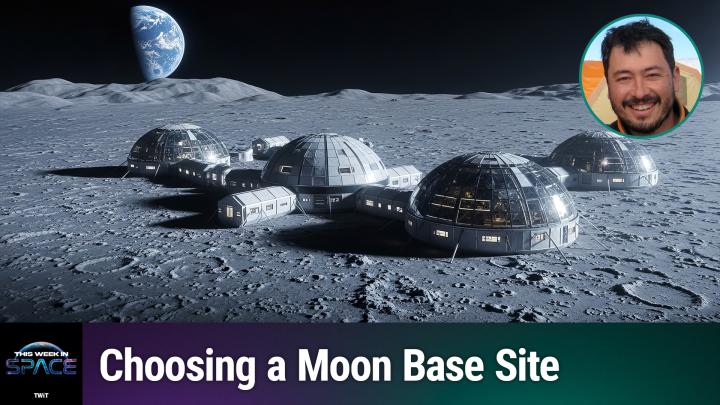
This Week in Space 218 Transcript
Please be advised that this transcript is AI-generated and may not be word-for-word. Time codes refer to the approximate times in the ad-free version of the show.
Tariq Malik [00:00:00]:
Coming up on This Week in Space, China just lands its first orbital rocket. Chasing SpaceX's heels. New Horizons has woken up out there beyond the edge of the solar system. And if when we're going to build a moon base, where should we build it? Dr. Pascal Lee is here to help Rodney out. Check it out.
Rod Pyle [00:00:27]:
This is This Week in Space, episode number 218, recorded on July 10, 2026: Which Way to the Moon Base? Hello everyone, and welcome to another episode of This Week in Space, number 218 that we like to call which Way to the Moon Base Edition. I'm Rod Pyle, editor in chief, Ad Astra magazine. I'm here with my good pal Tariq Malik, editor in chief of space.com. How are you, sir?
Tariq Malik [00:00:53]:
I'm doing well. I'm doing well. Look, we're out. I got my T shirt on this time.
Rod Pyle [00:00:56]:
Look, This Week in Space, I left mine sitting. So next week, let's both do it. Today we're going to be talking with returning friend of the show, Dr. Pascal Lee, about what's up with us plans for Moon base and why he thinks there might be a better way to do it or at least a better place to do it. So we'll save the juicy stuff for when he arrives. But for now, I have a space joke once again from retired attorney in front of the show, Bruce McCandless. Bruce, this one's for the engineers out there. Hey, Tariq.
Tariq Malik [00:01:25]:
Yes, Rod?
Rod Pyle [00:01:26]:
Why did engineers design the X33 Venture star to fly directly into space?
Tariq Malik [00:01:31]:
I don't know. Why?
Rod Pyle [00:01:33]:
Because they had stage fright.
Tariq Malik [00:01:37]:
Oh, oh, I get it.
Rod Pyle [00:01:38]:
Wow.
Tariq Malik [00:01:39]:
It doesn't have stages. That's right.
Rod Pyle [00:01:41]:
Single stage to orbit.
Tariq Malik [00:01:43]:
It has an aerospike engine. My mom invited me to go see a space shuttle launch and I told her in the 80s and 90s and I said no, they're building the X33 Venture Star. I'll go when we build that to see that first launch.
Rod Pyle [00:01:55]:
And we're still waiting.
Tariq Malik [00:01:56]:
We're still waiting.
Rod Pyle [00:01:58]:
Now, I've heard that some people want to strap us to a single stage to orbit launcher when it's joke time in this show. But you can help by sending us your best, worst or most different space joke at Twisted Twit tv. And we'll be happy to label you with credit or disgrace as the case may be. And now let's get to headline news.
Tariq Malik [00:02:20]:
Headline news.
Rod Pyle [00:02:25]:
All right, leading off, we have once again watched China do something pretty Impressive. As long as you're impressed with grabbing SpaceX's non patented technology and trying to use it for yourself. There is a difference here, their catch mechanism, a difference than SpaceX's. But gosh, it just all looks kind of familiar when you see it in action, doesn't it?
Tariq Malik [00:02:50]:
Well, it does. Landing rockets from space is no small feat, Rod. And, and until now SpaceX and Blue Origin have been like the only ones that have gotten these great big orbital ones to work. And we do. I don't know if we can show it the video that we do have, but for the first time China launched a Long March 10B rocket. It's a large, a large, I think it's actually a medium lift rocket from the like land and then they caught it at sea using a really weird setup. They built like a cage over a landing ship that has like these wires on it, right? Like guide wires if you think of like a trapeze. And as the rocket gets closer, those wires zoom like they like almost like a iris in to catch the booster itself and then it kind of dangles there.
Tariq Malik [00:03:41]:
It's a really interesting approach and like a very kind of novel take on that. You don't need a landing tower for it, but you also don't need to be overly reliant on any landing legs because it's still just hanging there. Yeah, we've got video for folks watching the video of it here. It's really, really cool. And the fact that they are able to do this shows that they're able to recreate kind of some of the pioneering technology that SpaceX and then now Blue Origin have been able to do with these orbital rockets. And then the next step of course will be to refly them. China's made this kind of an approach a really big focus to ensure that they're able to compete on the affordable access to space stage. And they're even building their own version of Starship for space tourism and heavy launch.
Rod Pyle [00:04:27]:
Well, and also this, this unique catch mechanism means if they come in a little off axis or off center, they just scoot the wires a little further in that direction and they can catch the rocket even if it's not in an optimal alignment. Right?
Tariq Malik [00:04:40]:
Exactly. Because it gets caught and snagged by these lines either way. So if it's leaning off to one side, they just zoom it in faster I would assume on the other side in order to compensate. It's a very interesting approach and it seems like it worked perfectly on this initial try.
Rod Pyle [00:04:57]:
So it's interesting because compared to what Elon did with the chopsticks. It's actually asking a lot less of the technology.
Tariq Malik [00:05:04]:
Yeah, yeah. I mean, it's a very achievable first test. Right. Remember, we've been catching satellites from space with parachutes and hooks and that kind of thing. And so this seems like exactly for 60s, as opposed to saying we're going to not just do vertical launch, vertical landing, but we're not going to land. We're going to catch at the landing site with these robots, arms that have to work. Right. Or else it destroys your landing pad.
Tariq Malik [00:05:27]:
You don't have to worry about a lot of that stuff there.
Rod Pyle [00:05:30]:
All right, next up, wake up New Horizons. We have a deep space probe. Deep, deep, deep in space, like, you know, leaving the solar system deep in space. That was just given the alarm clock.
Tariq Malik [00:05:42]:
That's right. So New Horizons, which, you know, famous for flying past Pluto, what was it? Was that 2019. I want to say 2015. So 20.
Rod Pyle [00:05:52]:
Anyway, you're, you're the news guy.
Tariq Malik [00:05:54]:
I mean, gosh, you'd think that I would know, but it is currently 5.9 billion with a B miles from Earth, and that's 9.5 kilometers for all of you folks that have to convert and, and it takes about nine hours for its signal to get back.
Rod Pyle [00:06:09]:
But for it was 2019.
Tariq Malik [00:06:11]:
The 2019. Yeah, there you go. There you go. Six, six years to get there is what I remember. And basically over the last, the last 321 days, you know, it's, it's been in that kind of hibernation mode, you know, quite, quite quietly out there. But it was still collecting data, so it wasn't sending anything home. And as a way to kind of control its power system and it's, they just have it on a hiatus for now, and now it's going to start spit, spitting all of this data that it's been collecting in passive mode over the last like, like near year back to Earth. And so scientists are really excited because it's collecting data.
Tariq Malik [00:06:51]:
It's so far away now that it's collecting data on the heliosphere. There's this outer boundary between our solar system and interstellar space. Of course, the Voyager probes have already passed through this boundary one and two, but they didn't have as instrumentated or as hardy.
Rod Pyle [00:07:09]:
Instrument.
Tariq Malik [00:07:09]:
Instrumentated. Is that how you.
Rod Pyle [00:07:11]:
Instrumented.
Tariq Malik [00:07:12]:
Instrumented Instrumented journalist? Yeah, you know, as, as, as, as New Horizons does in order to detect that, that, that medium that's out there, how thick or how concentrated are the particles the Magnetic fields, all of that stuff that protects our solar system's bubble from the rest of interstellar space. That's what New Horizons is able to do. And the scientists there are saying that, that it's doing well, it's in really good health. It's every status report was green during this entire period that it was in, in hibernation. And they're really looking forward to getting this, this data from the termination shock encounter that's like where the boundary of our solar system hits interstellar space, because they can compare it now with what they found from the Voyager probes and see has it changed over time and how is it evolving, which allows, allows them to know a bit more about how our solar system even exists in the first place.
Rod Pyle [00:08:08]:
ROD well, and I will just remind our, our friendly listeners that New Horizons very narrowly escaped cancellation and that my home organization and National Space Society, along with Planet Planetary Society and others, were instrumental in keeping that from being canceled. So go to nss.org and tell us how much you love us by becoming a member or something. All right, last up, we say farewell to Wally Funk, the last of the Mercury 13, quote unquote ladies that' kind of unofficially evaluated for spaceflight back in the 60s at the Lovelace Clinic where they said, yeah, women should go into space too.
Tariq Malik [00:08:49]:
Yeah, this is I don't mean to end our headlines on a downer, but I wanted to at least acknowledge the passing of Wally Funka, a trailblazing pilot. She died at 87 this week. And when she was 82, she made history as the oldest woman ever to fly in space. She launched on a Blue Origin New Shepard rocket, and she was the only one of those 13 women that, you know, had initially done some of those early tests for to be an astronaut, to actually reach space, even though she decided that flight was still going to be a passion and pursued that heavily her entire life. And so I just thought it would be a good kind of moment to recognize kind of both her dedication, her grit, if you will, and, and what she was able to achieve in her life there.
Rod Pyle [00:09:39]:
And for those of you who are listening to or watching this on Friday the 10th, which is today, we have a launch alert for tonight. If you're on the west coast or in the western states and you look to the east northeast sometime between 7pm and 11pm It'll be much better if it's between 7 and 9, because that's when you see the best show. SpaceX will be launching a Falcon 9 rocket out of Vandenberg Space Force Baseball up until about 8, 38, 45, it can catch what's left of sunset and you get some pretty spectacular visuals after that. You're basically just watching an orange dot go up in the sky. But it's still cool because if you watch carefully, you can sometimes see the separation of the lower stage as it does its burn back maneuver and so forth.
Tariq Malik [00:10:26]:
So, yeah, it's spectacular. You get that space jellyfish effect sometimes.
Rod Pyle [00:10:32]:
Yeah.
Tariq Malik [00:10:32]:
Gorgeous to see.
Rod Pyle [00:10:34]:
And it's just, you know, it's amazing. We live in an age where every week or two you can see a rocket launch when it used to be, you know, four times a year or something. All right, well, everybody stay with us. We're going to run to a quick break and then we'll be back with Dr. Pascal Lee to talk moon bases. Stay with us. We are back with friend of the show, Dr. Pascal Lee.
Rod Pyle [00:10:52]:
Hello, Pascal. Thanks for joining us today.
Dr. Pascal Lee [00:10:54]:
Good to be here. Thank you.
Rod Pyle [00:10:55]:
A fan favorite. Let's just remind everybody of who you are and why you're so important. So you're a planetary scientist. You work with the ames Research Center, NASA's facility up in Northern California and the SETI Institute. You built the Houghton Mars project out of cold, hard Arctic earth all pretty much by yourself, just by willpower. I mean, you had help, but it happened because of you.
Dr. Pascal Lee [00:11:21]:
Yeah. Good job.
Rod Pyle [00:11:22]:
You've been operating it for 26 years. 27.
Dr. Pascal Lee [00:11:27]:
27.
Rod Pyle [00:11:28]:
Yeah. And discover of Martian relic glaciers and volcanoes, along with many other things. And I think we need to add to your, your titular list here that you are a mentor to, I don't know, what, seven or eight grad students a year usually.
Dr. Pascal Lee [00:11:47]:
Oh, it's, it's more like 13. Yeah. Yep.
Rod Pyle [00:11:53]:
And, and my son, among other people.
Tariq Malik [00:11:55]:
It's not by mass that about 2,000 pounds of graduate students of graduate meat.
Rod Pyle [00:12:05]:
There we go. Well, and he treats his students very well. It's not the typical professor grad student relationship where it's like, okay, kid, get my coffee and do these statistical reductions for me. I mean, he really mentors the students. And so we were all together, the three of us at ISDC recently, and my son was there helping out and came up to me and he said, remember how it used to drive you crazy when people come up and tell you how awesome your father was? And I said, yes. And he said, I'm having the same experience with Pascal because all his think he walks on water.
Dr. Pascal Lee [00:12:40]:
Yeah, well, students are the future. And then the other thing is, I remember how I was treated so well as A student myself. And so I sort of want to pass it on.
Rod Pyle [00:12:52]:
Well, by Carl Sagan, among others. Yes.
Tariq Malik [00:12:57]:
Yeah.
Dr. Pascal Lee [00:12:57]:
As one does his last ta. But I wasn't even thinking of him in particular. I was just thinking that in general, all the mentors I've had were. Were really very supportive and gave me a lot of their time. So that was good.
Rod Pyle [00:13:09]:
That's great. I see that Tariq has his one and only friend in frame with him today.
Tariq Malik [00:13:14]:
That's right. That's right. I apologize. Everyone. This is Morris. She has graced us with her presence because she's.
Rod Pyle [00:13:21]:
You actually named your cat Morris?
Tariq Malik [00:13:24]:
Yes, yes. I named my daughter. Named her after Edmund Morris. I think he's a big. A big. A big, big to do in the creation of our county here in New Jersey.
Rod Pyle [00:13:38]:
Okay.
Tariq Malik [00:13:38]:
Not about space. Not as cool as Apollo, Pascal and your dog, you know, so. But this is. Yeah, this is the pet that I get. And at least. At least he's not knocking over or she's not knocking over the microphone like the last one.
Rod Pyle [00:13:51]:
Okay, that's very exciting. So you have a question to ask?
Tariq Malik [00:13:55]:
Well, normally I always ask. And Pascal knows this. You know, what captured you about space at the beginning. But, Pascal, you've been on the show enough times that maybe I should ask what's capturing you about space, like right now, aside from moon base and robots that we're going to be talking about, hopefully during this episode. But I guess what is. What is grabbing your heart right now about space?
Dr. Pascal Lee [00:14:21]:
Let me let this pass because there's a phone ringing in my background and I can't do anything about that. So. Standby. You'll be able to edit this out, right?
Tariq Malik [00:14:32]:
We'll get it in post. Right, Morris? Yeah, Morris says yes, too.
Rod Pyle [00:14:35]:
Okay, go.
Dr. Pascal Lee [00:14:40]:
So, to me, what is really grabbing me about space is the fact that humanity itself, I think, is entering this new era where artificial intelligence and robotics are coming together and making this world that's about to happen to us so new and so exciting and so different. You know, you don't have to be a visionary to realize that we're on the verge of a real change in our civilization with the emergence of androids, robots imbued with artificial intelligence, who essentially are being designed to just be like humans. And, you know, humans are creating humans or humanoids in their. In their own image. So that, to me, is opening some incredible prospects for human space flight and especially down the road, interstellar travel, which I thought until now was sort of a doomed prospect because hibernation and generational starships where the first generation leaves the Earth, and then only several generations later do you get to your exoplanet destination.
Rod Pyle [00:15:57]:
That.
Dr. Pascal Lee [00:15:58]:
That was never really practical. And it's so hard to get life support systems operating for so long, given the duration of travel. But Android robots, that would be caring for human DNA, traveling to interstellar destination, that is actually feasible, I think. So all of a sudden, I'm very optimistic again about our prospects for exploring deep space someday.
Tariq Malik [00:16:26]:
Wow, that's exciting. Yeah. Yeah. I think we're going to talk about the first steps of that today with, I guess, our hopes and dreams for the moon base. I don't know. Rod, would you sign up for an interstellar trip babysat by AI robots?
Rod Pyle [00:16:40]:
If I could get an Android body to do it, yeah. But I'd want it to be a lot better than the one I have. Especially I'd want it to have better teeth.
Tariq Malik [00:16:46]:
The svelte model. Right.
Dr. Pascal Lee [00:16:49]:
We wouldn't need Rod himself. We would just need some of his RNA or DNA and. And, you know, some of his other genetic makeup information. And all of a sudden we could. We could recreate a God, a Rod. God forbid.
Tariq Malik [00:17:08]:
Why stop at 1 Pascal, a whole ship of rods. Right.
Rod Pyle [00:17:11]:
Well, as long as you don't take my brain, that's fine, because I need what little I have left. All right, so we're here to talk about moon bases and just a brief rundown of how we got where we are now. And then, Tariq, I'm going to let you bring us up to date. The US started seriously noodling with this idea back in the 1950s, actually about the time NASA was founded. The US Air Force, which was still kind of new at that point, wanted to. They drafted a plan called Lunex for a base with 21 airmen or a spaceman. By then that would be in place 10 years later. It was going to cost $7.5 billion.
Rod Pyle [00:17:54]:
And they were going to send. With our little teeny rockets at that point, which usually blew up, they were going to send some small habitats up and bury them and live on the moon, because how hard can it be? And it was a flight of fancy. Then, 1959, not to be outdone, the US army, with Wernher von Braun at the helm, did a study called Project Horizon. It was going to be completed by 1967, a year earlier than the Air Force's base. And Project Horizon actually had weapons planned for it. We've talked about that before. Nuclear bazookas and lunar claymore mines and so forth to keep the, the scary Russians at bay or maybe to keep the Air Force at bay, depending on how things went. And that was going to cost $8 billion with a B, because how hard can it be? And that, that if you look at the illustrations for that, that involved, you know, landing multiple habitats with cranes that you could bulldozers to dig trenches and drag these habitats into the trench and cover it with lunar soil to abate the radiation and so forth.
Rod Pyle [00:18:55]:
So again, a little unrealistic. Then during the Apollo program there were plans mostly through the Apollo Advanced Applications Program, which included a drivable lunar module and a larger pressurized thing called molab that was going to drive around and allow them to basically have a mobile habitat, a small one. Lunar module truck was also in the plans. And then it kind of went quiet until the 1980s when Johnson Space center did a study for an 18 person base. By 2010 we missed that one. George H.W. bush was responsible for that one. And then under his sun, the Constellation moon base was planned.
Rod Pyle [00:19:39]:
And as we know, the whole Constellation program got canned. Next time we heard about it was our pal Newt Gingrich who in 2012 torpedoed his run for the presidency by saying in Florida, where you can say these kind of things and we'll have a moon base and you'll all be employed building it, everybody cheered and then the press said this guy's lost his mind. So now here we are in the 2000s and we're hearing about a moon base again. But nobody's laughing this time. So Tariq, give us a quick brief on where we are with that, if you would.
Tariq Malik [00:20:11]:
Yeah. Well now here we are as we're recording this. It is July of 2026 and we got a full revamp of a 30 million billion dollar party with a B, another B plan to build a long term sustainable moon base. Back in March when NASA did their big reset and for the Artemis and moon exploration program where they outlined three big phases to make a permanent moon base based around the South Pole. But it could be much bigger than that with a lot other places to, to send people to. They, they announced a whole suite of missions. I think three landing missions at that point in time, plus a multi hopper mission called Moonfall which you know is, is near and dear to Rod in the mind's heart. Right, Rod, because it's a classic classic sci fi name and oh, and what
Rod Pyle [00:21:01]:
a movie it was.
Tariq Malik [00:21:03]:
And since then there's actually been another rebrand because last month as we're recording this, Jared Isaacman came out and did another kind of reset where they, instead of having this big three phase thing that is out there kind of nebulous of all these different things put together, like commercial lunar missions, Artemis missions, partner missions, that kind of thing, they just made a moon base program and the whole idea is to have a moon base up and running by 2028. And all the missions that are going to be going there are called Moon Base 1, Moon Base 2, Moon Base 3 now. And as of last week, we are now getting monthly updates with new contracts. So there's no less than something like three to four moon landings, commercial uncrewed landings to send hardware and payloads there. Viper, of course, as we know, is one of those, but there's a few others like Firefly and Intuitive Machines who have new contracts as well. We just got a new contender. Japan's I Space has signed up to deliver payload to the moon on a starship, to be a provider for a lot of these missions. That'll be interesting to see.
Tariq Malik [00:22:10]:
But that is a bit further out that that announcement came out this week and, and it's actually going to aim for our first starship landing. And I quote rod and I can still feel your eyes rolling as early as 2030, which, which we know NASA wants to be on the moon way before then with Starship, but, but the wheels seem to be rolling much faster in terms of both. Keeping this in front of mind because NASA has promised monthly updates on the status of everything from their Artemis crew landers by Blue Origin and Starship all the way up through these new and kind of smaller missions as well over time. And they don't seem like they're stopping anytime soon. Also this week SpaceX is testing Starship for Flight 13. They just did the booster test and they already did the ship test earlier. We could be seeing the next launch of that moon lander test as early as the June, July 15, as we're recording this.
Rod Pyle [00:23:08]:
All right, so let's launch ourselves into a quick break and then we'll come back and let Pascal talk. Stand by. So Pascal, we have sort of a loose plan from, from NASA about which Artemis missions will start building the base. At least. I'm not clear on exactly what the hardware disposition is for these different missions, but they're saying start with Artemis 4 or 5, continue through seven temporary base camps first, then a larger permanent facility. And as far as I can tell, most of this is aimed at the south lunar pole. And I think you have some thoughts about this.
Dr. Pascal Lee [00:23:43]:
Yeah, well, first of all, I thought your summary Rod and Tariq's just now are really excellent and on point and up, up to date. The, you know, there are many things that are going on at NASA right now that I'm super happy about. I mean, I'm talking about the human exploration program. The fact that we're now embracing a moon base front and center as opposed to having that as a sort of a nice to have a little bit farther down the road is really a game changing decision and strategic move that I think is really worth. I mean it's a big plus for the United States and for all space faring nations to be sort of focused on getting that going as soon as possible. Moon base. The other thing of course is all the ancillary stuff, the Moonfall program that has provisions for these lunar drones to scout out different regions and do local and regional hops. I think that is also an outstanding decision.
Dr. Pascal Lee [00:24:46]:
Many other things like going nuclear on the moon, you know, regardless of actually where you would be set up on the moon, you need nuclear power to really reasonably support a base. And of course this will feed forward to Mars. We absolutely need nuclear power to support humans on Mars. I mean already Curiosity and perseverance don't go with solar panels. Imagine powering a base and rovers and with humans, et cetera. So, so nuclear is a big decision that also has been made and I think that's also a very good thing. Not to mention nuclear propulsion for going to Mars, which is a bit separate from the Moon. But back to the moon base.
Dr. Pascal Lee [00:25:29]:
Yes. The tactics of how to go about getting a moon base going is going to be something that's going to have to iterate because it's not just involving the US but also the international partners and their complexities when it comes down to actually implementing specific subprograms within Artemis. But to me there's a big strategic issue. There's a big but in my head that right now needs to be addressed and realized, which is essentially the three most important things about setting up a moon base, which are location, location and location.
Tariq Malik [00:26:09]:
Just like on Earth. When you're trying to buy a house.
Dr. Pascal Lee [00:26:11]:
When you try to buy a house. Yeah. And right now what we're seeing is still a rush towards the south pole, even though there are provisions for setting up things that are temporary and then maybe a more permanent base, not necessarily at the south pole. But I just want to stress as strongly as I can the importance of not setting up a moon base at the south pole or near the south pole, because the south polar regions are really very Very difficult to explore and move around. And meanwhile, they are not even very well suited for humans to explore. For astronauts in spacesuits, you're talking about places that are at temperatures that are often close to the temperature of the surface of Pluto. 50 degrees Kelvin or so, in the shadowed regions. Whether they are probably shadowed or not, it's super cold at the South Pole or near the South Pole at all these landing sites that are being considered.
Dr. Pascal Lee [00:27:15]:
You know, the other thing is.
Tariq Malik [00:27:17]:
Did you say 50 degrees Kelvin? Is that what you said?
Dr. Pascal Lee [00:27:19]:
Yes.
Tariq Malik [00:27:20]:
Is it Kelvin, like minus 250 degrees Fahrenheit?
Dr. Pascal Lee [00:27:22]:
Yes, yes, it's close to minus. Yeah, exactly. It's. It's an insane low temperature. Pluto's surface is at roughly 40 Kelvin. So that gives you a sense of nitrogen freezes at those temperatures anyway. But here's why the South Pole is such a quagmire for exploration. I mean, it'd be one thing if you knew where you would extract water, and somehow water was worth extracting economically, and somehow you knew where to set up your mining operations.
Dr. Pascal Lee [00:27:54]:
Then, sure, you go ahead and you land at that specific optimal location and you start extracting water. And again, I'm not even buying in the fact that it will ever be economically viable to extract the water on the Moon. But aside from that, everything else should be driving us to setting up an exploration base at a place that is much more convenient, safe, easy, efficient to explore from. And you don't want to just explore the south polar region of the Moon. You want to explore all of the Moon, and you want to have access to all of the Moon. And we have only so many, so much resources that we can put towards this without scattering our assets here, and then setting up a little temporary base there, and then somehow a bigger base later somewhere else. We really should be gathering all our assets as best as we can, as fast as we can, in one optimal location as early as possible. So, I mean, this has been the strategy that we use in Antarctica.
Dr. Pascal Lee [00:28:55]:
You set up McMurdo, this big base that we have in Antarctica is a logistics base for exploration. It's not necessarily where all the science that we do in Antarctica is done, although it's actually a good site for that. But it gives you access to all the more complicated and high risk and difficult areas to access across the entire continent of Antarctica. And it's important to understand that the analogy between a Moon base and an Antarctic base is not just the base itself, but the mobility system that you need to access the rest of the continent. In the case of Antarctica or the rest of the Moon. So we really should be looking at setting up a base on the moon for exploration that's at a convenient, easy to access, easy to operate in location and equip ourselves with the mobility system to roam all around the Moon and go to the North Pole, the South Pole, and everywhere else we need to get to. And that's what this base really should be doing. In addition, a base will be maybe sharing landing and launching facilities with a tourism facility.
Dr. Pascal Lee [00:30:00]:
There are many instances of this, even in Antarctica or in the Arctic, where a logistics base is paired up with a tourism or a civilian sort of regular life type of facility. You also want this base to support commercial testing and be inviting to, for industry to come in and learn how to explore the Moon. And all of this is not well done if you're at the south pole of the Moon. And let me tell you why the south pole of the Moon is not good. First of all, the topography is very challenging. It's not at all like the Apollo landing sites, its highlands, lunar highlands. You're deep in the. Surrounded by lunar highlands.
Tariq Malik [00:30:43]:
That's like mountains, right? Basically mountains, yeah.
Dr. Pascal Lee [00:30:46]:
It's very hilly. On Apollo 17, Jack Schmidt drove the lunar rover with Gene Cernan a little bit into highland terrain. They landed at the boundary between the two, like other Apollo missions did. And as soon as they hit the highland terrain and where I had to go up a little hill of about, you know, 15 to 20 degrees in slope, the rover was struggling and had to go in sort of hairpins and zigzags, cross, cross hillside to get to a location just 80 meters above the valley. And, you know, once again, the terrain is very steep at the south pole of the moon. And we're not even talking about driving around just with light rovers. We're talking about taking pressurized rovers, which are, of course, massive. And, you know, if you can avoid the highlands, except in a very surgical way, where you know where you're wanting to go, then that's really what you should be doing.
Dr. Pascal Lee [00:31:41]:
The second thing is that the terrain is very rough. The highlands are essentially ancient lunar crust that has been beat up by countless impacts. They're gigantic blocks in many places. It's both an opportunity for science, of course, but at the same time, it's really challenging terrain to drive up and down. I'm talking about the sort of, the operational aspects of this type of terrain, and then you have the lighting. We know, of course, of the permanently shadowed regions of the moon where the temperatures are cold year round. At 50 degrees Kelvin or so.
Rod Pyle [00:32:19]:
And these are may or may not including mid latitudes. Correct.
Dr. Pascal Lee [00:32:25]:
There are some that are lower latitude, but still all of them are at high latitudes. You have micro PSRs, permanently shadow regions, like in the shadows of boulders, for example, or even small rocks. But those are not the ones we're talking about. We're talking about the big areas that are so cold that ice might accumulate. Well, the permanently shadow regions are super cold to enter and they of course have no sunlight by definition. But it's not like the rest of the south polar region is well lit. The rest of the south polar region and the north polar regions is lit maybe 20% of the time, on average. 20 to 25% of the time.
Dr. Pascal Lee [00:33:05]:
I mean, that means that wherever you set up a base, unless you're in a very limiting and restricted area where you have somehow permanent sunlight, and those are not necessary places where you can easily access the rest of the moon,
Tariq Malik [00:33:18]:
because that's like the top of the crater, like a giant.
Dr. Pascal Lee [00:33:21]:
It's like the mountaintop rim of a crater. But then you're just on this ridge. You really don't have good illumination. Forget about just getting power. You don't have good illumination for driving around for your EVAs. And it's super dangerous because if you're operating in daylight and then the shadow is coming at you, you might be in shadow for days, if not weeks on end. So again, the lighting is really very challenging, very difficult. And unless you know exactly where you want to be, you don't want to be driving around in that kind of.
Dr. Pascal Lee [00:33:58]:
Sure, you use LiDAR, you can use, you know, other, other means of perceiving your, your landscape. But again, I'm talking about the purpose of having humans there with their visual eyes looking at the rocks and you know, doing exploration, building things or testing other things. It's a, it's a really suboptimal place
Tariq Malik [00:34:16]:
to be that life really.
Rod Pyle [00:34:19]:
Let's quickly rove our way into another break and we'll be right back with Targ's next question. Standby.
Tariq Malik [00:34:24]:
Pascal, you said that you had some more negatives about the south pole.
Dr. Pascal Lee [00:34:28]:
Yeah, we talked topography, illumination, don't build here the roughness, but there's also the fact that we might not have as much water as we think that we have on the moon at the south pole. What's advertised often is the fact that we have roughly, possibly the equivalent of 200,000 plus Olympic size swimming pools worth of water in the south polar region. That sounds like a big number 200,000 plus swimming pools, but that's not that much scattered over a very large region. The two areas where we think we have the highest concentration of ice at the lunar south pole, within the top meter of the regolith of the soil is at Cabeus Crater and at Amundsen Crater.
Tariq Malik [00:35:18]:
Not at the poles, right?
Dr. Pascal Lee [00:35:20]:
Not at the poles, yeah. Both Amundsen is very hard to get into and then surrounded by steep slopes. So Shackleton, by the way, but these are not drivable slopes really. And then at kbus, that's where the LCROSS mission actually crashed on purpose to create a plume of regolith dust and gases and volatiles that were then analyzed by another impactor before it impacted. And that's how we know that there's indeed quite a bit of ice at those locations. But what do we mean by quite a bit? It ranges. The estimates range from something like half a weight percent, 0.5 weight percent to, if you're optimistic, 1, maybe 1.5 weight percent. What that means is that half a weight percent means that if you take, if you excavate one metric ton of regolith on the moon and you are 100% efficient at squeezing out all the water it contains, you will get out of it five kilos of water.
Tariq Malik [00:36:24]:
That's not a lot of water, that's five liters.
Dr. Pascal Lee [00:36:26]:
You want to fill a single starship with hydrogen oxygen. Not that starship runs on hydrogen oxygen for now, it runs on methane and oxygen. But if you were to fill a single starship with hydrogen and oxygen harvested from the moon, you would need to excavate. To fill this 1000 metric ton of fueled rocket, you would need to excavate an area down to 1 meter of depth, an area that's equivalent to the size of 26 football fields. To fill one rocket. If you're 100% efficient and we're not just talking about excavating the regolith, you then have to extract the water out of it and all of this at 50 kelvin or so. And meanwhile, if you warm up the ice, it's going to sublimate. So the clock is ticking.
Dr. Pascal Lee [00:37:15]:
You have to then transport this water. How do you transport the water? You can't transport it in a solid state. You're going to have to transport it in liquid state. The amount of energy it's going to take to essentially liquefy that water and transport it to, to wherever you would refuel your rocket. That's also going to be insane. Infrastructure and plumbing. Nobody's saying it's not possible. Nobody's questioning the possibility of it.
Dr. Pascal Lee [00:37:43]:
What I'm questioning is we really have no realistic understanding of the cost.
Tariq Malik [00:37:53]:
Well, what about Pascal, I'm sorry to interrupt, but what about the gold rush, right, where we didn't have an understanding, or at least those 49ers, if you will, of the cost to go dig that gold up. And they didn't have like a base initially when they were out prospecting, all of that stuff sprouted up after they found the spot. Is there an argument for going there to see and then doing the things and then you can put your base at KBUS or put your base at. Absolutely right. And then, and then, and so you're not going to go to one big spot, you're going to go to seven. Because one of the things that, that's come out from this moon base plan, which is a little bit different from I think the past, is that they're not saying that the base is Shackleton. This actually came out, I want to say about the second presser that they had in where they were talking about setting up kind of satellite stations around the moon in like an 80 square mile perimeter so that the base isn't just like one spot but like all over the moon. And that seems like a very different approach to what a moon base is and, and what it can turn into.
Tariq Malik [00:39:10]:
Then maybe like what Rod was describing with Von Braun and some of the other other passes, it seems like that might be a bit more tenable to grow because you have a more spread out infrastructure. I mean obviously NASA's focus on the south pole because China is focused on the South Pole and they, they want to really sell that water deal. But on the back end it sounds like there is some thinking about, no, we're going to have this station over here for power and this station over here for remote sensing and this one over here. Yeah, these robot rovers that are going to go do their own thing, these pressurized ones that people can rent out if they come visit, you know, that kind of a thing. It sounds like there's at least the beginnings of that, that kind of growth strategy in mind.
Dr. Pascal Lee [00:39:54]:
There, there's that thinking. But you know, scattered assets do not make a base, or gathered assets a moon base do not make. It's the whole purpose of a base is to gather your assets in one location and that's why it's called a base. And from there you then explore. And once you have found places where things can be more focused on where, you know where that has to happen, then you Set up, you know, a mining camp or a drilling operation. I mean, for example, in Antarctica, we have this logistics base. And if we find a place in Antarctica where we want to do deep drilling to capture the best core of ice of the continent, we then set up a temporary camp from there. At that point, you scatter your assets in different directions to satisfy your needs.
Dr. Pascal Lee [00:40:51]:
But at first, the whole idea of a base is to create a logistical hub and a shelter that has lots of assets gathered in one location for just convenience and. And strategic sort of planning. The same thing with. So going back to the gold rush analogy that you brought up, yes, it started with individual prospectors not really knowing where they should go first. And then eventually, once gold was found in some substantial concentration, with lots of successes by prospectors finding gold, that's when you set up a. A mining town. Okay, but at first, these were individual prospectors. This is not sort of our approach here.
Dr. Pascal Lee [00:41:40]:
We don't really have individual people going to the moon quite yet. What we want really is. I mean, nobody's suggesting we not search for water aggressively and determine its concentration at sort of a local scale that we cannot get from orbit. But all of this is best done by robotic means. So the real good strategy here would be to decouple the two, to have a very aggressive campaign to explore the south polar regions of the moon with robotic assets. And this is where the moonfall concept is outstanding, because we could indeed, with various drones, prospect lots of different sites very efficiently, including going to places that are super cold or less cold. But then the human exploration part, humans have no business being anywhere near PSR right now. And if you want a core of frozen ice, well, you can do this robotically, and it'll be a nice challenge to bring back material that's preserved properly.
Dr. Pascal Lee [00:42:44]:
Or if we know a place where somehow ice is really easier to access and makes sense to send humans specifically to go get it, well, then maybe we can do one mission to that location. But generally, the idea should be that we should be building up a base in a place that's at lower latitudes, not far from the poles, but at the edge of the polar regions, ideally within driving distance, within flying distance, within relatively easy access, since we don't know yet exactly where, and we might not know for a long while, for possibly a few decades, exactly where we would set up a mining operation at the south pole of the Moon.
Tariq Malik [00:43:23]:
And, you know, don't say a few decades, because I think we've all been waiting a few decades over and over again.
Dr. Pascal Lee [00:43:28]:
I'M saying a few decades, just in terms of when, when it would be time to set up a mining operation. That would mean that we have mastered extraction techniques. That would mean that we will have master transportation of, of the, of the water across the surface of the moon to get them to, to launch pads and landing sites. So we're conflating right now the idea of building a mining operation to extract the resources of the moon, which again are not there for certain in an economically viable way, and setting up an exploration base, which really is not well served by being in such a location that has so little sunlight, so little lighting of the landscape, and without knowing where exactly we will find and how much water we will find, or for
Tariq Malik [00:44:19]:
there just being one. Right. When it comes to like an exploration base, you may want to have more than one of those outposts, right?
Dr. Pascal Lee [00:44:29]:
Eventually, eventually. But you start with a base at a very, I mean again, that, that goes to any basic strategy. Even in the military operation. You set up a garrison somewhere and then you, you fan out and you set up some local outposts to control the territory you want to control. I mean, we're not talking about a military occupation of the moon here, although some are. Yeah, we're talking about just the logistics of it. You set up a really good and as predictable in terms of lighting and temperature regime and of course local exploration opportunities as well. You set up a base in a much more benign location and from there you equip yourself with a mobility system that gives you access to everyone else, including the South Pole.
Dr. Pascal Lee [00:45:17]:
And once you find a good spot to extract ice, you do that.
Rod Pyle [00:45:21]:
We have to go explore a break. So stand by everybody, we'll be right back. So Pascal, you spent over 400 days in Antarctica in your long gone youth and you know, you understand that regime down there pretty well. Do you see that as a good model for. You know, we're looking at international bases on the moon. There of course, the Artemis Accords with the US There will be lots of countries involved with that. We hope China and maybe Russia are planning their own. There could be others.
Rod Pyle [00:45:53]:
So of course the idea of cooperation versus competition comes up and how these, how these regimes play out. What are your thoughts?
Dr. Pascal Lee [00:46:02]:
Yeah, I mean, I think once you are in the extreme environment, what happens there is much more collaborative and friendly. I mean, in Antarctica, even though some nations are at war economically against each other, there's generally a spirit of cooperation between different bases from different countries in times of need, in times of emergencies, on the other hand, and I see this happening in space too. I mean, it's even true with trying to make systems that are compatible with one another for mutual rescues in space. So in space, the cooperation and the competition is friendly. I think where wars are being waged economically and otherwise are on Earth. But the environment of space is so extreme, there are so many things that are really threatening to kill you, that unless you have this attitude that you should help your fellow human being regardless of where they're from, you're not going to survive yourself very long.
Tariq Malik [00:47:10]:
One of the things that you had mentioned, and this might be something that comes out of this international cooperation, because I think about Pascal, the recent slate of international missions to the moon, some successful, some not, some really striking, like Japan's crazy picture of its lander with its nose in there, but it still made it to the, to the surface. And, and I'm wondering how in like your best case scenario where we send the robots as the prospectors, but we have the science space somewhere else that's a little bit more accessible, that cooperation will work for different needs. Do you see a multitude of different types of robotic systems beyond just like the regular ones that we have some robot landers, some robot rovers off doing their things? You mentioned humanoid robots at the top of the hour.
Dr. Pascal Lee [00:48:02]:
Yeah.
Tariq Malik [00:48:03]:
And you know, we've, we know that Japan on the international front wants to send a humanoid robot to the moon as part of its, its plan. And I'm curious what that interplay is going to be or what it, what you feel it has to be as, as a scientist in order to get the most science return from these astronauts. Maybe there's three or four of them that spend a couple weeks on the moon or a month on the moon, max. But how do they, how do they use robotics to get the most science, the most sample studies, all of that, while also practicing safety, you know where.
Dr. Pascal Lee [00:48:40]:
Yeah.
Rod Pyle [00:48:41]:
And if the Japanese do send up the first robot, are they going to follow pattern and have it look like Sailor Moon? That's my big question.
Dr. Pascal Lee [00:48:49]:
This is where something like the Artemis Accords is sort of so important and such a good move for the United States and all its partners. A thing like a moon base or lunar testing program for robots. These are huge investments for nations that are committing to this. They want to be sure that they are in partnerships with partners that they can rely on and want to work with. The ISS has been very successful that way. The partners have gotten pretty much what they wanted and expected from the program. Opportunities to fly, opportunities to do experiments. And it has been really largely A big international success.
Dr. Pascal Lee [00:49:27]:
China has been excluded especially by the US to participate in the iss and that actually has encouraged them to set up their own space station program.
Tariq Malik [00:49:35]:
Two great success so far.
Dr. Pascal Lee [00:49:38]:
I think that some decisions are made early by nations to either see a cooperative collaboration long term on the moon or whether it's going to remain competitive for a while. But as soon as you. But Japan's, just to take your example, Japan and robotics, yes. Japan has all kinds of robotics capabilities that it would want to test on the moon. So does the US and these are best done in a place that is not essentially permanently or semi permanently shadowed, for example, and you can access places that are shadowed even at lower latitudes, if that's really what you want to test out. But you want to be doing all your testing and your development in a place that's a lot more benign.
Tariq Malik [00:50:21]:
Benign, yeah.
Dr. Pascal Lee [00:50:22]:
Okay. Why have that extreme complexity of temperature, etc. For now until you know where you want to go? So.
Rod Pyle [00:50:30]:
Well, excuse me, but I have a quick question, if I may. Do we have much experience with remote operations, robots essentially in these kind of temperature extremes? I don't think we do, do we?
Dr. Pascal Lee [00:50:41]:
Not at such low temperatures. I mean, on Mars your temperatures are at worst -125 Celsius. We're not talking about minus, you know, in this case, 220 Celsius or so. So, you know, again, we're talking about having robots that will have moving parts, mechanisms, not to mention power systems that have to operate at temperatures of order 50 Kelvin and digging into stuff that's really tough to dig into frozen dirt. So again, nobody's saying it's not possible to do. It's just that the challenge is huge and we're nowhere near being in a position to address it. And by going to the south polar region with people for now is really premature. Meanwhile is a strategic advantage to be understood and gained by having a base that's off polar.
Dr. Pascal Lee [00:51:40]:
And so I will just. I love everything else that the Artemis program is doing, everything else. I just wish we would have a dialogue to really consider very carefully. It's a very important question of location, location, location, which has to do with timing as well of how we do all this.
Tariq Malik [00:51:59]:
Well, and then speaking of this robotics and timing, one of the things that I kind of get the sense of from NASA administrator Jared Isaacman is a push to take what works now and then just use that now. Yes, and we saw that, I want to say, last week, right. Rod and I didn't get to talk too Much about it on our last episode, but Jared Isaacman announced, along with Garcia Galan, Marco Carlos. Carlos, yeah, the moon base manager, a plan to pull the engineering model for perseverance and curiosity and make, you know, just take that nuclear testbed and turn it into a moon rover. And I'm curious about that application of. Of proven things. You know, I would say that well proven and paid for and proven and paid for types of things. And we, you know, the revival of Viper is another example of that.
Dr. Pascal Lee [00:53:01]:
Of yeah.
Tariq Malik [00:53:02]:
Of taking those things and building just you know, making them a cookie cutter, building more of them because you know, they work already at that site. And is there, is there an advantage there that, that isn't being properly leveraged in order to, to make things work? Right. Because we don't have habitats. But maybe they're going to repurpose Gateway for that kind of.
Dr. Pascal Lee [00:53:21]:
I think that that is an excellent decision that Isaac man and Garcia Galan have made regarding the. Regarding robotic exploration of the moon. Absolutely. Use existing assets and capabilities, demonstrated performances like by spirit and opportunity. I'm sorry, by perseverance and curiosity to go and tackle the polar regions by robotic means. That is exactly. So nobody's suggesting here that we not explore the south polar region with robots once again. That's really what we should be doing more of.
Dr. Pascal Lee [00:53:59]:
And the more we can leverage existing technologies and capabilities including RTGs, radioisotopic thermal generators and other nuclear systems to do this, the better. But humans, aside from flags and footprints, the footprints you might not even see because they're shadowed.
Tariq Malik [00:54:21]:
I was just thinking about that. The live streams are going to be riveting, right. If it's going to be all at night because everyone knows that's the best time to cover.
Dr. Pascal Lee [00:54:28]:
I think it'll be spectacular once and possibly twice. But you're going to lose the public interest as well because the landscape is really just little threads of light on the hilltops. It'll be very beautiful but not very productive in my view to get humans there.
Tariq Malik [00:54:49]:
Maybe they'll set up some.
Dr. Pascal Lee [00:54:50]:
Until we really know where to work.
Tariq Malik [00:54:53]:
Yeah, yeah, I guess, I guess just.
Dr. Pascal Lee [00:54:56]:
And you know, scientists. Scientists are working. You know, I was just gonna say my peers. Scientists are working enthusiastically of course about going to the south polar region of the moon because there's a lot of scientific question that can be addressed there. And you know, but to me it's strategically, it's not a good approach. It's. It might be satisfying your short term needs and interest and thirst for knowledge to somehow set up a temporary outpost here to just get some ice. But from a strategic standpoint, the cost of doing any of this and setting up a base, you really don't want to be at the South Pole once again and you want to be a little more patient.
Dr. Pascal Lee [00:55:34]:
Set up the base first, create capabilities, allow you to explore and reach all the moon, including the South Pole. And then when we know where to drill for ice and excavate it and extract it, then we set up an outpost or mining operation.
Tariq Malik [00:55:48]:
Yeah, it sounds like it's a, it's a, it's a very kind of chicken and egg. We want to make the big case that we have to go to the Moon because there's ice to the, at the South Pole. But you're going to need that base anyway, that exploration base at a more accessible area. So why not do that first before you do the other thing? And, and so. Well, it'll be very interesting to see how that all evolves. Like I guess I had one just kind of final question about. And you, you also alluded to this earlier when you talked about tourism and joint operations and, and what we've seen with all of these new announcements from, from NASA and their partners about, you know, you know, this commercial plan for this land or this commercial thing for Blue Origin, you know, all these different options now to, to land different things. But it is, it's, it's paid for through a commercial model.
Tariq Malik [00:56:40]:
And I'm curious if you see based on like what you've seen at Antarctica, a similar commercial approach or it's already baked in. It's not NASA building the things first and then maybe finding commercial opportunities later like on the space station. It is like there's that commercial buy in already at the get go where it's, you know, a United landing pad, you know, for example, that everyone is going to be able to use because United built it or something of that sort. That will be a new model for a moon base establishment.
Dr. Pascal Lee [00:57:20]:
Yeah. So you know, in Antarctica, first of all, the biggest commercial opportunity that exists in Antarctica right now is tourism. That's worth noting because even though there could be resources to be extract it eventually, they would not be cost effective to extract for now in Antarctica. And so the only real business going on there is tourism. Some commercial outfits are using Antarctica and the Arctic to test equipment as a testing ground. So in that sense that's also something that the moon base could support and could do. And some bases have a private component to them in some bases and entirely private. So that's, I can see that Also being a possibility on the moon that we will have, you know, maybe a big Artemis sort of international national base, set up government base, so to speak, and then, and then maybe offshoots that are private bases.
Dr. Pascal Lee [00:58:20]:
But still, you know, you want to have this for the US as a nation. It's of strategic importance for us to have a base as a nation, not just as a collection of private enterprises.
Tariq Malik [00:58:33]:
Yeah.
Dr. Pascal Lee [00:58:34]:
And I didn't even bring up Space Force in this whole discussion. So that's another thing that has to be considered.
Tariq Malik [00:58:44]:
But I could see a base where you have the Lunar National Lab module and then you have the Space Force module and then there's all these commercial bits and bobs and then there's McDonald's. Right. Or something.
Dr. Pascal Lee [00:58:56]:
Then you have the launch pad, landing pad has to be away from the base anyway. It has to be at least 100 meters in elevation in difference apart, and then more than about 2km or more away, just so that you don't get directly sandblasted by rocket landings and takeoffs. But beyond that, you can imagine this airport as serving. It's a bit like Dallas Fort Worth, you know, you sort of have the airport in the middle. Beyond that you could have another direction in which you have a resort. And I actually believe that a lunar resort would be something that has a future.
Tariq Malik [00:59:36]:
I'd go there, I'd book a week, right.
Dr. Pascal Lee [00:59:39]:
I'm working on a paper with a student on water sports on the moon and think of doing the high diving from the high diving board into a swimming pool
Rod Pyle [00:59:50]:
that will take 19 football fields worth of ore to fill in.
Dr. Pascal Lee [00:59:54]:
Lunar gravity. Yeah. So we want one, one Olympic size swimming pool. But of course it's pressurized, right. Obviously. And, but you know, you can imagine the fun you could have in lunar gravity with that kind of thing, which I think would attract people who are either very rich or very lucky. You might win a lottery ticket, a bit like in Total Recall, to go to the moon for spend a week.
Tariq Malik [01:00:17]:
And well, well, Quaid was a spy in a previous life. So there was, there was that. You know what, this is a really good time that we can ask because I know that we're kind of at the end. We should ask our listeners, everybody out there, where would you want to build the moon base? Like you're in charge. Do you build it like where it's. With exploration in mind, where it's centrally accessible with your nodes and your satellites to go to all the different little bits? Or do you go straight for the wet stuff and go to Shackleton Crater and get the ice first and claim it, I guess, for all mankind, quote, unquote, it should let us know. And then if you were going to go to a resort on the Moon, what is the accoutrement you want to do? Is it swimming? Is it skiing? I've seen those kinds of reports. Is it off roading? That'd be fun.
Tariq Malik [01:01:02]:
Let us know. Let us know in the.
Dr. Pascal Lee [01:01:03]:
Can I share my favorite.
Tariq Malik [01:01:05]:
Yes.
Dr. Pascal Lee [01:01:05]:
Recommended site. Clavius.
Tariq Malik [01:01:09]:
Clavius, that's right. That's right.
Dr. Pascal Lee [01:01:11]:
60 degrees south on the near side of the moon.
Rod Pyle [01:01:14]:
And we already know how it should be built because we've all seen 2001 A Space Odyssey.
Dr. Pascal Lee [01:01:18]:
Exactly. It's the place where, as it so Happens, 2001 A Space Odyssey set up in space, but at the time they did not know why it was so scientifically interesting to be there. And it turns out to be really scientifically interesting. It's the largest, second largest impact crater on the near side of the moon that can recognize as an impact crater. And it's one of the oldest impact craters on the moon as well. And it's an amazing location where there are also caves nearby.
Tariq Malik [01:01:46]:
Oh, it's spelunking too.
Dr. Pascal Lee [01:01:48]:
Oh, I forgot about that. So lots of things that you could do at Clavius and of course it'd be an incredible case of reality meeting fiction to set up our base there. And you're within driving distance. The distance from Clavius to the south pole of the Moon is less than the distance from McMurdo to the south Pole station.
Rod Pyle [01:02:07]:
Well, and I'll be especially gratified when I get there and we unearth the monolith and it has your face engraved into it.
Tariq Malik [01:02:14]:
I want to thank you for expect a room waiting for us at Clavius Resort.
Rod Pyle [01:02:18]:
I want to thank you, Pascal and everybody else for joining us for episode 218, which we're calling which Way to the Moon Base. Pascal, remind us where we can find you and your ideas online, please.
Dr. Pascal Lee [01:02:31]:
I'm at the SETI Institute. I have a YouTube channel, but I'm also active on Twitter @pascaleetweets and on LinkedIn.
Rod Pyle [01:02:41]:
What's your YouTube channel called?
Dr. Pascal Lee [01:02:44]:
I think @PascalLee. It's just my YouTube channel. Yeah.
Rod Pyle [01:02:48]:
Okay, very good. Tariq, where's your YouTube channel? As if I didn't know.
Tariq Malik [01:02:53]:
Well, I'm gonna say first of all, you can find me at space.com as always, and also on the socials, @tarikjmalik on the Twitter, on the Instagrams, on the TikToks all that stuff. You can find me on YouTube @spacetronplays. It's a new season of more Rivals this weekend. That's going to be really exciting. This weekend you will find me at Manhattanhenge. And if you're looking for morespace.com, you can find us on our app, on mobile, for iOS and for Android. And if you want awesome This Week in Space Merch, right, you can find that on the twit.tv website right there.
Tariq Malik [01:03:30]:
And then if you want lovely cats, you can't have this one. She's taken.
Rod Pyle [01:03:33]:
And. And while you're there, you could join Club Twit because that's important for all of us. And of course, you can always find me at pilebooks.com or@astromagazine.com where I like to hang out. Remember, you could drop us a line at twis@twit.tv. We welcome your thoughts, ideas about where to put the moon base and of course, your space jokes. You're falling behind. Get busy. New episodes this podcast publish every Friday on your favorite podcaster.
Rod Pyle [01:03:57]:
So make sure to subscribe, tell your friends and give us reviews. Review Pascal. We expect at least six thumbs up for our friend of the show. You can also follow the TWiT Tech Podcast Network @Twit on Twitter and on Facebook @Twit.tv on Instagram. Gentlemen, thank you. It's been a pleasure and an honor to see you today and we will be back next week.
Tariq Malik [01:04:19]:
Say thank you to Morris. Thank you to Morris.
Dr. Pascal Lee [01:04:22]:
Thank you, Morris.
Tariq Malik [01:04:22]:
Thank you both.
Rod Pyle [01:04:24]:
Stop scratching your fleas, Morris. See you everybody.