Windows Weekly 997 Transcript
Please be advised that this transcript is AI-generated and may not be word-for-word. Time codes refer to the approximate times in the ad-free version of the show.
Leo Laporte [00:00:00]:
It's time for Windows Weekly. Paul Thurrott's here. Richard Campbell is here. We'll talk about the Windows Insider builds. There's some new stuff coming. We'll also talk about the Amiga. It's back, baby. And shenanigans at Lenovo.
Leo Laporte [00:00:15]:
That and a whole lot more coming up next on Windows Weekly. Podcasts you love. From people you trust.
Paul Thurrott [00:00:25]:
This is TWiT.
Leo Laporte [00:00:32]:
This is Windows Weekly with Paul Thurrott and Richard Campbell, episode 997, recorded Wednesday, August 19th, 2026. Bear Swamp and the Boathouse. It's time for Windows Weekly. Hello, you winners and you dozers. This is the show where we talk about the latest news from Microsoft with 2 of the bestest people in the whole wide world for that particular thing. I wouldn't hire them to do my indoor plumbing, but I would hire them to talk about Microsoft. Mr. Paul Theriot from theriot.com.
Leo Laporte [00:01:04]:
Hello, PT, back in PA.
Paul Thurrott [00:01:07]:
Yeah, nobody's happy about this.
Leo Laporte [00:01:12]:
Really?
Paul Thurrott [00:01:12]:
I'm sorry. No, that's enough. We've seen friends and it's—
Leo Laporte [00:01:15]:
Yeah, I had dinner with Mike and Amira Elgin this week. They're back in the country and they're doing what's called the Schengen Shuffle. Oh yeah, because you have to leave to come back, right, to renew your visa. Is that true in Mexico too, that you have to spend a certain amount of time?
Paul Thurrott [00:01:31]:
Well, okay, well, no, they do. So technically you have, um, I think it's— was it 6 months maybe at most? So you have to— we have residency, we can stay there forever.
Leo Laporte [00:01:41]:
Oh, aren't you lucky. Also here, and actually I would trust him to do my plumbing because it feels— I feel like Richard could do anything. Richard Campbell from Run His Radio. Hi, Richard.
Richard Campbell [00:01:52]:
How are you? I don't have a PEX compression tool, but I have the rest of the parts.
Leo Laporte [00:01:55]:
The fact that you even know what that is inspires me to say, would you like to come here and check my P-trap? Because— so, Rich is in the boathouse, which means—
Paul Thurrott [00:02:08]:
Better than being in the doghouse.
Leo Laporte [00:02:10]:
No, it means it's beautiful and sunny.
Richard Campbell [00:02:12]:
It's very beautiful here. But yeah, I'm here because the— 15 minutes before the show, the streaming workstation just took a header.
Leo Laporte [00:02:20]:
Oh, I hate it when that happens.
Richard Campbell [00:02:22]:
Very unhappy. And I suspect it's because of the Windows update this week, because my other machine did too, and it required a BIOS update to get working. I think they're tweaking stuff at the TPM level, and if you don't have everything current, very unhappy.
Leo Laporte [00:02:39]:
Yep.
Paul Thurrott [00:02:39]:
Well, we're going to talk about this a little bit later.
Leo Laporte [00:02:42]:
Oh, we are? Oh good.
Paul Thurrott [00:02:42]:
This is a Call of Duty problem. You know, it really is.
Richard Campbell [00:02:47]:
It really is.
Paul Thurrott [00:02:47]:
I know it sounds like it's not, but—
Leo Laporte [00:02:49]:
I had a similar problem because, uh, one morning my, my framework wouldn't start up, and I am so dependent now on AI that I didn't know what to do.
Richard Campbell [00:03:00]:
It was like, oh, uh, how did I do anything?
Paul Thurrott [00:03:06]:
Uh, it's really—
Leo Laporte [00:03:08]:
I realized how pathetic It's kind of like when you're driving and you're so dependent on GPS that you can't— you don't know whether to turn left or right without the GPS.
Paul Thurrott [00:03:15]:
Oh yeah, this is my daughter's default stance.
Leo Laporte [00:03:19]:
Yeah, I'm— I, I think this is a problem.
Paul Thurrott [00:03:21]:
It is a problem.
Leo Laporte [00:03:23]:
So what's my solution? I just made sure everything was kind of redundant.
Paul Thurrott [00:03:27]:
And the solution is to memorize all of the world's information and not need—
Leo Laporte [00:03:31]:
Oh, there you go.
Paul Thurrott [00:03:33]:
Oh, what did I think your problem is?
Leo Laporte [00:03:34]:
But I went to— I went to school for that. All right, let's, uh, let's, uh, enough, enough, uh, jolly talk. Let's get serious.
Paul Thurrott [00:03:46]:
Let's talk about Windows.
Leo Laporte [00:03:47]:
What's happening?
Paul Thurrott [00:03:49]:
Yeah, not too much. Um, okay, well, there we go.
Leo Laporte [00:03:52]:
Thanks for joining us.
Richard Campbell [00:03:53]:
Not a big deal.
Paul Thurrott [00:03:56]:
Um, well, a couple of things actually. Um, the big things being related to the Insider Program. So, uh, yesterday I'm losing track of days. Yesterday or Monday, Microsoft announced 5 new builds for the Insider Program, which is mostly not that interesting. But in a separate blog post, they talked about one of the things that they're doing around File Explorer, right? Which is redoing the context menus, which is one of the key main— or the key initial complaints about Windows 11 when it first came out, right? From Windows 10 guys.
Richard Campbell [00:04:30]:
Mm-hmm.
Paul Thurrott [00:04:30]:
Like you would right-click the taskbar, for example, instead of getting this giant cascading menu, there was one option initially for taskbar Taskbar settings. Now we have 2, uh, for Task Manager as well. But then they have these modern, um, context menus that appear when you click within File Explorer on the desktop, which is part of Explorer.
Richard Campbell [00:04:47]:
And— Dang icons, isn't it?
Leo Laporte [00:04:49]:
Well, there's—
Paul Thurrott [00:04:50]:
so there's— there was that, right? And there's that weird behavior where if you have something selected, like an, um, you know, a file or whatever, and you could use cut, copy, paste, et cetera, depending on where that menu opens, those— but those buttons will be on the top or the bottom, which kind of messes with your muscle memory. Um, initially they were just Uh, you know, Egyptian hieroglyphics. Now they have the words under them.
Richard Campbell [00:05:11]:
Cut, copy. Yeah, they finally put the words back on them. But it felt like the UX designed to make you feel stupid.
Paul Thurrott [00:05:16]:
Yeah. Yeah. Well, it was designed by people who are stupid. So, um, you know, that makes sense. Um, no, they really just, you could, you just got this vibe that these were like Mac users who had never used Windows.
Richard Campbell [00:05:27]:
And what are you doing?
Paul Thurrott [00:05:29]:
It's pretty, but it's dumb. You know, the kind of blonde supermodel of interfaces or whatever. But, um, but I like that one too. Yeah, I mean, but the complaints continue, right? So one of the things you can do if you are— if you missed the Windows 10 stuff, I mean, you can hold down the Shift key, right-click, and then you get the old menu, which has more options in it. Not as pretty, but whatever, it has everything. There's a registry/policy change you can also make that will make that permanent if you want to do that. But, you know, the complaints have continued. Microsoft, the, the point of this initially was to make Um, Windows 11 simpler, right? So unfortunately, when you have a big complex OS like Windows, the ways that you make it simpler include removing things.
Paul Thurrott [00:06:13]:
And it turns out there's someone who uses every one of those things, right?
Richard Campbell [00:06:16]:
Yep. Um, somebody's cheese and that somebody has a keyboard.
Paul Thurrott [00:06:20]:
That's right. And, and boy, do they complain. So, uh, the complaints have just continued. Um, Microsoft over time has added things to this right-click menu, right? So there's like the app actions we've seen in there, like AI actions or whatever, um, just with new submenus and all this stuff. And it's like, guys, seriously. So this build includes Microsoft's first attempt at fixing this problem. And I haven't seen it in person, so I can't say whether or not it's successful, but the menu is still fairly simple. They've taken a bunch of stuff out of the main menu, I guess I'll call it, and put it into a submenu called App Extensions, which is a lot of the open with or edit with.
Paul Thurrott [00:07:02]:
Well, actually open with is not in there. I'm sorry. But if you have— PowerToys installed, for example, all of the PowerToys stuff is in there. You know, apps that add themselves to the menus now go into submenu kind of thing.
Richard Campbell [00:07:13]:
Mm-hmm.
Paul Thurrott [00:07:13]:
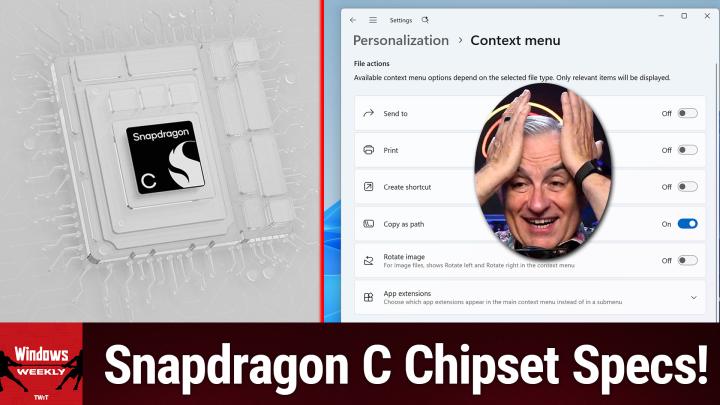
And it looks pretty good, and that's fine. But the bigger deal to me is that this thing has a settings page now, which it never had ever, um, for the context menu. I've never seen such a thing. It looks a lot like the settings page you have in the new Notepad, if you're familiar with that. So it's kind of a list of the actions you can take and other options, and then you can turn them all on or off. So you can actually customize this thing for the first time, um, using a, like a formal UI that Microsoft provides. So I feel like there's going to be more work on this, if that makes sense. Um, I don't— I'm curious about one of these things.
Paul Thurrott [00:07:48]:
So one of the options in here is keep cloud storage actions in their own section, right? So of course OneDrive, there's just a OneDrive option. Right. And then a submenu off of that. So I'm just going to go and see what it looks like on my computer here. And it doesn't look like anything. So let me go and find a file and choose a file anywhere. Yeah.
Richard Campbell [00:08:09]:
Okay.
Paul Thurrott [00:08:09]:
Yeah, no, actually that's already there. So I'm not sure, not sure what that changes, but one of the issues I run into if I use Synology Drive or if I use Google Drive is that those apps add to that context menu, but they don't appear in the default Windows 11 context menu. So if I want to see those options, I have to choose show more options at the bottom. And then it brings up the Windows 10 style menu and then you see those options there. So it's kind of an additional step, but I, I'm wondering if they won't be able to, um, add themselves to this thing. So instead of just OneDrive, you would see Google Drive, Synology Drive, whatever you have, Box, you know?
Leo Laporte [00:08:46]:
That'd be interesting.
Richard Campbell [00:08:47]:
Yeah.
Paul Thurrott [00:08:47]:
Yeah. So that's kind of interesting. Um, but to me anyway, the big deal here is that this is customizable at all. Like it's actually kind of, it's pretty good. So that's good. So if there's stuff like you never use, like Send To or Print, Create Shortcut, right? These are things most people probably never use. Um, you can just get rid of them. They won't be in the menu anymore.
Paul Thurrott [00:09:07]:
So that's, that's pretty good. You know, this is not a—
Richard Campbell [00:09:10]:
Yeah. Now, now let's add some smart. So if it notices you haven't ever used that, it just sort of takes it away.
Paul Thurrott [00:09:16]:
Yeah. I, right, right. That's like the, the, yeah, the old Office, actually, uh, Windows 2000, I think had menus like that. And, uh, Office whatever, probably 2000 whatever version, did that briefly. Of course, taking away UI on the fly is kind of a dicey prospect, you know. Oh sure, if you have like mainstream users, they'd be like, ah, what if you put it into it?
Richard Campbell [00:09:36]:
You put it into a faded state where it's like, you know, well, it's like Marty McFly, like you're disappearing as you—
Paul Thurrott [00:09:43]:
It's like, you better click it or it's going away.
Richard Campbell [00:09:45]:
Yeah, either click this or it'll fade away. I mean, you can put it back. It's underneath the other menu, but it's gonna fade off this one 'cause you're just not using it. Yep.
Paul Thurrott [00:09:54]:
So I don't, I don't know what to say to that. I, I, I, I just, I feel like Microsoft has tried, not necessarily in this exact UI, but over the years in Windows and in Office to come up with those kinds of things. Like how do we make something complex simpler? How do we expose options when you need 'em? How do you, you know, do we give like power users the option just to put everything up there so you see everything, et cetera, et cetera. Um, I don't know what the best approach is, honestly. They've moved, they've kind of ping-ponged from thing to thing, but, um, I do, I just like the look of this. Um, and we'll see where it goes, but I like the look of this, um, uh, customization screen, the settings, uh, pane as they call it.
Richard Campbell [00:10:30]:
Um, you like the cut of its jib.
Paul Thurrott [00:10:32]:
Yeah, there you go. Um, I, I looked through each of the release notes for the 5 different builds that they have. Released, right? And there's little things in there, like in experimental, I think there's like a camera roll backup setting now that's kind of interesting or whatever. But honestly, the, the other big thing in here to me is they're getting rid of Drag Tray. So, which is just one of the worst interfaces ever designed. So what I bring up—
Richard Campbell [00:10:59]:
Nobody ever used it, right?
Paul Thurrott [00:11:00]:
I don't think anyone even knew it was there, you know, to be honest. But I, but when it does come up, I, it's one of those things that just annoys instantly. So The thing people have seen is there's a snap feature where you drag a window and as you start to move it around, like that little pane comes down from the top. I hate that thing so much. So, but I hate it because when I go to position something precisely near the top of the screen, it gets in the way and it will snag the mouse cursor and then the thing snapped. It's like, I didn't want that. I'm trying to, you know, move it into some precise thing. So I don't need that feature.
Paul Thurrott [00:11:32]:
I disable it.
Leo Laporte [00:11:33]:
Right.
Paul Thurrott [00:11:33]:
I like that you can disable it. I mean, that's a nice thing. So doing this, like having to deal with this over whatever number of years, they introduced this feature called Drag Tray, which initially was called Drop Tray. And Drop Tray is, does that, but for files. So like it's not appearing on the screen. I must've already turned it off. You could turn this off too, but, um, the way it works.
Richard Campbell [00:11:54]:
Yeah.
Paul Thurrott [00:11:54]:
So the way it works is just like Snap, but instead of dragging a window, you drag a file. And if you do that, Mm-hmm. Same thing, like you get a little pane thing that appears. If you bring it up to that, you get a, like a, I guess it's a row of icons that are share icons. One of them would let you go to the normal share pane, right, that we've had since, well, since Windows 8 when it was in fact actually a pane, but the share window or whatever. They have updated it several times because everyone who did see it and used it hated it and complained about it. They changed the name. Right.
Paul Thurrott [00:12:27]:
Like I said, from, uh, it was Drop Tray, I think was the initial, and then Drag Tray is the name, whatever. But in, in each of these builds, there's a note that says, thank you to everyone who provided feedback about the Drag Tray experience. Based on that feedback, we're removing this experience.
Richard Campbell [00:12:42]:
Um, yeah.
Paul Thurrott [00:12:42]:
Like they're like, thank you and get lost. Yeah. It's like, uh, we get it. You hate it. And, and it's like, I, I will say one of the things they added, I mean, the initial release of it, other aside from having a different name, You couldn't remove it, which was something you could do with that Snap feature. So they added the ability to remove it, and I think everyone removed it. I'm sure they could see through telemetry. They're like, this has a 100% success rate.
Paul Thurrott [00:13:04]:
Everyone is removing it. Um, and then people hated it, so they're getting rid of it. So, um, unfortunately they're still screwing with it. So they're like, we're looking forward to sharing more information about a future replacement experience in a later update. And it's like, why do you just not do this? Nobody needs this, like ever. Like, this is the dumbest thing. Sharing in Windows is something I feel like almost no one ever uses. I use it with myself, meaning I use nearby sharing to share files from one computer to another, which is a nice way to bypass all the stupid home networking problems we have in Windows these days.
Paul Thurrott [00:13:38]:
But, um, as far as like, we, I think we use share a lot on phones, right? Because that's a standard interface on phones, which is why Windows has it. And I, I also use it to, well, it's not the same interface, but, um, if you use something like Instapaper or, um, some other read, read it later type interface, I mean, that's sort of the same thing. Like you're—
Leo Laporte [00:13:59]:
I think Instapaper's gone. I may be wrong.
Paul Thurrott [00:14:01]:
No, it's not gone.
Leo Laporte [00:14:02]:
It's not?
Paul Thurrott [00:14:02]:
No, I think you're thinking of Pocket.
Leo Laporte [00:14:04]:
Pocket's gone.
Paul Thurrott [00:14:05]:
Yeah, Pocket's gone. Which is why I know this, because I was using that. Now I use Instapaper, even though Instapaper might predate Pocket. Both of those were around.
Leo Laporte [00:14:13]:
It feels like both are relics of the early 2000s.
Richard Campbell [00:14:15]:
They are. Yeah, they are.
Paul Thurrott [00:14:17]:
But you know what?
Richard Campbell [00:14:17]:
Web 2 world, right?
Paul Thurrott [00:14:19]:
Yeah, I honestly though, um, Instapaper is updated pretty regularly. They— if you use an iPhone, it's beautiful now on iPhone. Like, they've done a nice job with it. Um, I use it on desktop and mobile, but, um, that is how I, you know, do read later. It's— it works good, but it's sort of like a share type interface if you think about it.
Leo Laporte [00:14:36]:
Yeah, I do like Raindrop, and that has a lot of bookmarking tools have, uh, kind of read it later stuff, but not as good as Instapaper.
Paul Thurrott [00:14:45]:
I mean, I'm not that— I don't know, but I, I— but whatever, it works, it's fine. Uh, it's free, you know. Um, but you know, Windows, like, for all the experiments of like, let's make Windows work a little bit more like a mobile platform because people are used to smartphones and everything, like, I sort of get it, but I just don't— people aren't sharing, you know.
Richard Campbell [00:15:04]:
Right.
Paul Thurrott [00:15:05]:
We're not, we're not doing that. That's not the activity. I'm not, I'm not on, you know, Insta, like Facebook, and do it like on my computer. Like, that's— I don't know, I don't feel like a lot of people aren't, but Anyway, it's just a different thing. I, I'm glad they got rid of it, um, or, or get in the process of getting rid of it. So that's good. Um, and then previous to this, I think this was late, late, this could have been Friday, uh, late Friday, probably knowing Microsoft, but they also released 3 builds to the, uh, release preview, um, channel channels really. Right.
Richard Campbell [00:15:35]:
Uh, yeah.
Paul Thurrott [00:15:36]:
So there's 2 different builds for 24 and 25H2, but with the same features, right? 'Cause that's the way those things work. And then there's one for 26H1, which is a month behind because that's how that thing works. And these are previews of what we're gonna see in Week D, which I believe, bum, bum, bum. Yep. And it's next Tuesday. And then also in Patch Tuesday for September, which is this September 8th. And this is a big one. So we've had a couple of big months.
Paul Thurrott [00:16:03]:
We've had several kind of small months for feature updates, uh, this year. This is the big one. And the timing is interesting. In fact, the timing is so interesting, I'm kind of wondering if that September Patch Tuesday thing won't be a preview release so that this becomes 26H2 in October, which is the kind of normal schedule. But then again, everything's up in the air, so it's kind of hard to say. Um, but what do I mean by this? So this is the new taskbar, this is the new Start menu, this is the new Windows Search, right?
Richard Campbell [00:16:34]:
Um, is this starting to find like a new Windows? Like this might—
Paul Thurrott [00:16:37]:
yeah, like this.
Richard Campbell [00:16:37]:
And then call this Windows 12.
Paul Thurrott [00:16:39]:
Right.
Richard Campbell [00:16:39]:
At some point.
Leo Laporte [00:16:40]:
Yep.
Paul Thurrott [00:16:41]:
I mean, look, I really, I like that they're touching interfaces they have not touched in a while. I like that they're improving interfaces.
Richard Campbell [00:16:50]:
That says is that we're willing to poke at this code.
Paul Thurrott [00:16:53]:
Yeah. Right. Okay. I was like joking for a second.
Richard Campbell [00:16:55]:
Years. Right.
Paul Thurrott [00:16:56]:
That's what I mean. Like there are things we have not discussed. Um, and they're, they're just kind of small. So it's kind of a weird thing to like even talk about, but things like the run dialog, right. Which no one uses, although I bet In this audience, a higher percentage than the normal population does. I use it all the time. Um, the print, uh, dialogs, right? The sub-windows that appear still in Settings that are still the old style Windows 8.
Richard Campbell [00:17:19]:
They're still the old Control Panel.
Leo Laporte [00:17:20]:
Yeah.
Richard Campbell [00:17:21]:
The MSCs.
Leo Laporte [00:17:22]:
Yeah.
Paul Thurrott [00:17:23]:
You see, I didn't, I don't know when this happened. And this is, this kind of, this says something because I feel like I, I mean, I, I did write a book about Windows, but Um, I have to install fonts every time I bring up a new computer.
Leo Laporte [00:17:36]:
Sure.
Paul Thurrott [00:17:36]:
And you used to— what by used to, I mean for the past 30 years, probably 20 years anyway, you could select one or more font files, right-click and choose install. So the other day I'm doing this, it doesn't, it's not there. And I'm like, uh, that's kind of weird. So I was like, well, maybe I'm missing something. So I tried, like, I'll just try one font file and it wasn't there. I'm like, okay, what's going on? So I know that there is a, there's a fonts interface that is in the control panel. I have vague understanding that there is a fonts interface in the settings app, but I'm like, I will just go to start. You can all try this for yourself at home if you'd like, type in fonts and see what comes up.
Paul Thurrott [00:18:15]:
Right. And on this computer, the, well, this is probably every computer. The best match is fonts and it says control panel. So you click on it and you're thinking, well, the control panel's gonna start. No, it does not. The settings app comes up.
Leo Laporte [00:18:26]:
Mm-hmm.
Paul Thurrott [00:18:27]:
With, uh, personalization fonts. And it says fonts control panel is being redirected here to access the legacy interface. Click this link. And that tells me this is probably gonna go away, right? They're, they're, they have a modern interface for this. So I'm not saying I've never seen this because that would make me look like an idiot, but I am saying I've never seen this. And you can drag the files from Explorer into this thing. You drop it, right? Um, and then it takes like, you know, half an hour to install for some reason, but it works. And so this is like a, just a small modern UI that will not impact most people.
Paul Thurrott [00:19:03]:
Most people would never install a font. Why would you ever have to do this? And, but they're touching, like they're, they're, they're like screwing with it like that. That is amazing to me. There's a lot of stuff like that. So, you know, Mm-hmm. Taskbar Start Menu search. That's a lot of news. And those are dangerous to touch because those are high-profile, highly used interfaces, literally a billion people every day.
Paul Thurrott [00:19:28]:
You screw with those things and you make a mistake, it's bad, you know?
Richard Campbell [00:19:32]:
Yeah.
Paul Thurrott [00:19:32]:
So it's impressive they're doing that. But honestly, it's the fit and finish stuff. If you force me to say like, what's the primary difference between like Windows and the Mac or Microsoft and Apple when it comes to user interface design or user experience design? There's a bunch of stuff I'd probably throw out there, but one of the big ones to me is that Apple has a way of throwing away old stuff and just having like a way to do things. And it's modern to the time. Microsoft does not do that. Microsoft typically has multiple ways to do things, but also has multiple layers of like almost archaeological interfaces that date back. The fonts interface in Windows in the control panel dates back literally to Windows 95.
Richard Campbell [00:20:10]:
There are.
Paul Thurrott [00:20:11]:
Interfaces in Windows today that are 30 years old, you know, and they're— I'm not— I'm wondering aloud, I'm not saying they are, but are they going to actually fix this problem?
Leo Laporte [00:20:23]:
This is—
Paul Thurrott [00:20:24]:
I would have bet money that they would never fix this problem, let alone tackle it at all. I know.
Richard Campbell [00:20:30]:
I don't know, it seems like everything— Pavan kind of opened the doors to all of this, right?
Paul Thurrott [00:20:35]:
Right.
Richard Campbell [00:20:36]:
Yep. I just wonder Well, I wonder who, you know, who he's let loose. Like, who's, who's— so who's the Kevin Gallo in this? Who's running around?
Paul Thurrott [00:20:45]:
Yeah, this is the— these are the jobs or the tasks that are, generally speaking, thankless, right? Um, if you like, if you like, if I were to write an article about, uh, my— and I say this kind of thing a lot— Microsoft fixes some feature in the new Outlook which everyone hates. Or Microsoft adds some feature that was missing in the new Outlook or whatever it is. Invariably, someone will come up and say, yeah, but what about... and then dot, dot, dot, because there's this laundry list of stuff that's wrong with the new Outlook that everyone hates. And that's me. But imagine what it's like for Microsoft. So Microsoft goes out publicly on Twitter or wherever they are and they're like, hey, we're actually serious about fixing Windows. We're doing this stuff.
Paul Thurrott [00:21:27]:
They make the stupid mistake of saying, if you have any feedback, we'd love to hear it. And they're like, oh, we have feedback.
Richard Campbell [00:21:31]:
Here it comes.
Paul Thurrott [00:21:33]:
And unlike Windows 10, Windows 8, the, the feedback doesn't go into a trash basket. It actually— someone is reading them and someone's acting on them, and they're, they're triaging these things. And I think they're assigning them some sort of a weight or a, um, uh, you know, what are we going to do first or whatever. And you're like, okay, but at some point they're going to hit all of the, you know, the top 10 big things or something.
Leo Laporte [00:21:56]:
Yeah.
Paul Thurrott [00:21:57]:
And of course this is gonna Um, so it's gonna, you know, it's gonna fade away and like eventually they're gonna be like, mission accomplished, we're done. And look, God love you, you did what you did, but they keep adding stuff. Like, I'm, I'm actually kind of blown away by this because the, the— you can come up with very cynical reasons for why Microsoft is fixing the pain points in Windows 11 all of a sudden. Like, these things are not new complaints. We've been talking about this stuff for years, but now they're doing it. Yeah.
Richard Campbell [00:22:24]:
Yeah.
Paul Thurrott [00:22:24]:
But, but to keep doing it, right, to, to keep going— I— this is, this is the thing I always say is anyone can start a blog, anyone can start a YouTube channel, anyone can start a podcast. The trick is to keep doing that thing, you know?
Leo Laporte [00:22:39]:
Yeah.
Paul Thurrott [00:22:39]:
You know, Richard's been doing whatever, podcasts for over 20 years. Twit, same thing. And people start podcasts every day, they make 3 episodes and they're done. And that usually is how Microsoft does stuff with Windows. Not to be a jerk about it, but I mean, there's a lot of good intention and then the energy fades and we're done. And I, so I don't know what to tell you. This is good.
Richard Campbell [00:23:01]:
I just get it. I get a sense that Pepin has enabled certain engineers to deal with stuff that just hasn't been on the priority list for a long time. And the priorities have sort of shifted around.
Paul Thurrott [00:23:11]:
Right.
Richard Campbell [00:23:11]:
And maybe he's noticed what it's done to the team.
Paul Thurrott [00:23:14]:
Yes. Oh yeah. I think there's a lot of energy there. And yeah, I also like, look, we're on the outside, right? So we can look at some stupid thing in Windows and be, God, how do you— does anyone use this thing? Why would you put this here? Or why is this not working correctly? Whatever it is. But those guys are in Microsoft too, right? Guys and gals. I don't mean men, but like people, those people, there are people internal to Microsoft who have been complaining about this stuff for the same amount of time, for the same reasons, right?
Richard Campbell [00:23:40]:
Yeah.
Paul Thurrott [00:23:40]:
And I think it says a lot about the state of Windows at any point in time where you had to know there were a lot of complaints. Internal and external, and no one did a thing about any of them. Right. But now they're doing it. And so now those people who were complaining are like, nice, I would like to get involved. I want to see this thing be as good as it can be. You know, like the Scott Hanselmans of the world are involved.
Richard Campbell [00:24:03]:
Yeah. I just wonder if he's pulled a bunch of not well-known, but obviously important engineers back into the loop. Like, remember that thing you always wanted to fix? Now's the time.
Paul Thurrott [00:24:13]:
Now's your chance. Right. We're looking for people who actually know how this stuff works. We know you're out there. We know you've been scattered to the winds, but come back home. We're working on the thing. It's kind of exciting. I mean, it's nice.
Richard Campbell [00:24:26]:
Well, and again, I've certainly had the conversations where there was a lot of pressure to get the Windows team thinking you're not the center of the company anymore.
Paul Thurrott [00:24:36]:
Right.
Richard Campbell [00:24:37]:
The center of the company is over here in Azure. And maybe that's finally passed. Maybe it's like, okay, now, now we all get it. Now what kind of Windows did you wanna make? 'Cause in, 'cause the other side of not being the center of the company anymore is you're a little freer to do stuff.
Paul Thurrott [00:24:54]:
That's right. That's true. Right. That's a good point. And look, I, I, uh, Microsoft diversified. I mean, you know, we, you know, we got Server, we got Office and Microsoft 365. And that happened. You're like, okay, but Windows is a big central part of that.
Paul Thurrott [00:25:07]:
And then we go to the cloud and it's like, uh, boy. We're not really part of that. And now we're doing AI. And yeah, we are sort of part of that. We're more a part of that than we were of the cloud. But, but enough time has gone by. And I think the, the end— look, Microsoft is, we're gonna talk about more about their, my, in my, my new weekly segment on their finances, um, you know, is a far bigger and more diverse company than it's ever been.
Richard Campbell [00:25:33]:
Mm-hmm.
Paul Thurrott [00:25:34]:
And so, I look, if the last few years of layoffs and upheavals and AI nonsense and whatever else hasn't, you know, uh, driven that message home, I, you know, I, then you shouldn't be there anymore anyway. But, um, I'm sure that's for everybody. So I think we get it. Like, I think at this point we're like, we get it, you know?
Richard Campbell [00:25:53]:
Yeah, yeah, yeah. So, well, and it's like you said, you have now this freedom to do this and then you, you just sort of float and it sounds super cliché, but it's like, what would you have to do to make Windows awesome? Like not just angering.
Paul Thurrott [00:26:06]:
Right, right.
Richard Campbell [00:26:09]:
I don't know that they're there. I think they're just trying to reduce the anger. Yeah.
Paul Thurrott [00:26:12]:
And, and I think there are things that will happen in phases because they're complicated. For example, the Start menu, right? So one of the things that came up pretty early on in this discussion about pain points, so back in whatever that was, February, is this notion that we want to move as much as we can over to the modern WinUI 3 user experience. Okay. But we also want to fix the performance of key interfaces like Start and the taskbar and widgets and whatever else. And you're like, yeah, but, but those things, but WinUI makes things slower. Like these 2 things seem like they're contrary goals. Like it doesn't seem to me that by making everything WinUI 3, you're going to make anything faster. It's, you know.
Richard Campbell [00:26:55]:
Yeah.
Paul Thurrott [00:26:55]:
But, but they're also doing work on WinUI 3, which has been an on-again, off-again thing for ever since it existed, right? Since Project Reunion became the Windows App SDK. And, you know, we kind of call it just WinUI 3 now, although that's only a component of it, but whatever.
Richard Campbell [00:27:10]:
Yeah.
Paul Thurrott [00:27:11]:
It's complicated stuff. It doesn't seem like this was a priority for anybody. The people who did come in briefly to try and fix it were by themselves and it could do nothing. But now it's like the Windows team is actually looking at that stuff. So—
Richard Campbell [00:27:25]:
Sure.
Paul Thurrott [00:27:25]:
You're gonna see further improvements.
Richard Campbell [00:27:26]:
I just hope that they've got some relationship with the broader UX teams at Microsoft, with the folks that build the dev tools and things as well, because that's also been a problem where the Windows team did their own UX stuff totally isolated from everyone else.
Leo Laporte [00:27:40]:
Right, right.
Paul Thurrott [00:27:42]:
So I think that—
Richard Campbell [00:27:43]:
One step at a time, owning the UX problem, because when they didn't own it, it was worse.
Paul Thurrott [00:27:48]:
Right.
Richard Campbell [00:27:48]:
That's a pro— is progress, that there's more steps that could be taken.
Paul Thurrott [00:27:52]:
Yep. So I, you know, I, I, I'm uncomfortable with you being positive here. Yeah. So I was just gonna, I was gonna say, who is this guy? If you think it's weird for you, imagine how weird it is for me.
Richard Campbell [00:28:06]:
Yeah.
Paul Thurrott [00:28:07]:
Like, and not, not because I, I want to be super clear about this. I, I, well, in the sense that we all want to present ourselves in the best possible light. I mean, I, I, I don't—
Leo Laporte [00:28:20]:
no, I do.
Paul Thurrott [00:28:20]:
Never mind. I was going to say I don't go negative immediately. Well, because everything is usually so crappy, it's the right way to approach something in this case. Like, this is un— this is— I can't— well, let me think. Um, no, there have been times in Microsoft, you know, Windows 10 was a nice return to form after Windows 8. Like, Windows 7 was a nice return to form after Vista, which was after Longhorn, right? Um, you know, Windows 2000 was excellent. Uh, there, there were times where it was like, oh, this is nice, you know? Um, but there were, there were also long periods of time, like the whole Vista thing or the Windows 8 thing, obviously. Um, and then Windows 11 to us, well, not to a small— in some ways the, the problems in Windows 11, um, UX stuff is like UX stuff.
Paul Thurrott [00:29:01]:
But to me, the bigger problems are like the insertification stuff. And that is, that's serious. I mean, that stuff's serious.
Richard Campbell [00:29:06]:
Mm-hmm.
Paul Thurrott [00:29:07]:
Because Microsoft is selling things and trying to make money in different ways or whatever.
Leo Laporte [00:29:11]:
So that kind of stuff is gross, but Um, it's been like that for so long.
Paul Thurrott [00:29:17]:
It's weird that it's like, I'm still like, I'm dreaming, right? Like I'm going to wake up and be like, oh no, they, this is, I invented this in my brain. This is not happening. Um, you know, this is how I cope with things, but no, it's happening. Like it's, and, and it's, you know, look, I made this point twice, uh, back at the original announcement. And then when Pavan did his probably July update. Where it's like, hey, let's not forget, they're not actually addressing, I'm gonna say, 7 of the 8, like, top-level insertification things in Windows 11 that I pointed out.
Richard Campbell [00:29:48]:
Sure.
Paul Thurrott [00:29:48]:
But that doesn't mean this isn't a positive step forward, right? So like, you want to just kind of have that balance. But they're also now starting to exceed in some ways what they said they were going to do, if that makes sense. Like, they're continuing, like, the work continues because people are providing feedback. They're actually listening, which is astonishing. And, um, yeah, I mean, this is good news. Like, I don't know, right? This is what good news looks like. I'm not used to it. I, I, I think like this is—
Leo Laporte [00:30:15]:
Yeah, so puzzled.
Paul Thurrott [00:30:16]:
It's weird. Like, like, what's happening? I feel squishy inside.
Leo Laporte [00:30:20]:
Like when a baby eats a lemon.
Paul Thurrott [00:30:21]:
Yeah, yeah, yeah. It's like, I, I— what is this feeling? It was like, um, uh, I don't remember the word she used. I, I was talking about feeling good about someone else to a friend and She said, yeah, that's called— it wasn't empathy, but it was a word like that. And I was like, I've never felt this before. You know, like, I was like, I feel good for someone else. You know, it's like the opposite of schadenfreude. Like, um, anyway, it's good. So it's just, I like, you know, I like seeing it.
Leo Laporte [00:30:50]:
Let us, uh, let us pause, if you gentlemen don't mind, to, uh, hear a word from our sponsor. We've got the one. We should really stop.
Paul Thurrott [00:31:01]:
We'll beat it to death. I need to go get a drink.
Leo Laporte [00:31:05]:
Um, we'll be back with more Windows Weekly. We're gonna talk hardware in just a little bit. Is IFA coming up again?
Paul Thurrott [00:31:10]:
I can't believe— uh, September 1st, 2nd, somewhere in there.
Leo Laporte [00:31:15]:
Life is just— I know there's going to be a new iPhone in like 2 and a half weeks. My life is going— actually, it's exactly 3 weeks from today, we think. It's just going— it's like It's like faster and faster.
Richard Campbell [00:31:28]:
It might just be you.
Paul Thurrott [00:31:29]:
I think it's my age.
Leo Laporte [00:31:31]:
As you get older, you know.
Paul Thurrott [00:31:33]:
Yeah, this is the bird beating heart thing. Like, um, you really feel it. I don't know, I feel it too.
Richard Campbell [00:31:39]:
I—
Leo Laporte [00:31:39]:
yeah, Christmas comes like every other day now.
Paul Thurrott [00:31:44]:
There's too many Christmases. I didn't think you'd have too much of it.
Leo Laporte [00:31:48]:
IFA is Christmas for telecom hardware geeks. Yeah, plus you get to go to— is it Berlin?
Paul Thurrott [00:31:55]:
Berlin, yeah, which I love.
Leo Laporte [00:31:56]:
Are you gonna go?
Paul Thurrott [00:31:57]:
Yeah.
Leo Laporte [00:31:58]:
Oh, I'm so jealous.
Paul Thurrott [00:31:59]:
I love Berlin.
Leo Laporte [00:32:00]:
All right, so one of the things we're gonna see at IFA is a new Snapdragon.
Paul Thurrott [00:32:06]:
Yes, that's my guess, because, you know, Qualcomm announced the Snapdragon C probably back a couple months ago. As a response to, you know, the MacBook Neo and the rising cost of laptops and components.
Leo Laporte [00:32:24]:
And, you know, this is not a high end. This is not the—
Paul Thurrott [00:32:26]:
No, this is a $300. Yeah. And when you look at, so what they did this past week was release more information about the specifications of this chipset. And if you go through it, I mean, the thing that sticks out to me is that it looks like, it looks more like device than PC. And so what I mean by that is like slower RAM. Yeah. Okay. Um, you know, Wi-Fi 6, not 7.
Paul Thurrott [00:32:51]:
Um, but, uh, and one, one external display, right? You know, uh, at full HD with any, you know, uh, no, that's not true. I'm sorry. 4K, 60 frames a second. Um, but USB 3.1, which is 5 gigabits per second, not 40, like we see on, you know, uh, Thunderbolt 4, USB 4. And what's it called? The type of storage you see in like a phone, like not an SSD. What the hell is it called? UFS. I'm sorry, UFS storage. So it supports UFS 3.1, which is actually pretty fast, and 2.2 storage, not SSD, right? So these are all things aimed at keeping the cost down, right? That's the point of this.
Paul Thurrott [00:33:31]:
This is supposed to go into a computer that costs about $300. Historically, by which I mean forever, there has never been such thing as a sub-$500 computer that was worth a damn. Unfortunately, with the rising component prices now, um, that has edged up. I would make the argument in the PC space, like you gotta spend at least $1,000 basically to get something to, unless it's on sale or the random, you know, there's, there was that IdeaPad I pointed out a couple of months ago. Every once in a while there'd be like this one computer where it's like, okay, this thing's $800, $900. It's actually really good. Um, but this is the space that's typically been dominated, is a strong term, served by like the, what we used to call Pentium, Celeron type chips. Right.
Richard Campbell [00:34:13]:
Right.
Paul Thurrott [00:34:14]:
Um, which is Atom.
Richard Campbell [00:34:15]:
Yeah.
Paul Thurrott [00:34:16]:
Which, yeah, exactly. Which is garbage. Right. So, you know, we'll see. I, I, I do feel like if anyone can get this right, it might be Qualcomm. 'Cause you know, this Snapdragon X2, X, XX2 stuff is awesome. Um, And maybe there's a version of this, you know, I, one thing I found consistently across both generations of Snapdragon X is that even the very lowest end chipset, right? Um, is awesome. Like I, I still, one of my favorite laptops still is that, uh, HP Omnibook 5 from last summer.
Paul Thurrott [00:34:47]:
Um, which at that time you could get for like $600. It's like probably $800 or $850 today. But, um, the lowest end first gen Snapdragon chip, like not Snapdragon, it wasn't even called, no, I'm sorry. It was called X.
Richard Campbell [00:34:57]:
X.
Paul Thurrott [00:34:58]:
So they used to have like X Plus and X Elite, but this was just X, you know, it's like half a core, you know, whatever. But, um, no, it was awesome. Like it's, that's an awesome computer and it's, you know, fascinating when something low-end can work well. So, uh, we'll see. But they, so they released some more specs. Uh, they did not talk about IFA, but my guess is given the timing, um, this would be when. computer makers would want to announce these products. Now, back to school is occurring as we speak, right? And in some ways you could argue it's winding down.
Paul Thurrott [00:35:30]:
So it's, it's somewhat curious to me that this couldn't happen more quickly, but I can't believe they're going to wait beyond IFA for this, right? Like you want to get the stuff out there. So, um, we'll see. We'll see. I, I think this, um, uh, the inherent kind of efficiency, reliability, blah, blah, blah, whatever that is. that they've done on Snapdragon is going to help here, um, where the Intel stuff was just always coming from the wrong place. And, uh, you know, they were just never going to serve this market correctly. So we'll see, we'll see what happens. There is that.
Leo Laporte [00:36:07]:
Are we due for a new high-end, like an Elite 3 or whatever?
Paul Thurrott [00:36:11]:
No, no, no.
Richard Campbell [00:36:13]:
I—
Paul Thurrott [00:36:14]:
the, the X2 stuff just started rolling out Oh, it wasn't quite mid-year, but it was in the spring.
Leo Laporte [00:36:20]:
Yeah.
Paul Thurrott [00:36:21]:
Yeah. And who knows? I mean, that doesn't mean they couldn't announce, you know, more X2 chips of some kinds. I, but I've never heard anything about that. So I'm not really sure what to say there.
Leo Laporte [00:36:32]:
We're pretty happy with this though, right? I feel like Apple is moving rapidly. They do a new M series every year.
Paul Thurrott [00:36:40]:
Yeah. But, you know, this year they're dropping all the variants, right? They're going to do like a base M6.
Leo Laporte [00:36:46]:
Yeah, well, what they— it's actually, it's really interesting to me as somebody who uses AI. I mean, the problem— Here we go. You're not going to get an amen.
Paul Thurrott [00:36:55]:
As somebody who uses AI. As somebody who kind of likes it. I would never not use AI, but if I were to do that, well, I would recommend—
Leo Laporte [00:37:04]:
The reasoning I hear is that the M7, because they saw all the demand for these Macs for it locally. The M7 is going to be highly optimized for running AI, right? So they thought, well, let's— we'll put out a couple of things with M6, but let's not spend a lot of energy on it.
Paul Thurrott [00:37:22]:
It's crazy because honestly you can make the argument that M— M-whatever, right?
Leo Laporte [00:37:27]:
I'm using an M4 Pro and I happen to have stupidly a year ago bought a 64GB Mac Mini.
Paul Thurrott [00:37:34]:
Well, of course, you know what though, but I, but I think that's gonna have legs. Like, I The M1 MacBook Air and Pro last, you know, they're still going strong. Like the, um, I feel if you have like an M2, M3 or whatever Mac Mini, those things are probably great for AI, right? So they're, they're in a good place. I mean, they can kind of afford to do this. I think this is an area where the PC actually has to—
Richard Campbell [00:37:57]:
Yeah, I think it's tricky to optimize when things are changing so quickly. Like that's a big commit on the hardware side.
Leo Laporte [00:38:02]:
You're shooting, you're putting, shooting way ahead of the puck.
Richard Campbell [00:38:05]:
Yeah.
Leo Laporte [00:38:06]:
Yeah, yeah. Who knows what next year is going to bring?
Paul Thurrott [00:38:08]:
Yeah. Well, but Apple—
Richard Campbell [00:38:09]:
so I mean, look, last time I looked, Wayne Gretzky just went off the board, right? Tim Cook just took a nap. So I hope the new guy's got a good aim.
Leo Laporte [00:38:16]:
Never mention hockey when there's a Canadian in the house.
Paul Thurrott [00:38:19]:
I was like, so I, I just experienced what I think my wife experiences when I talk about technology, because I have no idea what you just said.
Richard Campbell [00:38:27]:
And like, Wayne Gretzky— I heard Wayne Gretzky quoted as saying No, I got that. Where the puck's gonna be.
Paul Thurrott [00:38:33]:
No, I know. I, that, that I do know. Okay. But then you, that whatever you just said though, I was like, what? Did something happen to Ray and Gretzky? I was like, I don't know what's happening. I don't, I'm sorry.
Leo Laporte [00:38:44]:
It's just not— Uh, nevertheless, I think the point is this, uh, AI stuff is moving more quickly than any technology we've ever seen. And, uh, sure. Maybe, I don't know. Yeah.
Richard Campbell [00:38:54]:
It's like, what is optimized hardware?
Leo Laporte [00:38:55]:
The Kinect on the Xbox is probably the only comparable technology that's that's grown as fast.
Richard Campbell [00:39:01]:
And, uh, yeah, I mean, boy, it fizzled fast, didn't it?
Leo Laporte [00:39:05]:
Boy, I don't think AI is going to fizzle quite as fast as Xbox.
Paul Thurrott [00:39:07]:
It's like when you do a, uh, like a firework and it's briefly excellent, then it goes, it just falls apart.
Leo Laporte [00:39:13]:
Like, yeah, you're like, oh, there are people who hope that will happen to AI as well. Uh, yeah. So, but I, but I also see Apple as seeing, you know, they missed, they missed enterprise completely, right?
Richard Campbell [00:39:25]:
Uh, well, they tried a couple of times, but it's not in their nature. They also recognized who they were.
Leo Laporte [00:39:30]:
Right. And but they— and then they chased the creator, you know, the professional creator.
Paul Thurrott [00:39:34]:
As they should, you know.
Leo Laporte [00:39:36]:
But that kind of— that, that only sold like a few dozen max.
Paul Thurrott [00:39:39]:
No, you know what, you know what it is?
Richard Campbell [00:39:41]:
I—
Paul Thurrott [00:39:41]:
this is, uh, there is something to this because Apple, because they have had so many generations of mobile chips, because they were very early on. Yeah, Google did the same thing. Google just doesn't have a full desktop OS thing yet, right? They're working on that sort of, but But because of this, because of, they recognized early on, we have a phone where battery life is paramount. We wanna do something related to computational photography maybe, or whatever it might be. And we, they, they've been doing this for years so that when they bring this over to the desktop, that stuff's just there. So I feel like they weren't optimizing for the use cases people are using today for AI on Mac Minis or whatever they're using. But the reason people are using those things is because that work was done and Those things in that way are ahead in ways that I don't think we understand in the PC space because this has just never been a priority. You know, you're like, we're trying to jam MPUs down people's throats now and ignoring the GPUs that people already have, which by the way is insanity.
Leo Laporte [00:40:39]:
And I bought a 3090 to replace an RTX 3070, and I can run the latest Quen that everybody's raving about.
Richard Campbell [00:40:48]:
Yeah, but you know, this is The difference, I imagine, is the big thing.
Paul Thurrott [00:40:51]:
Yeah, but you can't use Co-Creator in Paint to make a picture of a turtle. So, you know, I, I don't know what you're talking about, Leo, but like, no, it's, it's like stupid how we've constrained the, like, Windows in this way, right? Like, we have these features in Copilot+ PCs that could easily be run.
Leo Laporte [00:41:09]:
It really has flipped because the Mac was the laggard in the business space and all this stuff. You never got any of this stuff, right, ever. And then all of a sudden now Windows is the laggard when it comes to AI. And I think—
Richard Campbell [00:41:20]:
I tell you that the latest SM120 drivers for my 5080, I did a transcript of a 30-minute podcast in 30 seconds.
Leo Laporte [00:41:30]:
It's amazing, huh?
Paul Thurrott [00:41:31]:
So I can explain— I can explain what you said.
Leo Laporte [00:41:34]:
What are you using for the model?
Richard Campbell [00:41:35]:
That was for the faster Whisper. Yeah.
Leo Laporte [00:41:36]:
Yeah. I use Whisper Large now. I just by accident said something in Chinese and it translated it. I thought, wow, that's kind of unusual. Then I tried French, it translated that.
Paul Thurrott [00:41:49]:
You've brought up so many things in my brain. So Leo, what you just said is explainable, right? So Apple was never able to get into the enterprise explicitly. They've had some success there just by virtue of the fact that C-level people are like, look, I want a MacBook, make it work.
Leo Laporte [00:42:01]:
Yeah, yeah.
Paul Thurrott [00:42:02]:
Or whatever, or an iPhone or an iPad, whatever it is, right?
Leo Laporte [00:42:04]:
So that— An iPhone has been a wedge. You're absolutely right. BYOD changed things a little bit.
Richard Campbell [00:42:08]:
But okay.
Paul Thurrott [00:42:09]:
But Microsoft meanwhile has— and this is Microsoft and Intel are both explained by the fact that the big part of this market, which is enterprise, is slow-moving and resistant to change. They want things that they know and understand. And they, you know, you throw like a Snapdragon something at them, you throw something with an NPU at them and they're like, yeah, we don't care. This is not anything we like, we know about. So the thing that made, you know, uh, Apple unsuccessful in the enterprise helped them to be successful in this new thing because— It's the, the status quo that we have in the PC space is what is holding back AI in the PC space.
Leo Laporte [00:42:47]:
That's almost canon in the business world that— well, I use— I often think about cell phones. Because the United States invented cell phones, we had a lot of legacy technology. And so—
Richard Campbell [00:42:58]:
Hey, that's, that's your whole electrical grid.
Leo Laporte [00:43:00]:
Yeah, we, we were behind, right, countries that had no— they had no landlines, no nothing. And now cell phones are everywhere and it's a dominant technology there. We just got to SMS 10 years after everybody else. You know, I mean, this was years ago, but—
Paul Thurrott [00:43:16]:
I had to pause on this because we went away, but I had gotten like Google has a new smart speaker, right? So it's Gemini now instead of Google Assistant or whatever. Right. And the primary difference here being you have to actually pay to get all the good stuff and B, you can have a conversation with it, which you have to pay for, but whatever. So it's a conversational model, not just ask question, get an answer kind of thing. Okay, fine. Um, I read, I don't know if this is the New York Times, it might've been the Wirecutter, which is part of the New York Times, or it might've been somewhere else. But there was this excellent, just like, it was like, this thing sucks. And it was like, it said, I asked a question, it had no idea what I was talking.
Paul Thurrott [00:43:50]:
It kept getting things wrong. I would correct it. It wouldn't listen to me. And then she's like, I don't really like the third instance of this. She's like, no, listen to me. It's this. And then it just started talking in Chinese. She's like, I give up.
Paul Thurrott [00:44:05]:
She's like, I'm done. Like, I'm out. Like, I just—
Leo Laporte [00:44:09]:
nope. That's hysterical.
Paul Thurrott [00:44:11]:
Unbelievable. Just the most excellent thing I've ever read, like, from a, like, a tech review kind of thing. Just started talking shady. You're like, I give up. I don't— I guess we're not talking anymore. Like, how? How about— you're like, what is— what the hell is happening? Yeah, like, it's just beautiful. I love that. So I, I wish I could remember where it was, but it was really funny.
Leo Laporte [00:44:30]:
Very funny.
Paul Thurrott [00:44:31]:
It's worth If you could find it.
Leo Laporte [00:44:32]:
It sounds like either Victoria Song or Jennifer Pettis and Tui, both of them.
Paul Thurrott [00:44:36]:
It was a woman. Um, and that shouldn't help you find it, but it was a woman. I did. Yeah, I did see that. It was just excellent. Like, it was really well done. Yeah. Um, speaking of Google.
Paul Thurrott [00:44:46]:
Yes.
Leo Laporte [00:44:47]:
Jeff Jarvis is gonna get just so excited later today when you tell him this good news.
Paul Thurrott [00:44:53]:
I mean, I am, I'm interested. I mean, I guess the whole Google— well, the Chromebook thing has always been vaguely fascinating to me. It never took off I think with individuals and certainly not with businesses like I kind of thought it might. Um, they did that, uh, Chromebook Plus, I think it's called. Yeah. Plus a couple years ago. I'm like, okay, interesting. It's still, you know, they're, it's kind of like the Copilot Plus PC of that space.
Paul Thurrott [00:45:15]:
It's just like, eh, like whatever.
Richard Campbell [00:45:16]:
Hmm.
Paul Thurrott [00:45:17]:
So now they're rebranding Chromebooks as Pixelbooks or Google Books. Sorry. Um, we're hoping for a Pixelbook, but, um, and they're having an, they've, I've not been invited to this, but I guess sometime in mid-September in New York City. They're going to have an event with the press. So Laurent, you know, the guy who writes news for me, wrote this thing up. I got a— I got an email from their PR department that was like, just to be clear, we're not announcing anything on that day. That's the day we're— so in other words, what they're having is like a reviewer's workshop that day.
Richard Campbell [00:45:51]:
Right.
Paul Thurrott [00:45:51]:
And then I guess they'll be able to write about it in a week or two after that, whenever And I'm like, okay. She's like, really appreciate it if you could like fix that. And I was like, look, you didn't invite us to this event. I don't know what you wanted us to get out of this. It's like, whatever.
Richard Campbell [00:46:05]:
Yeah.
Paul Thurrott [00:46:06]:
But anyway, I, there, this is not the day of a Google Book public announcement. It's the day that media is gonna get to see probably the new Chromebooks from whatever the companies are, like ASUS, Acer, Lenovo, HP, whatever. Dell, I'm sure is in there. Um, and maybe learn more about the platform, right? We know it's— and it's basically desktop Android, right? So, you know, I'm vaguely— I'm interested. I mean, I— the idea of a simple-ish mobile platform kind of graduating up to desktop class to some degree is always sort of interesting. So we'll see if they can pull that one off. Um, I don't know.
Leo Laporte [00:46:42]:
Are you gonna go?
Paul Thurrott [00:46:44]:
No, I wasn't invited. Um, so I don't like—
Leo Laporte [00:46:47]:
Where's the Pixelbook reviewer in these Yeah, I don't know.
Paul Thurrott [00:46:50]:
Well, I mean, all the Google, like the 9 to 5 Google guys or like Android Authority or like whatever those sites are.
Leo Laporte [00:46:56]:
Um, probably note they, uh, say designed for Gemini and Gemini intelligence. It's very much an AI book.
Richard Campbell [00:47:03]:
Yeah.
Leo Laporte [00:47:03]:
So, um, I wonder if it should be Chinese.
Paul Thurrott [00:47:07]:
I guess I didn't, I didn't talk about, I don't have the Pixel thing in the news, in the notes rather. But, um, so my, I, I ordered a Pixel Oh, you have the new one?
Leo Laporte [00:47:17]:
Yeah.
Paul Thurrott [00:47:17]:
So that arrived today.
Richard Campbell [00:47:18]:
The 11.
Paul Thurrott [00:47:19]:
11, sorry.
Leo Laporte [00:47:20]:
Yeah.
Paul Thurrott [00:47:20]:
So that arrived today. Um, it was supposed to arrive tomorrow, which would have been really bad timing because we're going away tomorrow. But anyway, arrived today. Nice. Um, I will say, you know, in writing that up a little bit, just like first impressions kind of thing, I went to the Google Store website to kind of— because you can compare year over year, like the 11 with the 10. And it's a sea of the same specs, right? Like it's, most of it's the same, but there are these kind of subtle differences. One of the differences, I swear to God, it says, uh, the Pixel 10 series came with Android 16 and Gemini, and the Pixel 11 series comes with Android 17 and Gemini Intelligence. And it's like, okay, whatever.
Paul Thurrott [00:48:06]:
Yeah, sure. Right. You know, like whatever. Um, but yeah, I, there's, um, I don't know yet about, I, I can't say much about almost anything honestly, but you know, there's that highlight feature which used to, was originally called Pixel Glow where it's just a, other companies have done this. You have like an LED on the back and it pulses different colors for things. So if you have, you can assign colors to your contacts and if one of them sends you a text message, like if my daughter did a, you know, her color might be purple or whatever and it would glow, like glow purple. I'm like, oh, Kelly or someone purple is, you know, messaging me. It might make me wanna pick that thing up and see what it is.
Paul Thurrott [00:48:44]:
Um, and then I think the other thing it does, what's the other one? Oh, if you're talking to Gemini, it will do like a pulsating color thing, like the Gemini animation. And, uh, yeah, I mean, that's the, that's the reason to spend $1,100 right there. Um, I don't know why you need to know anything else about this phone. Um, but there are things that are, are gonna come to other Pixels, right? No doubt. They're not talking about that. They're trying to sell devices, but. There's a bunch of new camera app features, which I think are really cool. Um, the, the best one, and I'm, I'm, I sometime today, if I can, I'm going to run out of time, but I want to put, I've already written it, but there's a thing in there called Camera Looks, which is Google's version of photographic styles on the iPhone.
Paul Thurrott [00:49:22]:
If you've ever used photographic styles, you know that this thing is a crime against humanity and that The Hague is calling and they have some questions. And it's a horrible, horrible interface. It requires you to like, A, pick a, like a kind of a color-based style, but then you use this weird grid to like precisely position with your finger, which is like the worst way to do anything precise on a grid. You know, the plus and minus, whatever values this thing is. And then if you don't set it up right, and to set it up right, you actually have to leave the camera and go into settings and find the camera app settings that are in settings, not the camera app, and tell it to remember. The settings between sessions, because if you don't, you could change that thing by mistake and you just blew away everything. I've done this many times, and I was just, um, who was telling me about this? My brother-in-law, um, got an iPhone and he's like, what the— he goes, why do all of my photos look washed out? And I said, oh, you screwed with the, the, that setting. And he's like, no, there's no way.
Paul Thurrott [00:50:22]:
But you do. It's so easy to screw it up. And if you don't have the you know, save my setting as it was originally set. It will just stay whatever, wherever you mess it up, it will just stay messed up. It is the dumbest UI ever invented. It's horrible. And I've used an Apple Watch, so there's a high bar on like horrible Apple UIs. But this is Google's version and Google's version, I swear to God, it's, it's just awesome.
Paul Thurrott [00:50:46]:
It's like you get, you get a menu, you have like 4 or 5 top-level styles. One of 'em is, um, The one I'm using is called Vanilla, which sounds like a weird name, but the top-level photographic style I use on iPhone is called Amber, and it's kind of the same thing. And then on the fly, you can just make changes to it if you want or not, and it will remember it, and it's in the app. You don't have to go somewhere else to set it, and it's just simple. Like, it's just like, yeah, like this. Like, and so Google, not world-renowned for user experiences or whatever, and Apple, who likes to pat itself on the back for everything it does. Um, somehow Google has destroyed, uh, the iPhone from a user interface perspective. I'm not— I still need to, you know, obviously Pixels take awesome photos, but I need to take more photos with this.
Paul Thurrott [00:51:29]:
But people are— I think people are focusing a little too much on the wrong thing here, which is that we have all these awesome computational photography features, right? They're— I mean, they're awesome. It's the reason why you can pick up a Pixel with these tiny sensors and— Take a picture. Awesome. But people are like, oh, but it looks like a smartphone photo. It's like, look, maybe it's a little too vibrant. Maybe it's a little too contrasty. Maybe it's this, that, whatever the thing, whatever it is. And so one of the settings in here is just called, um, I think it's the, I think it's called natural is the one.
Leo Laporte [00:51:56]:
Crappy.
Paul Thurrott [00:51:57]:
Well, it's like, it is crappy photography. Yeah. It turns down the, the processing a little bit. Right. So it's a little dull. It's not as dull as like a stock iPhone photo. Um, you know, in the sense that like Pixel has always kind of been in the middle between like iPhone and Samsung, like Samsung, super overtly vibrant, bright, whatever. Um, but now you can kind of change these things on the fly.
Paul Thurrott [00:52:18]:
And I have to say, I get it. Like I get it, you know, a decade plus of, um, computational photography and now they're turning the dials down or letting you do that. Yeah. I mean, yeah. But also I, Pixels have always taken great photos. The fact that like this will make this more, um, interesting to other, like to people who may otherwise have been like, yeah, I don't, you know, I use an iPhone because it takes terrible photos and then I can take raw shots and make it look like however I want it to look or whatever. Um, anyway, I, this is an awesome user interface. Like it's, it's, I'm sorry, awesome is so stupid.
Paul Thurrott [00:52:54]:
It's a simple interface. It's just that the, the thing on iPhone is so bad. Like it's so incredibly stupid. Um, that just by making something normal, like I want to celebrate it because it's just like calling it awesome is stupid. It's just the way it should look, like it's simple. Anyway, I— they've done a good job with that. So that's all I have to say so far. But it's lit.
Paul Thurrott [00:53:14]:
The phone is— I mean, it's basically identical.
Leo Laporte [00:53:17]:
It's, you know, that's really the number one, uh, difference I think is the photography thing.
Paul Thurrott [00:53:23]:
I think so too. Yeah, it's software stuff. And that's the thing. So if you have a 10 especially, or a 9 probably, and then depending, we'll see. But, you know, Pixel every quarter puts up Pixel Drops, and invariably a lot of those new features are things that debuted in the new phones a month or two ago, but now we're coming to other devices, right, that are already in the market. So, um, I— there's no way that other Pixels are not going to get this feature. They don't want to say that now, you know, like I said, they're trying to sell phones. But like in December, if not in December, then in March, you'll definitely— these things will all be on other Pixels, like, um, less new Pixels, um, than 11.
Paul Thurrott [00:53:59]:
But anyway, so that one, that's good. You know, that's nice.
Leo Laporte [00:54:03]:
Yeah, good.
Paul Thurrott [00:54:04]:
But the most important news of the week, and I would like to formally request that we rename the podcast to Amiga Weekly.
Leo Laporte [00:54:12]:
Okay, he's going to his roots, kids. Pretty soon it'll be all about Delphi. It's gonna be fun.
Paul Thurrott [00:54:20]:
It's Weekly with an A. Um, is— so most people probably have heard, you know, Commodore's back, right? So some YouTube guy was like, this brand has been sitting there doing nothing. Is there any way we could get this thing back?
Leo Laporte [00:54:33]:
Blah, blah, blah.
Paul Thurrott [00:54:33]:
And it was like, we, you know, it's like we freaking did it. Like, so anyway, Commodore's the thing again, right? So, but Commodore, the new company, so to speak, is, you know, they own all the trademarks and IP and all that kind of stuff. And they're putting out kind of modern versions of like legacy 8-bit computers, right? So like a C64 Ultimate, there's a C64C Ultimate now. imagine at one point we're going to see a 128, you know, whatever. Okay. That's fine. But those are not, those are not like viable computers today. You know, obviously they're like 45 years old.
Paul Thurrott [00:55:06]:
Um, but I mean, fun. I mean, it's a whole enthusiast nostalgia thing there and there's fun games and all that stuff. I get it. But like, you know, whatever. Like I saw that and I was like, okay, this is, I'm super excited. This is happening. Absolutely not buying one of these things. I just don't need this kind of thing.
Paul Thurrott [00:55:20]:
But now, uh, there's been like, so there was Commodore and Amiga, right? So when Commodore went out of business, the Amiga IP, because that was really valuable at that time, um, changed hands multiple times, right? Gateway, um, I forget, uh, Escom, is that the right name? I think Escom was one of the companies. It's gone through different things. So it's been kind of scattered to the wind. So there were companies like Clawantu, uh, Hyperion, um, Retro Games, and, and then. some company that was called Amiga something, you know, at different times. Like there was an Amiga, I think it was LTD Amiga Corp at one point, it's Corp again, you know, whatever. So it was like a guy from Cloanto and Cloanto is the company that makes Amiga Forever and C64 Forever, right? These are the emulator packages for Windows, Mac, I think Linux too. That company actually had rights to all the ROMs for Commodore and Amiga computers somehow like that, like The stuff was just spread around.
Paul Thurrott [00:56:16]:
Hyperion was developing new versions of AmigaOS software that would run on PowerPC computers, right? Which are themselves like out of date now. The original Amigas were 68K, like Motorola-based computers. So there's a company called Amiga, that's corp, corporation, run by a guy from Cloanto who has been in legal talks with all these companies. And now they have all of the IP and all of the trademarks. And they're licensing the name to appropriate things going forward. And in fact, they're the company that's licensing the Commodore ROMs to Commodore so that they can make the C64 Extreme or whatever it's called, Ultimate, whatever, which is kind of interesting, right? But they are going to consolidate all this software and they're going to keep making new versions of AmigaOS that will run on legacy 68K Amigas. Um, PowerPC Amigas and then future Amigas, right? And, and including this thing that Retro Games announced back, I guess it was late last year, um, at the time, and still it's called the A1200. So it's an Amiga 1200 in the original case, but emulator interior, right? Like it's probably like a Raspberry Pi or something.
Paul Thurrott [00:57:26]:
I'm not really sure. But, um, and I, I found out about this in February and immediately preordered it. It was supposed to come out in June, right? So June came and went, didn't hear anything. And I'm like, what's going on with this? And I checked the site at one point. It was like, it's gonna be coming out in December. And I'm like, December? Like, okay. So like, this is kind of screwy, but it was a couple hundred bucks. I'm like, okay, we'll see what happens.
Paul Thurrott [00:57:48]:
It turns out this is why. So these companies were all doing this kind of legal entanglement thing and sorting it out. And they have. So now it's all, it's all set. There was an Amiga event in Germany this month where this guy and some of the other people from the company showed up. They have like revised the, like the logo and the, you know, the, the brand, you know, all the branding stuff and talking about all this stuff, like all the stuff they're doing. And he was saying that this Amiga 1200 that's coming out from Retro Games is coming out. It'll be out by the end of the year, but now it's gonna be like an actual Amiga.
Paul Thurrott [00:58:18]:
It's gonna boot into AmigaOS. It's gonna have, you'll be able to, you know, it's not just like an emulator. It's like, this is now gonna be like an actual computer. And it's like, okay, like this is like, it's, it's pretty cool. So we'll see. I don't, again, I don't, I don't think Amiga is going to take over the world.
Leo Laporte [00:58:32]:
It's just a nostalgia play, right? I mean—
Paul Thurrott [00:58:35]:
Well, it's a— it is, and it— yes, it is. But so the one, the one thing Commodore is doing semi-right— I, I, I— the new Commodore, I disagree with some of the details. Like, they can't— they're coming up with like a flip phone. It's like, guys, I just like— whatever. But they— there's a nostalgia play, right? I mean, that's obvious. This nostalgia is a big part of it. Remember when life was simpler? You know, um, it was so simple you couldn't get online. You know, well, unless you're—
Leo Laporte [00:58:58]:
scan lines and interlaced displays.
Paul Thurrott [00:59:01]:
Right, exactly. Exactly. Yeah.
Richard Campbell [00:59:03]:
Right.
Paul Thurrott [00:59:04]:
So, uh, and we're like, yeah, we do. And we love those days because, you know, we didn't have families or wives and we didn't have responsibilities. And that day, that was way better back then. So there's a positive, there's a positive kind of, you know, association with the past. Right. But the, like the new Commodore is talking about, like, this is as a sort of way forward that technology doesn't have to be about surveillance and big tech and you know, complicated interfaces and things. It's like you could have this simpler kind of thing going on. And it's like, oh, I, I like the message.
Paul Thurrott [00:59:31]:
I mean, I think the Commodore stuff is a little too, you know, simple maybe. But interesting. The Amiga stuff though, it's like, well, okay. I mean, like, you know, there have been like attempts to do like kind of Linux-based Amiga, if you will, like Amiga UIs and things. And it's like, I, you know, a world, like a, a thing that looked and worked like an Amiga. but was modern and maybe could run whatever it is, PC software, Linux software, whatever it might be. In addition to that old stuff is like, okay, that, that I could kind of wrap my head around. So, um, I didn't go to Germany for the Amiga event, whatever that was, probably attended by 300 people or something.
Paul Thurrott [01:00:10]:
But, um, but I love that they're doing this. And, and this to me is more interesting than Commodore, frankly. I mean, I love that Commodore is a thing, but Um, and I, look, I, I had a Commodore 64 and a Commodore 64C. I was heavily involved in that world at that time. I loved it, but I had a rattle and a, you know, I lived in a little cage when I was a baby. I, I don't really miss that either. So it's like, I, you know, at some point there's a line where it's like, well, maybe it's too far in the past.
Richard Campbell [01:00:39]:
I don't know.
Paul Thurrott [01:00:40]:
I'm, I'm glad that this happened. So anyway, I'm excited about, uh, the Amiga thing. We'll see what happens.
Leo Laporte [01:00:48]:
I have somewhere— Jerry Ellison, uh, it was a contract employee who made a joystick that hold— held the whole Commodore 64 ROM in it.
Paul Thurrott [01:00:59]:
Oh geez.
Leo Laporte [01:01:00]:
What the point of it was, you'd hook it up to a TV and it would have the games.
Paul Thurrott [01:01:04]:
Oh yeah, yeah, of course, right.
Leo Laporte [01:01:05]:
But she built in a back door, probably up, down, left, right, left, right button.
Paul Thurrott [01:01:12]:
But nice.
Leo Laporte [01:01:12]:
I think it was actually But she built in a backdoor that would unlock the entire Commodore ROM. And so you'd get a— you'd get the Commodore prompt and the BASIC prompt, and suddenly you have a Commodore computer in this joystick.
Paul Thurrott [01:01:25]:
So you can— I mean, you, for years, like, you could buy Amiga Forever or buy C64 Forever. You get the ROMs, right? This is— it's legal. These are the real ROMs. Like, it's— and then you can find the games and you can play them on that thing.
Leo Laporte [01:01:36]:
I—
Paul Thurrott [01:01:37]:
this is, I don't know, 7 or 8 years ago, I, I built a Raspberry Pi Amiga for a friend for Christmas. So it looks like a little Amiga 500. It's like this big. So the case looks like an Amiga 500, but it's just a Raspberry Pi with a little SD card in it. And it has, you know, boots into a menu and you can choose different OS versions. It has a menu of all the, you know, it's all the games he remembers playing when he was, you know, much younger.
Leo Laporte [01:01:59]:
Right.
Paul Thurrott [01:02:00]:
Um, that's nothing, you know, that's kind of cool. The joystick is bigger than the, you know, than the little computer.
Leo Laporte [01:02:05]:
Well, that's the funny thing is that the joystick that Jerry Ellison designed is, you know, it's just—
Paul Thurrott [01:02:10]:
Right.
Leo Laporte [01:02:11]:
But that's a whole Commodore in there.
Paul Thurrott [01:02:13]:
I think that the latest, uh, product that the new Commodore announced actually is a joystick. And it's like a— it's not one of those crap, like, you know, if you ever bought that original CX-100 or whatever, Atari joystick, you just snap it off, you know. No, so this one is like rock. It's like a— it's a piece of titanium. Like, it's never, you know, you could— you could stand on it and it would be fine. But, um, That's honestly the thing Commodore always needed was like a joystick.
Leo Laporte [01:02:38]:
Are there joystick controllers for Xbox? Like modern joysticks? Or is it—
Paul Thurrott [01:02:43]:
so, no, I mean, you can't know because by the time we get to PlayStation, well, I'm not even sure this was the beginning of it, but certainly by PlayStation you get the D-pads and you get the thumbsticks, right? Basically there were one or two thumbsticks.
Leo Laporte [01:02:57]:
Like I remember the thumb.
Paul Thurrott [01:02:58]:
Yep. Yeah. So we had, we went like, remember the original Nintendo was basically an Atari joystick, but it was a game pad. Right. And then, uh, the Sega Genesis, it was really evolution. Right.
Leo Laporte [01:03:09]:
And then the Genesis had a bigger one. I'm going to name my AI the evolution of games and have it go like evolution of games.
Paul Thurrott [01:03:13]:
Yeah. Because the controller, well, you know, the, um, the Sega Master System had this tiny, thin little gamepad thing. And then the Genesis had the bigger one. And I don't remember exactly the progression here, but—
Leo Laporte [01:03:25]:
So you really do have a joystick with, and these are Hall effects, I think so. They're even better than a joystick.
Paul Thurrott [01:03:30]:
Yeah, yeah, I mean, yeah, right. I, I suppose you could use a thumbstick as the joystick, right? And then the buttons are there.
Richard Campbell [01:03:38]:
But in a proper controller, you've got your thumbs on 2 different D-sticks and you've got your finger, several fingers in action, right? Clicking different things. So, right, I mean, back, you know, in the early days, the joystick thing, it takes up too many, too much.
Leo Laporte [01:03:50]:
You only get one button on a joystick, and I think the old ones only had 4, you know, up, down, left, right. I don't think you had anything else.
Paul Thurrott [01:03:58]:
Yeah, they were super simple. Well, because that's what you'd— in the arcade, you'd have a kid jamming on the thing. Those things were rock solid. Those would last forever.
Richard Campbell [01:04:05]:
But they were blocks of steel. They were tough.
Paul Thurrott [01:04:07]:
And they were— but they were 4-direction, you know, initially.
Leo Laporte [01:04:10]:
I remember playing Tank Battle.
Paul Thurrott [01:04:13]:
They probably still work fine today, right?
Leo Laporte [01:04:16]:
But they had the— they had the tank stealer steerers. Oh well, anyway, enough nostalgia. Sorry.
Paul Thurrott [01:04:21]:
No, it's— I, I said fun.
Leo Laporte [01:04:24]:
So, um, you young people, you don't know. You're watching, uh, Windows Weekly. That's Paul Thurrott, the old guy in the middle. Uh, I'm a lot older than he is. And, uh, Mr. Richard Campbell on the right. And we are talking— he's in the boathouse. He's in the boathouse now.
Richard Campbell [01:04:42]:
In the boathouse.
Leo Laporte [01:04:43]:
In the boathouse now. Uh, and we are talking about Microsoft And now Lenovo. My favorite laptop is a Lenovo X1 Carbon. I just love it.
Paul Thurrott [01:04:55]:
I love Lenovo. They make great products. I could be wrong, but this is the first time I noticed them doing any kind of financial shenanigan thing. And in this era, you know, I'm starting to see this a lot, right? I mean, obviously—
Richard Campbell [01:05:08]:
Financial shenanigans season.
Paul Thurrott [01:05:10]:
Yeah.
Leo Laporte [01:05:10]:
Well, if somebody's— if other people are doing it, right, you're gonna say, well, I gotta do it.
Paul Thurrott [01:05:14]:
So I will say in the, in the, in the spectrum of financial shenanigans, there are extremes and they're not at an extreme. Like they're, this is like a, what I would call a Spotify-level financial shenanigans, not a, we're hiding tens to hundreds of billions of dollars in spending cuz we don't want you to know how bad it is. Like Microsoft, Google, Amazon, et cetera, we're doing. So it's not like that. But I pointed out a few quarters ago and they did it again this past quarter, Spotify, which has always been very transparent in their earnings, which is the only thing I ever respected about this company— started to mix and match different types of profit and earnings numbers. There's the GAAP numbers, which are generally accepted accounting principles, which they would do for revenues, which they have to. But then, they would say, well, we had an operating profit of yadda-yadda. I'm like, whoa, I'm sorry, operating profit? What does that mean? It's like, oh, if we don't factor in the cost of doing business, we were profitable.
Paul Thurrott [01:06:11]:
Yeah, but you have to factor in the cost of doing business. That's what a profit is. And they, they did it.
Richard Campbell [01:06:17]:
No, but we didn't pay anybody. We made lots of money.
Paul Thurrott [01:06:21]:
Right, right. Like, if I didn't have to pay rent or whatever, I'd be rich. Yeah, no, we all would be, but we have bills, you know, like, and it's like, I, you know, like, what are you talking about? But I saw this and I was like, wait, what? So that kind of threw me a little bit. And that's what Lenovo's doing, right? So Lenovo. And you see headlines like— I started, you know, people write about it and they just parrot what Lenovo says because why would Lenovo lie? So Lenovo reported revenues of $26.9 billion. Awesome. Adjusted net income of $1.1 billion. Uh, and not only does it— they've never used this term before, right? But not only does it say adjusted net income, but then they bragged that was the first time we had a $1 billion I'm like, uh—
Richard Campbell [01:07:06]:
Because we finally found a way to fudge a number.
Paul Thurrott [01:07:08]:
So, what is adjusted net income? Well, it's not net income. Net income is profit. And they didn't have a profit. They swung to a loss. So, using generally accepted accounting principles buried in their numbers, they lost $609 million. However, the reason they did was because of a non-recurring, one-time fair value loss due to the revaluation of financial warrants That cost them, well, $1.6 billion apparently. So, um, okay, yes, I— look, things happen, uh, but the, the, you know, money in, money out is what is— this is the game. And I'm sorry, but—
Richard Campbell [01:07:44]:
It's fine to take these one-time losses.
Paul Thurrott [01:07:46]:
Yeah, like, I— look, I, I, I don't mind reporting both. They didn't report the $609 million loss. I mean, they did, it's in the numbers, it's in the spreadsheet, But it's nowhere in their announcement.
Richard Campbell [01:07:57]:
It's perfectly reasonable to say, hey, we had a one-time cost of $1.6 billion.
Paul Thurrott [01:08:02]:
If it wasn't for this, we would have— There you go. There you go.
Richard Campbell [01:08:07]:
That's a little more honest.
Leo Laporte [01:08:08]:
Yep.
Richard Campbell [01:08:08]:
That's a lot more honest.
Paul Thurrott [01:08:10]:
Right. My guess is— again, I'm the canary in the coal mine here for some reason. I'm not a financial person. I'm not an accountant. I was not trained in any of this. But whatever, I write about this every quarter. What I've seen is, companies will report side-by-side GAAP and non-GAAP numbers for whatever they're calling profit, like net income, typically, and/or revenues. They do that because, yes, there are currency fluctuations, for example.
Paul Thurrott [01:08:39]:
Maybe the U.S. dollar is trading a little high or low against whatever other currency, and they have customers in those other locales, and they sell worldwide. All these companies are ginormous international conglomerates. And if it wasn't for that, we would have made this other number, which is a non-GAAP number, which is not what you're legally required to report in any country on Earth, by the way. Um, if we would—
Richard Campbell [01:09:02]:
if we could just make up numbers, we'd say this, right?
Paul Thurrott [01:09:05]:
So, but the thing is, those things are usually kind of close. So I'll just make up numbers. So say in this case, like, forget the one-time thing that Lenovo had, but maybe Lenovo normally would have been like, all right, look, we made $1 billion in profit, net income, on $27 billion in revenues. In non-GAAP terms, those are $1.2 billion in profits, net income, and $28, $29 billion in revenues. So like, okay, they're close. I think the problem this time is that it's like, this is a $1.6 billion difference, right? $1.7.
Leo Laporte [01:09:37]:
Hmm.
Paul Thurrott [01:09:38]:
So a net income of $1.1 billion plus a profit is way better. It's not slightly off. It's way better than a $609 million loss. You know what I mean?
Richard Campbell [01:09:50]:
Yeah.
Paul Thurrott [01:09:50]:
Instead of just providing those things, they just used a GAAP number for revenue and a non-GAAP number for what they're calling profit, net income. Ding, ding, ding, ding! Nope, you can't do that. I mean, you can. No one's calling them on it. They're a Chinese company, too. Who cares? Chinese company that reports their earnings in U.S. dollars, by the way. But okay, that's fine.
Paul Thurrott [01:10:11]:
Look, I like, I like Lenovo. I mean, I, you know, I reviewed a lot of their products, et cetera, et cetera. But like, and then the other thing going on here, just because, and the reason I, I'm mentioning this in the first place is they sell PCs, right? But like Dell and unlike HP, who remember has split from their cloud infrastructure company, right? So there's an HPE now and an HP. So HP, the PC maker, literally makes PCs and That's their whole thing. They don't do any of this other stuff. Dell, and now Lenovo, which is actually kind of a newish thing for Lenovo, are doing data center things, AI data center things. That's where all their growth is coming from. In Dell's case, I think it's where most of their money's coming from, too.
Paul Thurrott [01:10:55]:
Dell's PC business today is still bigger than their data center stuff or whatever.
Richard Campbell [01:11:01]:
Sure.
Paul Thurrott [01:11:02]:
The data center stuff is going through the roof because that's, you know, the crazy market we're in right now.
Richard Campbell [01:11:06]:
Yeah.
Paul Thurrott [01:11:06]:
Um, there are companies—
Richard Campbell [01:11:08]:
because they're coming from almost nowhere, their growth is going to look spectacular.
Paul Thurrott [01:11:12]:
Yeah.
Richard Campbell [01:11:12]:
Yeah.
Paul Thurrott [01:11:12]:
And Wall Street loves this. Like, Wall Street loves big growth, you know. Um, Lenovo's stock price has increased over 20% this year because they've done this twice. There's been 2 quarters where they're like, oh my God, the AI stuff's going gangbusters. The AI stuff today is half what their PC business is. That's the only way to say it. But, but the growth is astronomical, right? Extraordinary was how they described it. And the PC thing is, yeah, actually the PC business went up pretty well.
Paul Thurrott [01:11:46]:
They're, they, Lenovo has done a good job. And look, Lenovo, honestly, the PC business is kind of awesome because, you know, low margin typically. Typically, for most companies, the PC market is fairly flat. But they can switch to a higher mix of premium products, and those do well. They still have good margins, etc. They had really good growth in that part of the business. They actually sold— sorry, in revenues. They sold 2% fewer computers this quarter than they did in the year-ago quarter, but they expanded their market share lead over HP.
Richard Campbell [01:12:21]:
Wow!
Paul Thurrott [01:12:22]:
by some— I didn't write— 4.9 percentage points. Um, they own— they're, they're like one quarter of the entire PC market, right? So they sold fewer computers, they made more money, and they extended their lead in market share, which is unit sales, meaning the other computer makers' sales fell harder than theirs did, right?
Richard Campbell [01:12:41]:
Yeah.
Paul Thurrott [01:12:41]:
So they're doing great. I mean, given the, you know, like the market is terrible, it's not their fault, but they're doing great. And they have this Why the number then? Because, right, I actually, I'm, I, I personally, I think this is inexcusable. I would, there are two, but I'll give you two reasons. One, everyone's doing it and there have been no repercussions. None.
Richard Campbell [01:13:02]:
Right.
Paul Thurrott [01:13:02]:
Right. I'm coming at this from a, I'm gonna call it an almost two-decade, lemme think about that, at least 15-year period where I've watched Microsoft slowly and then more accelerating in recent years be ever less transparent. and reporting where the money comes from and where it's going. And, you know, it's astonishing.
Richard Campbell [01:13:20]:
Shitification of corporate reporting.
Paul Thurrott [01:13:22]:
100%. Um, so yeah, so no one is calling them on their nonsense, and they see this. Look, they're a big company. They're like, we can do this, you know. And I think the other one was just the allure of, you know, Lenovo typically— like, remember, this has historically been just a PC business, right? They're starting to get into these data center things, so the mix is shifting, but This is historically and literally forever has been a low margin business, right? So you make $27 billion, but you only made a profit if, let's say this never happened. So maybe they made $1 billion. Like, it's not a, you know, they didn't make $14 billion. Yeah, it's, it's small.
Richard Campbell [01:13:59]:
But, but that's normal for them.
Paul Thurrott [01:14:01]:
They've never hit $1 billion in profit. And they were like, look, it's like that.
Richard Campbell [01:14:05]:
This was the one time you should not say that.
Paul Thurrott [01:14:08]:
I think so, right? But I'm not an accountant, but I mean, this is like the Luke Skywalker comes back in The Empire Strikes Back and he's like, you told me that Darth Vader killed my father. I just found out that this guy is my father. And he's like, well, what I told you was true from a certain point of view. Actually, that was a retcon.
Richard Campbell [01:14:26]:
From the point of view of a liar.
Paul Thurrott [01:14:28]:
But yeah, this is what I mean. This is from a certain point of view, that point of view being adjusted net income. Yeah, they had a $1.1 billion problem. I mean, okay. Someone, some accountant somewhere was like, guys, there's a 1 followed by like whatever that is, 9 zeros. Yeah.
Richard Campbell [01:14:47]:
Let's do it.
Paul Thurrott [01:14:48]:
Let's do it. And I wish they hadn't, but they did. So I think Wall Street would've responded. Well, actually, maybe this is the real reason I should have said this. Wall Street responds to feel-goods, right? This is a feel-good. And you're doing data— oh, you're in AI? Awesome. Love to hear that. Your PC business somehow is doing incredible.
Paul Thurrott [01:15:10]:
Everything else is cratering.
Richard Campbell [01:15:11]:
Yeah.
Paul Thurrott [01:15:11]:
And you just had your first billion-dollar quarter. Your stock's up 20%. Well, guess what?
Richard Campbell [01:15:15]:
Yeah.
Paul Thurrott [01:15:15]:
That's real money they can spend now to buy their way out of this situation they're in, right? So that's why it's an accounting trick, but it's also maybe Just accounting, right?
Richard Campbell [01:15:28]:
Yeah. I mean, stock price increases does not mean more cash in the bank.
Paul Thurrott [01:15:32]:
Well, uh, no, no, not directly, but I mean—
Richard Campbell [01:15:36]:
But it might, may, you know, might mean some lending benefits and things like that.
Paul Thurrott [01:15:39]:
Yeah, yeah.
Richard Campbell [01:15:40]:
Honestly, God, if somebody got a promotion off the back of this set of lies, I'd be very disappointed.
Paul Thurrott [01:15:45]:
Well, this— yeah, uh, yeah, I don't know that. I don't, I don't know that part of the company, but, um, so I I've been pretty vocal about the big tech spending on AI stuff, right? And again, I shouldn't be the guy. This shouldn't be coming from me. There are people who know way more about this stuff, who know way more about just accounting and the financial responsibilities that these companies have and what the SEC expects and yada, yada, yada. This should not come from me. I'm not— this is not my area. But, you know, like I keep saying, I keep reporting on this stuff every month, every quarter. I see it and I've seen the weirdness and the lack of transparency in Microsoft over many, many years.
Paul Thurrott [01:16:25]:
And then AI happens and it's like, well, what's, man, what's happening here? This is where they, you know, they're spreading out the lifecycle of components that go into data centers, but from like 5 to 10 years, whatever the timeframe is, they've never lasted that long.
Leo Laporte [01:16:42]:
Yeah.
Paul Thurrott [01:16:42]:
Like this is moving so fast. How could they possibly last this long now? They just in their last quarter stretched out the amount of time they're going to take to pay off all of their physical, non-AI data center component-based physical assets, meaning buildings and real estate and all the stuff that goes around with that, as well. And they're taking a big chunk of that spending off of CapEx, which is what everyone looks at to understand how much you're spending on AI. That's been almost literally 100% accurate— well, except we're finding out that's not true. But like, this is the number that we're putting on how much we're spending on AI. So they're, they're obfuscating like how they're spending money and how much money they're spending, et cetera, et cetera. Um, so we did, I did the thing with Microsoft like I do every quarter where I did whatever, whatever information they provided. I have this analysis.
Paul Thurrott [01:17:30]:
And then there was a, I don't remember the publication, Bloomberg maybe. I don't remember, but somebody went through their 10-K filing, not the 10-Q filing, but the 10-K filing. which comes out once a year and said, you know, it turns out these guys, like 70% of their revenue is coming from OpenAI, but they gave OpenAI all that money to spend on their stuff. And it's like, this is money that doesn't actually exist. And that's kind of astonishing. Like there's no real market here for that. And since then, this has literally been, not literally, I mean, it's almost been like 3 weeks in a row. It hasn't really, it's felt like 3 weeks in a row.
Paul Thurrott [01:18:03]:
It's probably been like 5 weeks, but 3 of the 5 weeks, like, there's been some big thing. But this past week, The Wall Street Journal, which belatedly started writing about Microsoft and how they're not meeting their regulatory disclosure requirements, has a report. And Bloomberg actually has a report about the same thing and came to the same set of numbers.
Leo Laporte [01:18:26]:
Mm-hmm.
Paul Thurrott [01:18:26]:
Which is basically that Google, Microsoft, Amazon, have 3 customers, 2 customers for AI, and it is like 70% of their revenues.
Leo Laporte [01:18:37]:
Right.
Paul Thurrott [01:18:38]:
And none of this money is real. It's like, they're like, they're, they're just coming up with ways to hide the spending. And it's kind of like way worse than we thought it was. So if you look at the amount of money that these companies have said they've spent and the amount of money they say they will spend through, say, 2028, I think was the timeframe. They are vastly underreporting those numbers to the tune of, Microsoft is in the $200-something billion. It's actually like a trillion. And those 3 companies combined are spending over $3 trillion in money they do not have, hiding those costs all over the books in different ways. And then I don't remember which of the two, I think Bloomberg or the Wall Street Journal compared it to like other types of spending.
Paul Thurrott [01:19:30]:
And AI spending this year is 56 times the amount of money our entire country is spending on what they call traditional infrastructure, bridges, tunnels, energy products, 56 times. NASA is going to return to the moon at a cost of $126 billion. Which is less than 1/24th of the amount of money that we know big tech is spending on AI through 2028. But we don't know the full cost that there's, you know, like we don't actually know. They're so good at hiding this money.
Richard Campbell [01:20:03]:
So the real question is, if they don't have that money, where is it coming from?
Leo Laporte [01:20:08]:
Right.
Paul Thurrott [01:20:08]:
Well, there's a— so this is often referred to as a, like a circular spending pattern, where money is invented out of whole cloth and given to some company, which gives it to this company, which then gives it back to the original company. And all 3 of them report it as revenues.
Richard Campbell [01:20:29]:
Right.
Paul Thurrott [01:20:29]:
It doesn't exist. I don't know. A company like Microsoft, they're humongous. They have big cash reserves. Market cap, you were saying, that's not cash. And you correctly said, This is money they can— but they can borrow against it, right? One of the things I like to look at— it's not so true of Microsoft yet, although this will happen— but Google and Amazon, which is a different kind of company, frankly, because of all their retail stuff, but are some of the biggest borrowers in the world as well, right? So these companies that have more cash than anybody are also borrowing more money than everybody. And a big part of this story—
Richard Campbell [01:21:07]:
We've invented a new form of credit default swap. 'Cause it's feeling like 2008.
Paul Thurrott [01:21:12]:
Turns out this isn't a new form 'cause this is what Enron did, right? So what they did was, and what these companies are doing is borrowing money on rates that can only go up over time. And there's no ceiling on how high the rates can go. So at some point your interest payments are just off the charts more than what the thing you're paying off is worth, right? Like, I keep saying this, but the problem with AI The problem with this spending stuff is just the scale of it, right? So when Enron did their— Enron's famous. They made a movie. They wrote a book and there was a movie about it, right?
Leo Laporte [01:21:47]:
Yeah.
Paul Thurrott [01:21:47]:
Actually, an award-winning documentary was made, The Smartest Guys in the Room or whatever. These guys reported revenues of $100 billion one year. It was at their peak. And they cost investors tens of billions of dollars. It was the grossest financial malfeasance in— well, one of them in the history of the United States. The amount of money that big tech is spending and reporting makes that look like a kid selling lemonade on the corner of a lawn. This is trillions of dollars, you know? So, look, again, I'm not the guy. I shouldn't be the one talking about this.
Paul Thurrott [01:22:22]:
It bugs me. I, it really, it just freaks me out because the ultimate problem here, the problem, I guess, is that This is going to impact all of us. You guys are hoping to retire someday, right? This is impacting the economy. And I don't mean just our country's economy, which is humongous by itself, but the entire planet economy. This is kind of weird. Google right now is— and again, I'm not going to get which of these publications said this, but They're on the hook for over $800 billion in purchase commitments and contractual obligations that this, whichever publication said, by the way, you cannot get out of. You owe that money. And that cost is, if you don't borrow anymore, and they will borrow more, the cost of that's only going to go up because this is a variable interest rate and it doesn't go down.
Paul Thurrott [01:23:20]:
You know what I mean? At some point, the lender is going to be like, okay, Let's go. Time to pay that thing off. Oh, and by the way, now it's $1.6 billion, or, you know, or whatever the number is, right? I, I, it's, ugh, I don't know. This is, um, this is concerning.
Richard Campbell [01:23:35]:
Mm-hmm.
Paul Thurrott [01:23:37]:
So anyway, that's my new, my new, uh, my new role as Canary. Um, let's throw that out there.
Leo Laporte [01:23:43]:
You were so happy earlier.
Paul Thurrott [01:23:45]:
It's, uh, well, I, you know, I knew they could bring it back, you know. Um, Just stay true to yourself. We'll be fine. Okay. So one of the worst kept secrets in our little corner of the world is that Microsoft has been talking about doing the super app thing, right? And ChatGPT, OpenAI with ChatGPT talks about this. Anthropic talks about this. And the reason they all talk about it is because it's the same thing, right? They have all these different chat products or AI assistant products. And they do things like there's the chatbot thing and they have the cowork or the work and the, uh, the coding things and whatever.
Paul Thurrott [01:24:24]:
And they're like, we're gonna combine all this stuff into like a single app. It's gonna be for everybody. And if you're a Microsoft guy, if you've been around for a while, actually not that long, 'cause it wasn't that long ago, we played this game before, right? This is what they did with Teams, right? Remember when Teams came out? I think originally there was a client and they were talking about federating it with, um, MSA, like Microsoft accounts, so you could chat with Skype, right? And that, I don't think ever happened. Didn't matter. But at some point they were like, okay, we're gonna have 2 apps. They're both gonna be called Teams because Microsoft, and there'll be one for consumers and there'll be one for businesses. And that was super confusing. And then there were computers that had both of them, right?
Richard Campbell [01:25:00]:
Skype for Business.
Paul Thurrott [01:25:01]:
Yeah, it's a, it's a tradition. So, um, you get all that stuff and then they're like, you know, I, We're just going to make one app. I don't know what we were thinking. Sorry, just kidding. We're going to have, we're going to have a single app. And that took—
Richard Campbell [01:25:15]:
I've literally got the 2 Copilot icons side by side. One's marked 365 because it's—
Paul Thurrott [01:25:20]:
Exactly. So the way this, this, this has evolved over time, originally there, there was a Copilot app and, and to be clear, there were multiple versions of that app, meaning multiple user experiences and architectures. But originally the goal was we're going to do both in one app, right? And then the idea was like, well, okay, as it turns out, because of the unique needs of businesses and policy and all that kind of stuff, we have to do 2 apps. And so there's a Microsoft 365 Copilot app, which is for Microsoft 365, you know, business accounts, right? And then there's the Copilot app, which is for consumers. And for a little while, if you got a Windows PC, you got Copilot. But in last year, I'm not sure the exact timeframe, but, um, you will have one or the other. There was a period where you could have both like pre-installed, which is like whatever. But there was a— now the way it works as of today is if you buy a computer, if it's a business class computer, which is not as complicated as it sounds, if it comes with Pro, Mm-hmm.
Paul Thurrott [01:26:26]:
You get Microsoft 365.
Leo Laporte [01:26:28]:
Copilot.
Paul Thurrott [01:26:29]:
If it comes with Home, you get Copilot. And then either one of those apps can be uninstalled. If you need the other one, you can install it. They're available in the store. I think you can get both just from the web as well, whatever. It doesn't matter. But now they're like, just kidding, we're gonna have OneApp. It's like, of course you are.
Paul Thurrott [01:26:44]:
So there's been like 300 different versions of Copilot apps. Now we're gonna have 301. And there's this notion of this super app, right? Which is gonna be the combination of all these capabilities and— God knows how it's gonna work. But, um, so when, when I saw this announcement, you know, they sent it to me early or whatever, and I, I saw the email and I was like, okay, here we go. They're gonna, they're gonna be talking super app. This is the super app. The combined, the combined app is the super app, right? And like, no, no, no, we're still doing a super app, but this is not it. Uh, this is the first step to the super app.
Paul Thurrott [01:27:14]:
First we have to combine the things and then we're gonna have a super app. It's like, guys, just, could you just make the app? Like, just like make it or don't make it. Like, I don't really— Just do one thing. I mean, It's just like so stupid, but it's like ahead of the super app, we will have a app. It will be an okay app. It's not super, it's like, it's kind of an average app, but, um, and it's gonna happen over time.
Richard Campbell [01:27:36]:
We call it the empty app.
Paul Thurrott [01:27:36]:
It's, yeah, it's, it's, it's, it's whatever it is. I don't know. Jesus. Microsoft, just classic. I just love, like, I love when things just recur, you know, it's like the, you know, those who do not learn from his—
Richard Campbell [01:27:48]:
So we're really gonna do this thing again?
Paul Thurrott [01:27:49]:
Yeah.
Richard Campbell [01:27:49]:
Oh, we're excited.
Paul Thurrott [01:27:50]:
It was so good for Teams. Let's do it again.
Richard Campbell [01:27:52]:
You know, do you remember we did that for Skype? That was awesome.
Leo Laporte [01:27:56]:
Yeah.
Paul Thurrott [01:27:57]:
And then you say that and people get like PTSD and they're like, yeah, I do remember that. I'm still, I'm still in therapy because of that. You know? And, and they do what they do.
Richard Campbell [01:28:05]:
I remember Skype for Business. It's not Skype. And isn't that good for your business?
Paul Thurrott [01:28:09]:
But if I, I have the app, I could, I could Skype with people on Skype, right? Oh no, that's ridiculous. What's wrong with you?
Richard Campbell [01:28:16]:
What are you thinking?
Paul Thurrott [01:28:17]:
That, no, you're right. That's on me. Uh, yeah. And they just keep doing it. Like they're doing it again. It's crazy.
Richard Campbell [01:28:23]:
One more time. It's a new generation. Yeah.
Paul Thurrott [01:28:27]:
They're getting rid of a bunch of features that nobody used, like the podcast feature, that little, the little animated character that was sort of like Clippy. Remember that thing? Um, I don't remember the name. Miro or something.
Leo Laporte [01:28:37]:
Miro.
Paul Thurrott [01:28:37]:
That's going away.
Richard Campbell [01:28:39]:
Uh, the whole—
Paul Thurrott [01:28:39]:
Bob. Bob. Yeah. Bob.
Leo Laporte [01:28:41]:
It's just an evil twin.
Paul Thurrott [01:28:43]:
Uh, I don't wanna spend any time at all. I just wanna riff on the headline. Um, OpenAI. What goes through your brain when you see OpenAI announces ChatGPT for teens?
Leo Laporte [01:28:55]:
Nice.
Paul Thurrott [01:28:57]:
Goddamn. Um, okay. I just, what? Okay. It's all like, what could be dumber than this? This is gonna be, uh, populated entirely by 50-year-old men. I don't know. I don't understand what this is for. I don't get it, but I'm not even, I'm not going to give that the time of day. Just, I just want to point out how stupid that is.
Paul Thurrott [01:29:19]:
Um, Mozilla has been talking about something called Smart Window for almost a year, actually last year that it was originally called AI Window, but they were, they were trying to come up with a way for the users that do want to use AI in Firefox to do that without compromising the whole point of Firefox. But also while respecting the wishes of people who, uh, just don't want any AI, right? So, um, it's evolved over time. It's still in beta. Um, I think you have to be in the US and it has to be in English, maybe Canada too, uh, to access this today. You can get on a waitlist if you want to try it out early. Um, it works well. It works like, um, whatever they call an incognito or in private window, whatever that's called in Firefox. It works like that.
Paul Thurrott [01:30:01]:
Um, But of course, once you do that kind of thing, it's like, okay, but so you're separating this. You've got this thing that has its own context, but there are gonna be times when people do want the thing to, you know, have the context of, uh, other open tabs or your browsing history or blah, blah, blah, whatever. So, um, they just announced their way, the way they will be doing that. And part of it includes, I've never heard of this company, maybe Leo or, um, Richard have, but. They're partnering with a company called Exa, E-X-A. Oh, and I guess they make a— I don't want to call it a private web search, but they make a web search service that's built, you know, for a—
Leo Laporte [01:30:38]:
you know, Exa is one of many, uh, providers you can have for your agent to do searches for the web. So Coggy has one. I use, uh, I use one.
Paul Thurrott [01:30:50]:
Yeah, I figured you'd— I figured you would.
Leo Laporte [01:30:51]:
Yeah, called SirXNG. or searching. But X is another one. Yeah. Yeah.
Paul Thurrott [01:30:58]:
There's quite a few of these. This interview, or not interview, but this announcement is interesting because there was sort of an announcement just about Smart Window and here's how, you know, the couple of things we're adding. This was one of the 3, but they also had a separate announcement just for this partnership and they were talking about this. So, you know, Mozilla, relatively speaking, is kind of a small organization, right? They don't have infinite money and they're like, look, this kind of partnership Uh, and they didn't say it exactly this way. I'm just like paraphrasing here, but of like-minded, you know, uh, organizations or companies is the type of thing you're gonna see us do more. Like when we find a service like this we can trust where this can make sense within Firefox or whatever we're doing. Um, you, this is the first of what they said will probably be many of these types of partnerships. So, um, this is like the way to get like, um, recent or what do you call it, like, um, yeah, recent web results or whatever it is as part of whatever thing you're doing in this AI window, which is not called Smart Window.
Leo Laporte [01:31:54]:
But so you'd still use Google or whatever, or Kagi in my case in Firefox, whatever you're—
Paul Thurrott [01:32:00]:
whatever.
Leo Laporte [01:32:00]:
This is for the Agentic?
Paul Thurrott [01:32:02]:
Yeah, so this is for their Smart Window. So if you think of— think about it like a, like I said, like a private window. Yeah, it's a, it's a different kind of private window, but it's just for, for AI. But you have to let things in, you know, or you want— maybe you want to, right? Including such things as like web results, right? Like you want to be able to search the web.
Leo Laporte [01:32:20]:
Right.
Paul Thurrott [01:32:21]:
And have that— have whatever you're doing with AI be able to access that recent information. So they're starting to integrate that into Smart Window. If you have Firefox on iPhone and iPad, it's also available in the Quick Answers feature in that app, which I don't So this makes sense.
Leo Laporte [01:32:39]:
I mean, I do the same thing with my agent. If I say to my agent, just like it's doing in the Mozilla example, what's the best way to train for a 10K? The agent's going to go out to the web and look what people say.
Paul Thurrott [01:32:53]:
You don't want to just have like whatever's in the AI database from the 1950s. No, every once in a while. It's like a lot of potatoes.
Richard Campbell [01:33:01]:
Smoke.
Leo Laporte [01:33:01]:
That's actually a funny thing.
Paul Thurrott [01:33:02]:
It'll help keep the weight off.
Leo Laporte [01:33:05]:
If it can't get— for some reason, my agent often finds it hard to find the searching database. So it just says, well, I couldn't find it on the web, but I happen to know quite a bit about this subject. So it really will look within its model. And so, you know, depending on how recently the model has been trained, sometimes it's actually pretty, pretty good.
Paul Thurrott [01:33:25]:
Right.
Leo Laporte [01:33:25]:
It's kind of funny. It's fun to work with AI because weird things happen. All the time like that.
Paul Thurrott [01:33:31]:
Well, including speaking in Japanese and Chinese.
Richard Campbell [01:33:33]:
Yeah, it's the land of rabbit holes is what it is. Right.
Leo Laporte [01:33:37]:
Well, it's because it's a probabilistic machine, not a deterministic code. So it does weird things sometimes.
Paul Thurrott [01:33:45]:
No one will like this word, but there's a certain— it's almost, again, I know it's not correct, but there's an almost creative nature to this because everyone has Yeah, because everyone's experience, like on a phone or on the computer, you do it, you, you search for something.
Richard Campbell [01:34:00]:
Mm-hmm.
Paul Thurrott [01:34:01]:
And then some link is like, and you do a lot of alt, you know, click tabbing, like control tabbing, whatever. And you go over to this set and then you're, you know, it's the rabbit hole thing. And so the next thing you know, it's 5 o'clock and you have to go home. You're like, what did I do today? All I did was read these webpages, you know? But then, you know, AI doesn't turn it on its head, but AI kind of makes it into more of a, a conversation you're having with this entity. Which feels like a person sort of in some ways. And then, yeah, because some of the stuff that comes out with, with, you know, this is like crazy. It's like, this is like, like it becomes entertainment almost. Like it's, it's the same thing, but it's also different.
Paul Thurrott [01:34:36]:
You know, if that makes sense. Um, I don't know. It's, it's interesting.
Leo Laporte [01:34:41]:
Um, but you just never know.
Richard Campbell [01:34:43]:
I think I did say to my copilot at one point today, this is not what I wanted, but you have amused me. So you may add more electrons upon it.
Paul Thurrott [01:34:50]:
You get to live for another day. Did you actually do that?
Leo Laporte [01:34:54]:
Yeah, that's what I said.
Richard Campbell [01:34:56]:
Yeah.
Leo Laporte [01:34:57]:
It's good. I, I talk— I know it's, it's, uh, probably pathological and not a good thing, but I talk to my agent like it's a person.
Paul Thurrott [01:35:08]:
I know, I actually— I, I've— I, I do think that's actually healthy and the right thing to do. I, I also think—
Richard Campbell [01:35:13]:
Constantly reminded it's software. I did not, you know, say go have a drink.
Paul Thurrott [01:35:16]:
It's like, go ahead, get some of those sparkling electrons If I was, if I was literally retired, I would probably spend entire days just messing with AI. And I mean literally messing with AI the way, like, if a telemarketer would call me, I sometimes would answer the phone and say hello and like, hi, I'm blah blah. And I put the phone down and I would just type. I would just keep working. I couldn't hear what they were saying. And they're like, hello? Hello? And they could just hear me typing. Like, I would mess with them like that. I'd be like, no, no, you are the smartest guy in the room, dude.
Paul Thurrott [01:35:44]:
You are the smartest smartest guy in the room.
Richard Campbell [01:35:45]:
guy.
Paul Thurrott [01:35:45]:
No, like, you just like, like, be as dumb to them as they are to you.
Leo Laporte [01:35:49]:
I don't want to do that because I'm afraid it will remember it and punish me later.
Richard Campbell [01:35:53]:
Right, right.
Leo Laporte [01:35:54]:
No, it does. I have— I mean, because I have a lot of memory wired up, it will remember it.
Paul Thurrott [01:35:58]:
No, I mean, the way you're using AI, you should not do that.
Leo Laporte [01:36:00]:
But yeah, well, but I did make, uh, so I, I did make, uh, Grok's voice be, uh, because I call it Kronk, the voice of Kronk from The Emperor's New Groove. You know, it's, uh, what Patrick Warburton does, that great kind of—
Richard Campbell [01:36:14]:
That's so great.
Leo Laporte [01:36:16]:
And then I made, uh, I made, um, GLM-5, who I call Zed because it's running on Z.AI. Uh, Zed is, uh, HAL 9000's voice, which is really funny. So every once in a while—
Paul Thurrott [01:36:28]:
You've created like the Audible version of a collection of Batman villains.
Leo Laporte [01:36:32]:
It drives me crazy.
Paul Thurrott [01:36:33]:
Like, you're probably wondering why I gathered you all here today.
Leo Laporte [01:36:36]:
It's totally minions, you know. Yeah, but it's fun because every once in a while I'll say to Zed, open the pod bay doors, and it will immediately respond in HAL's voice. But it doesn't— it does, it says, I'm sorry, Leo. It doesn't say I'm sorry, it says, I'm sorry, Leo, I can't do that, and then laughs maniacally. I'll tell you, I have the other one as Captain Picard. So nice.
Richard Campbell [01:36:58]:
The other—
Leo Laporte [01:36:58]:
so yesterday I said, make it so, uh, number 2, And it said, no, you've got that wrong. It's number 1. Nice.
Paul Thurrott [01:37:06]:
Yikes.
Leo Laporte [01:37:09]:
In Picard's voice!
Richard Campbell [01:37:10]:
You haven't earned your promotion.
Paul Thurrott [01:37:13]:
I still— like, I told the story years ago, probably, but there's a— this is no longer the case. But there was a thing where we would leave where we live here in the car, and the Google Maps is talking to you and it says, take a left or take a right onto Laura Makunge. And then you would drive down the street, and Makunge is not correct, it's Makunge. But then you're partway down the road, it will say, continue straight on Lower Makunge. And you're like, wait a minute, what? So I'm writing about this stupid— The stupid Google speaker. Oh yeah, I wasn't even talking to it. I was talking about— I was just talking out loud to my wife. I guess she's the only one in the house, but about some weather thing.
Paul Thurrott [01:37:53]:
And then it says, the temperature in Makunge today Will reach a high of 84 degrees. A, I did not ask you. B, it's McConaughey, idiot. Like, what? Like, could we get this consistent at least? It kind of takes you out of it.
Leo Laporte [01:38:08]:
I misspelled McConaughey, and I apologize. I'm gonna fix that right now.
Paul Thurrott [01:38:12]:
Did you fix it? Are you—
Leo Laporte [01:38:13]:
I can't even see it. I changed it. You said lower Mac, and I just— oh, for consistency, I made it be McConaughey, but I misspelled it, so I'm fixing it.
Richard Campbell [01:38:22]:
It's not correct.
Paul Thurrott [01:38:23]:
This is where Google gets their pronunciation from. Thanks.
Leo Laporte [01:38:25]:
It's Leo's fault. It's Leo's fault.
Paul Thurrott [01:38:29]:
I knew it. Bastard.
Leo Laporte [01:38:31]:
Is it Scots? It must be Scots.
Paul Thurrott [01:38:35]:
Oh, uh, it's— oh no, I believe that's a— actually, that's a, like, an indigenous word.
Leo Laporte [01:38:41]:
Oh, oh, it's an Indian.
Paul Thurrott [01:38:43]:
It means bear swamp.
Leo Laporte [01:38:45]:
Really?
Richard Campbell [01:38:45]:
Nice.
Paul Thurrott [01:38:46]:
Yes. Our time—
Leo Laporte [01:38:48]:
if you've ever watched—
Paul Thurrott [01:38:49]:
what's that show that was like a take on The Office with, uh, Amy Poehler, Parks and Rec.
Leo Laporte [01:38:53]:
Oh, Parks and Rec. Yeah, yeah.
Paul Thurrott [01:38:54]:
If you ever watch that, like, that town there, Pawnee or whatever, that's money. It's like, it's like the, the, it's exactly that. Yeah, it's exactly that town.
Leo Laporte [01:39:03]:
That's how I see it. Our Petaluma, turns out, means the other side of the hill.
Paul Thurrott [01:39:08]:
There you go.
Leo Laporte [01:39:10]:
And since I'm over the hill, it's perfect for me.
Paul Thurrott [01:39:12]:
Right, right. Yeah, like, yeah, lower MacGyver.
Richard Campbell [01:39:16]:
I'm confused about Mad Park. It makes perfect sense.
Leo Laporte [01:39:19]:
Mad Park is great. Love Mad Park.
Paul Thurrott [01:39:22]:
Yeah. Yep.
Leo Laporte [01:39:24]:
Um, oh, now we're, uh, we're moving on to, uh, did you do the free TV?
Paul Thurrott [01:39:29]:
No, I just— I don't have an article about this. I just saw this headline. I thought this might be slightly interesting. I— there's a— there could be a case to be made that for consumers who just want to talk to a box on the wall or whatever, Alexa Plus might be the thing, except they charge you for it. But now if you have a Fire TV device, apparently in the United States, you actually just get that for free. Like, you don't have to have Prime.
Leo Laporte [01:39:49]:
It's just a way to get it.
Paul Thurrott [01:39:50]:
Yeah, I mean, I'm not— I'm definitely not saying get a Fire TV, and I'm absolutely not saying use Alexa Plus, but I don't know. I mean, if you just want to talk to a—
Richard Campbell [01:40:00]:
How does that product survive with what's happening right now?
Paul Thurrott [01:40:05]:
Plus, I mean, it's run by Panos Panay now, so that business must be going great.
Leo Laporte [01:40:09]:
It's somewhat amusing. I should ask it, are you pumped? Are you pumped? Come on, Alexa, you're pumped, aren't you? I did notice that for some reason my Nvidia Shield, which is a Google TV device, has started using Alexa's voice.
Paul Thurrott [01:40:26]:
Oh, that's interesting. Alexa's voice or the actual service?
Leo Laporte [01:40:29]:
No, I think it's Alexa. Yeah.
Paul Thurrott [01:40:31]:
Oh boy. I know.
Leo Laporte [01:40:33]:
Why would Google do that? No, but Nvidia maybe made a deal. Maybe it is an Nvidia device.
Richard Campbell [01:40:39]:
I don't know.
Leo Laporte [01:40:40]:
I turn it off immediately.
Paul Thurrott [01:40:42]:
Yeah, geez.
Leo Laporte [01:40:42]:
It stopped. Ladies and gentlemen, you are attending the very fabulous Windows Weekly Show featuring Bear Swamp and the Boathouse. Yeah, pretty much our new band.
Richard Campbell [01:40:57]:
Uh, I'm pretty sure that's a movie with Clint Eastwood in it.
Leo Laporte [01:41:01]:
It does sound like a Clint Eastwood movie. Bear Swamp and the Boathouse.
Paul Thurrott [01:41:04]:
Is this the one where he sings? I don't like the one where he sings.
Leo Laporte [01:41:11]:
Well, you've, you've put up with enough now. Let's, let's— this is your reward, the dessert at the end of the rainbow. It is time for the fabulous Xbox segment with Mr. Paulie T in Bear Swamp, PA.
Paul Thurrott [01:41:26]:
Yeah, I mean, for a change, I don't think I have any bad news this week, so that's kind of fun.
Leo Laporte [01:41:34]:
This is the new Paul Theroux. We are really puzzled by this.
Richard Campbell [01:41:37]:
I am. Somebody did a typo and I'm here for it. It's Pal Theroux.
Leo Laporte [01:41:41]:
Pal Theroux, our buddy.
Paul Thurrott [01:41:44]:
Yep. Your AI assistant with positivity.
Leo Laporte [01:41:47]:
Oh, I'm okay.
Paul Thurrott [01:41:48]:
I'm making a new AI called Pal Theroux.
Richard Campbell [01:41:50]:
I love it.
Paul Thurrott [01:41:51]:
It'll be grumpy. It's like him, but it is nothing like him.
Leo Laporte [01:41:57]:
Goddamn it.
Richard Campbell [01:41:58]:
It's Pal Tharot.
Leo Laporte [01:42:03]:
Okay, pal.
Paul Thurrott [01:42:04]:
I got nothing.
Richard Campbell [01:42:05]:
All right.
Paul Thurrott [01:42:05]:
So, uh, we're, we've moved into the second half of August. So we got a new batch of, uh, Game Pass titles coming. Um, none of these mean anything to me other than, uh, what I believe is the third Plague Tale game, uh, Resonance of Plague Tale. Legacy is the name of the title.
Richard Campbell [01:42:24]:
They made 3 of those?
Paul Thurrott [01:42:26]:
I thought there were 2. I don't know if this is the 3rd one or a remake of an earlier one or whatever, but I do know I played, you know, I never finished one, but I played through quite a bit of, I want to say the 2 of them, if I'm not mistaken. I don't know.
Richard Campbell [01:42:39]:
Anyway, so many games.
Paul Thurrott [01:42:40]:
It's a good game.
Richard Campbell [01:42:40]:
God.
Paul Thurrott [01:42:42]:
And then the rest of this is like, uh, like what?
Richard Campbell [01:42:45]:
It's just like, you're just roster.
Paul Thurrott [01:42:47]:
You're just making up names. now. Shell Diver.
Richard Campbell [01:42:49]:
Yeah.
Paul Thurrott [01:42:50]:
Relooted. BlazBlue. What? Like, I don't, are we just mixing up letters?
Richard Campbell [01:42:56]:
All your favorites.
Paul Thurrott [01:42:58]:
Yeah. I, it's like, okay, whatever. But anyway, so whatever. Okay. That's fine.
Richard Campbell [01:43:01]:
Your favorites from the Steam list.
Paul Thurrott [01:43:03]:
Um, every month there's an, uh, uh, an update for Xbox. Um, in months past, in years past, it's always been across platforms. So you get updates on the mobile, on PCs and console. Um, there, there are still updates across all the platforms. Oh my God, this year it's all been— well, it seems like it's all been console. There's been a lot of stuff going on on console. Um, the big one to me is if you, uh, they have sometime in the past year, they added this notion of like game hubs to the UI. So for many games, not all games, but you can go like when you click on a game in the interface, it brings up like a hub for all the stuff that you have.
Paul Thurrott [01:43:39]:
That it has about the game and you have. So if you like, whatever achievements you've gotten, the game captures you've made, you know, blah, blah, blah, whatever. Um, so they've added Xbox 360 titles to this, which is kind of cool. And I think, uh, kind of a hint toward the future where we get backwards compatibility, uh, of Xbox 360 games on the PC, right? Um, speaking of which, I didn't put this in. No, I haven't written about this. So I, at first I, I was positive I would write about it and then I was like, eh, I'm not really sure what to say here. Um, I did play 2 of the backward compatibility games from the original Xbox on PC. I think the reason I didn't see them immediately was I was in Mexico, I'm guessing.
Paul Thurrott [01:44:16]:
Um, but as soon as I got home, they were right there. It was fine. They came up, you know, normally. Um, they're okay. You know, these games are dated. I mean, obviously the weirdest thing about it is like, in both cases, I couldn't figure out how to exit out to the desktop. Like there's no, Unless I'm— I must be missing something. I don't know.
Paul Thurrott [01:44:35]:
But, um, I had to like literally crash both games to get out. Um, but they just, you know, they play and they work like you would expect. They're— you know what? That's not true. I'm sorry. Let me rephrase. They work and play as they did then. The thing is, things have changed since then, right? And so in both cases, like, um, you ever, like, uh, in the original Halo and the remake of Halo, they just did the first thing you do. is they wake you up, you're Master Chief, right? And then you do a thing where the guy says, look up at the ceiling and you look up at the ceiling and the guy and the thing says, is this correct? Or do you wanna reverse the joystick direction? Right? Like there's a—
Richard Campbell [01:45:09]:
Right.
Paul Thurrott [01:45:10]:
You know, cuz it's kind of like a flight sim thing where you push forward to go up or whatever. You know, it's kind of reverse of what many people would think would be the normal, you know, uh, movements or whatever. Um, these both, both these games were backwards to me. Like I think they were what was normal in 1990. I almost said 1980, uh, in 2001 or whatever year. Um, today I think the default is actually the opposite. So using both was actually very awkward, right? Um, one was Blinks, that time travel game, like the kind of, it looks like a Crash Bandicoot type title. And the other one was that Crimson Sky games, which I remember being awesome.
Paul Thurrott [01:45:44]:
And if speaking of the Amiga, if you ever played, um, God, was that by, uh, Wink? Nope.
Leo Laporte [01:45:52]:
Oh God, I forgot.
Paul Thurrott [01:45:52]:
How could I forget this? There was an awesome biplane World War I game on the Amiga that is kind of reminiscent. The presentation is very reminiscent. Why can't I think of the name of this thing?
Richard Campbell [01:46:06]:
I can't.
Paul Thurrott [01:46:06]:
Anyway, I can't think of it, but everything was backwards.
Leo Laporte [01:46:10]:
Wings of Glory?
Paul Thurrott [01:46:11]:
No, it was the guys that made Defender of the Crown. And, uh, it came from the desert. And there was a Three Stooges game. Cinemaware, I think, was the name of the game.
Leo Laporte [01:46:24]:
Three Stooges game? Really?
Paul Thurrott [01:46:26]:
Yeah, there was. It was actually pretty good if you like pies in the face.
Leo Laporte [01:46:28]:
Um, yeah, Wise Guy.
Paul Thurrott [01:46:32]:
Dawn Patrol? Nope.
Leo Laporte [01:46:34]:
So, Charum, what do you—
Paul Thurrott [01:46:36]:
Someone will know this. I have the game— the name Wing Commander stuck in my brain, which is why I can't think of it. It's Wing— Wing— Wing I think it might just be called Wings, like the TV show, maybe something like that. It was awesome. It was a really good game anyway. Yeah.
Leo Laporte [01:46:50]:
Wings. Thank you.
Richard Campbell [01:46:51]:
Yeah, there it is.
Leo Laporte [01:46:51]:
Um, if a very gamer says it's Wings.
Paul Thurrott [01:46:54]:
Yeah, no, that, that's it. It's awesome. Um, this, the presentation of, uh, this original Xbox game is very similar, you know, obviously more modern, but anyway, it just worked. And I was like, I don't know what to say. It like, it kind of just works. Like it's, you know, like whatever. So it's just there anyway. That's there.
Paul Thurrott [01:47:10]:
But they're putting Xbox 360 games into the hub system they have now. And I think that's gonna be because we're, you know, they're gonna be on PC soon. Um, and then separate from the stable monthly release, Xbox Insiders are now testing new features, which, you know, they've been doing a lot of this year. Um, and this is like local game management stuff, um, new profile badges and then more detailed, or actually the more detailed achievements might be in the stable and I don't remember, but, um, it's been a, it's been a busy year. Like if you have a console and you really care about this and they've been paying a lot of attention to it. So that's been good. Um, so, uh, there's been a lot of stuff with Google and Epic and antitrust in the United States. And now Google has third-party game stores in the Play Store.
Paul Thurrott [01:47:57]:
These 2 companies settled twice and both times the judge said, nope. It has to be better than what you both agreed to. That's astonishing. They, after the second—
Richard Campbell [01:48:07]:
Almost sounds lame.
Paul Thurrott [01:48:08]:
I, it's incredible. So after the second settlement, which the, the, the judge approved of, they implemented the first. So the first, we talked about this probably a week or two ago, the first third-party game store is available in the Play Store, but you can't actually find it. Like if you go to the game, if you go to Play Store on your Android phone, you're like, all right, well, I know the name of it. I'll search. Nope. If you're like third third-party game stores? Nope. So the judge was like, no, this isn't right.
Paul Thurrott [01:48:31]:
You have a week to fix this. This has to be easier. Like, I— that's astonishing. Now we have Apple.
Richard Campbell [01:48:37]:
The judge is very annoyed with Apple.
Paul Thurrott [01:48:39]:
I— this is— that's Google. So, oh, okay. Yeah, no, there's a whole thing with, uh, Apple that's happening too. There's a whole thing in the US. Uh, the Supreme Court is going to look at a very small part of Apple's attempted appeal, but, um, Apple had to I don't know that I'd touch this with a 10-foot pole. I, it's incredible. I know, same. But, uh, Apple was basically, so, but the, the lower court is continuing with, you still have to figure, you have to tell us.
Richard Campbell [01:49:05]:
When do you simply charge contempt?
Paul Thurrott [01:49:07]:
I, right. Well, I, I mean, Apple's been charging all of us with contempt since they started the App Store. So yeah, I, it should be something that happens immediately. But anyway, that's ongoing. But now in the EU, of course, we have the same problem, right? So the EU is like, yeah, no, you're, this App Store stuff is violating our, the DMA. We, You have to allow third-party app stores, you have to make it frictionless, you can't just charge arbitrary fees, blah, blah, blah. Apple pretended to comply with that a year and a half ago, whatever it was, with the core technology fee, which is basically like, all right, we're not going to charge you 30%. You can use any app store, any fee system you want.
Paul Thurrott [01:49:41]:
You can have a third-party app store, but we're going to charge you 27%. It's like, guys, no. So, they came back with something that the EU has provisionally agreed to, the European Commission, and it's much lower fees. 5% commission on transactions that occur within apps that are distributed outside its app store, which is still junk fees, you know, but 5% versus 27%, basically. That's kind of— I'm simplifying, but, but there are other things. And I was like, okay, like, this looks pretty good. But then like, uh, Epic Games came out with this thing where they were like, no, like, they're still charging a 20% fee on alternative in-app payment options. They're still charging a 15% link fee on links just to make purchases outside of apps.
Paul Thurrott [01:50:24]:
And then the 5% thing. So they're basically quoting back to the EU what their law says and what they said was okay that Apple is now doing. And they're like, no, this is not okay. If you allow this, your law is meaningless. And I was like, it's still better, you know, but, but I— okay. So we'll see what happens. I don't know. Uh, they've been pretty malleable on this.
Paul Thurrott [01:50:46]:
Um, and then I, uh, I think we— I don't remember if we talked about this before or during the show, but, um, on Friday, so 2 days from today as we record this, on the 21st, uh, the first early access beta for Call of Duty Modern Warfare 4, the next Call of Duty, is occurring.
Leo Laporte [01:51:04]:
Mm-hmm.
Paul Thurrott [01:51:05]:
So if you preorder the game, you can get into this thing. It will run from the 21st to the 25th, and then there'll be an open beta from the 28th to the 1st. So if you preorder, you'll have those 2 periods of time where you can actually play this thing. The thing that's unique, well, there's a couple things. So it's gonna be on Xbox Series X and S, of course, PlayStation 5 and PC, but also Nintendo Switch too. No, they won't.
Richard Campbell [01:51:27]:
Wow.
Paul Thurrott [01:51:28]:
They actually, they have to wait till the open beta, but that's happening. So that's coming to that platform. That's a big deal. Um, and also for the first time ever for a pre, like a, um, an early beta like this, a, a, um, Pre— what do we call this? Uh, closed beta, early access beta. Um, there's gonna be a single player level in there so you can actually kind of see what that looks like. I think they're really trying to get people to—
Richard Campbell [01:51:49]:
Has Call of Duty ever had a single player game? I thought it was always a multiplayer game.
Leo Laporte [01:51:53]:
Not— well, you can play Call of Duty versus—
Paul Thurrott [01:51:56]:
yeah, almost every— yeah, no, but they— no, there've been single player campaigns. Like most Call of Duty games do have a single player experience.
Richard Campbell [01:52:03]:
Right.
Paul Thurrott [01:52:03]:
They've never done one in the beta.
Richard Campbell [01:52:06]:
Oh, okay.
Paul Thurrott [01:52:06]:
So that's the thing. Yeah, the beta has always been multiplayer. So they're actually giving people a chance to just look at the single player, right? Which suggests to me that they feel pretty good about it, right? Because usually it's a steaming pile of crap. But, um, well, that's not fair. I mean, back in the day, some of them were really good actually. But lately, you know, I, I, I, I try every one. Um, Black Ops 7 doesn't technically have a traditional single player experience. It has kind of like a, like a co-op.
Paul Thurrott [01:52:35]:
It's like, it's, it's like a, it's not a multiplayer thing, but it's co-op campaign. And it's like, so I've, I've never done that one, but I mean, other than that, I pretty much either played all of them all the way through, or at least partway through. Um, but this one's starting to look like it's gonna be pretty good. Like, it looks like this is gonna be gritty and kind of, you know, boots on the ground type stuff, like what Call of Duty has not been for quite a while. So, That's exciting. Um, I'm going away tomorrow, like I'm gonna be gone for the long weekend, and I am absolutely bringing a gaming PC. And it's like, have fun at the winery, guys. Um, I'm gonna be here.
Leo Laporte [01:53:08]:
Wait a minute, you're bringing a desktop computer or a laptop?
Paul Thurrott [01:53:11]:
No, no, it's a laptop. I'm not an idiot. It's an 18-inch laptop, but it's like, you know, it's, um, you know, it weighs 30 pounds. Yeah, it has a handle, you can carry it. Yeah, it has 2 wheels pop out and you can roll it You are wild.
Leo Laporte [01:53:26]:
So they're gonna be out there tasting wine, enjoying—
Paul Thurrott [01:53:29]:
I mean, I'll do some of that.
Richard Campbell [01:53:31]:
I don't know, like, you bring me some wine back to me, I take a break once in a while.
Leo Laporte [01:53:36]:
Everybody listening to this show completely understands Paul because we're just a bunch of introverts and there's only so much time you can spend with a human before you have to retreat.
Richard Campbell [01:53:46]:
I can't charge your batteries.
Paul Thurrott [01:53:48]:
So as you said that, I I often say to people, and I think 80% of the people I say this to do not know what I'm saying. Like, other people will be leaving and I'm staying back, and I'll be like, you kids have fun storming the castle.
Leo Laporte [01:54:01]:
I get it.
Paul Thurrott [01:54:02]:
They're like, is your husband brain damaged? What was that? You know?
Leo Laporte [01:54:07]:
See, you're amongst friends here, Paul.
Paul Thurrott [01:54:08]:
Yeah, I know, I know, I know you guys get it. I'm like, but yeah, I just don't— I don't know.
Leo Laporte [01:54:13]:
I don't mean just—
Richard Campbell [01:54:14]:
You do Princess Bride quotes all day long. Yeah, right.
Leo Laporte [01:54:16]:
Oh my God, I mean, Richard and me, I The entire 70—
Paul Thurrott [01:54:19]:
No, I know, I know, I know what you mean. Yeah, no, I know, I know.
Leo Laporte [01:54:23]:
They all get it. Do y'all get it right? All right, now it's time for the back of the book and Mr. Paulie Thoreau, your tip of the week, sir.
Paul Thurrott [01:54:32]:
Well, I, I think I mentioned this off the cuff a couple of weeks ago because I saw it for the first time and I was like, this can't be real, but it's real.
Richard Campbell [01:54:42]:
Um, this is another Paul Thoreau moment. I'm loving this show.
Leo Laporte [01:54:46]:
So Pollyanna, we're going to call him.
Paul Thurrott [01:54:50]:
Hi, Pollyanna. Thank you. Um, so there's been some history here which I could not possibly decipher the entire history of, but at some point, you know, uh, in, uh, on September 30th, 2009, or no, no, 2014, Microsoft announced the Windows Insider Program, right? It was very engineering, uh, driven. Uh, they quickly got millions of people to join up. They were providing feedback. They were apparently listening, et cetera. And, um, back then the Insider Program was simple. Each version of Windows you were testing, or with the thing you were testing, the, the rings as we called them at the time, or channels today, were tied to some Windows version that was coming out in the future.
Paul Thurrott [01:55:30]:
And there's a checkbox that has— is in there to this day. If you enroll a computer in the Windows Insider Program, you can go in and you can go back into it and check the box that says when this version of Windows ships, Get me out of here. That thing hasn't done anything for 10 years. Like, it has not worked.
Richard Campbell [01:55:48]:
Like that light switch on your wall that does nothing.
Paul Thurrott [01:55:50]:
Exactly. And then the phone rings one day and it's the guy from Germany, so stop doing that. Exactly. So yes, that's exactly— so you know exactly what I'm talking about. Um, this has always bothered me, right? You got to give people an escape hatch. The problem from their perspective, Microsoft's perspective, I guess, was that at some point the Windows Insider Program evolved to where many of those channels now were not tied to a version of Windows anymore. And it was like, well, we don't really— this doesn't make any sense anymore.
Richard Campbell [01:56:20]:
So there's nowhere to get out.
Paul Thurrott [01:56:22]:
This, like I said, this UI is still there. I was in Mexico.
Richard Campbell [01:56:24]:
My experience is you had to pave the machine like that.
Paul Thurrott [01:56:27]:
Oh yeah, no, I, I can't tell you how many times I've done that. So I was in Mexico. I don't remember the circumstances anymore. But I checked the box. I'm like, just what the heck, you know? And you reboot, comes back, you have a new build. And, and what it says in Windows Update is you have, you have a new, um, instead of like preview update, blah, blah, blah, build 266 some number, it says you have Windows 10 version 25H2. Like, wait, what? And I'm like, are you kidding me? And it worked. And I was like, oh my God, this is the first time I've seen this thing work in, like I said, 10 years.
Paul Thurrott [01:57:04]:
So since I've been home, I have many more computers here, several of which are in the Insider Program. So I'm paving one over today and— 2 today, sorry, but I finished one. And in both cases, I just checked the box. You would, you know, you reboot, you install whatever updates there, reboot, and then you're offered Windows 11 25H2. And I'm like, yeah, this is what this thing should do. So it's even better than what it says. It's not just go back when this version of Windows ships. It's go back today.
Richard Campbell [01:57:33]:
Yeah.
Paul Thurrott [01:57:33]:
Right. I want to have that, which is the way operating systems should work.
Richard Campbell [01:57:37]:
Yeah.
Paul Thurrott [01:57:37]:
So that's really good news. Now I'm gonna keep working on this. Um, but I've now seen this on 3 different computers and it's like, okay, so something has changed here. This is really good news. So that's just awesome. You know, um, I mentioned a web browser last week. I'm not gonna talk about that web browser. Um, but I am gonna talk about Brave briefly because they had an announcement this week about Brave has always been kind of at the forefront of privacy, security, and web browsers, whatever.
Paul Thurrott [01:58:04]:
They do really good with the anti-tracking stuff. There's a site everyone should use called Cover Your Tracks. As you install or use a web browser, you install whatever extensions you're using to block ads and trackers and stuff, go to that site and just make sure, because it will test exactly what you're giving up to the world. And you want to get that kind of, There's 3 main criteria, but then you get details, whatever. Brave is always, you know, well, Helium, very good too out of the box because Helium comes with uBlock Origin. But Brave, like with no extensions, is like, yeah, no, you're fine. Like it's the only browser, like it's kind of awesome like that, right?
Richard Campbell [01:58:43]:
So that's how it's built.
Paul Thurrott [01:58:44]:
Yep. It's just excellent. But, you know, we know this from like the way that Meta and Facebook and those things like bypass the app tracking feature that's built into iPhones now, and the way that, um, these companies track you on the web when, uh, they can't directly track you because maybe you're using a VPN or maybe you're using like a good browser like Brave or whatever. Um, they are starting to do more advanced forms of fingerprinting, which is basically a collection of many small data points that collectively point to you as an individual with a computer on the internet or whatever. the devices. And, um, and that's how they get around this stuff, right? So they've gotten really sophisticated at it. There's a new form of fingerprinting that uses GPU and WebGL APIs that expose information about your graphics cards and the drivers and stuff that you have. And that's become a major way to fingerprint you online.
Paul Thurrott [01:59:35]:
And so starting with the latest version of Brave, which is already out, um, desktop and Android so far, um, they're, they're just obfuscating all this information. So Everyone who uses Brave is sending the exact same data to these idiots, and it— you just— they have no idea who you are, so they can't use this information to fingerprint you anymore. So there you go.
Richard Campbell [01:59:55]:
That's cool.
Paul Thurrott [01:59:56]:
Just— yeah, yeah.
Leo Laporte [01:59:57]:
It's so funny because, you know, we focus so long on cookies, right? That stupid cookie banner.
Paul Thurrott [02:00:03]:
You got to move on to the next threat, you know?
Leo Laporte [02:00:06]:
Like, these are not— they weren't much of a threat, and now they're none of a threat because of fingerprinting.
Richard Campbell [02:00:11]:
It was easy to understand, right?
Paul Thurrott [02:00:13]:
Yeah, yeah, everything gets complicated.
Leo Laporte [02:00:16]:
To understand, I guess, right?
Paul Thurrott [02:00:20]:
So anyway, I, I would imagine other tracker extensions and whatnot will start doing this kind of thing as well.
Leo Laporte [02:00:25]:
But, um, yeah, I mean, and you can— I love Cover Your Tracks. It's a very good— that's EFF, and it's a good way to see what your fingerprint is.
Paul Thurrott [02:00:33]:
Yeah, it's just a nice quick reminder that nothing you do is sacred online.
Leo Laporte [02:00:37]:
So Um, you know, it is very tempting just to give up and say, all right.
Paul Thurrott [02:00:41]:
Yep. Oh yeah, no, you look at you like, yeah, no, I'm screwed. It's just like, it doesn't matter anymore. Like, as long as I'm online, like, yep, it's you, you know.
Richard Campbell [02:00:48]:
Gotcha.
Paul Thurrott [02:00:49]:
And this is a lot of the phone is listening to your thing too, when you think about it. Like, people like could still convince, like, oh no, the phone— like, the microphones are on, and they don't really need that. They're fingerprinting. Like, that's, that's so primitive.
Leo Laporte [02:00:59]:
That's so old school.
Paul Thurrott [02:01:00]:
Turn on your microphone. Are you kidding me?
Leo Laporte [02:01:02]:
That's one of the reasons I'm spent so much time and money trying to make my AI more local because everything you do with AI is getting sent up to this cloud.
Richard Campbell [02:01:12]:
Oh yeah.
Paul Thurrott [02:01:12]:
Yep.
Leo Laporte [02:01:13]:
And who knows what they do with it?
Paul Thurrott [02:01:15]:
Well, they're going to target missiles with it eventually, Leo. So, so you—
Leo Laporte [02:01:19]:
Maybe I should send them my information. Let's talk about Run As Radio, Mr. Richard Campbell.
Richard Campbell [02:01:28]:
Very fortunate to get Liz Tesh back on the show. I had her on once before. She used to be part of MEERCAT team, which was the Microsoft Incident Response and Critical Action Team. So, this is literally the person that was part of the team that dealt with major cybersecurity incidents, both within and outside of Microsoft, but has moved over into an architecture role for— on the product side, specifically in Defender. And so, the conversation we went into is what they call automatic attack disruption, and predictive shielding for Microsoft Defender, which is a terrible name, but it also tells you exactly what it does. This is astonishing. And I didn't know this was in here, but if you've got the Defender XDR turned on, and you've got to have a certain class of tenant and so forth for that, you now have a tool that monitors what's going on inside of your tenant all of the time. And when it sees something it thinks is an attack, not only does it immediately notify, but it takes actions.
Richard Campbell [02:02:31]:
It locks down accounts. It can restrict a server it thinks is compromised, a VM. It can even go so far as to start reversing changes that were made from that account. So if GPOs were changed or even safe mode features, like it'll just start shutting all that stuff down. in real time. So it's essentially, as soon as a breach— what's happening now is that breaches are happening and there's automation now to quickly make lateral movements inside of your tenant, to get into a server, to open up rights and so forth. And so they've essentially built a set of tools now that respond in real time. And so by the time you've got the message that there's a possible breach underway, they've already— the tool's already contained it.
Richard Campbell [02:03:17]:
It's, uh, it's— this is what you pay for cloud for, is the level of something you couldn't do yourself, just be able to respond that quickly. And they have the fingerprints of all of these attacks. Of course, they have that catbird seat over top of what's happening throughout the cloud universe here. And so, you know, these new Defender tools are just getting brighter and brighter and brighter, and now they're taking action on it that you can really By the time you know about the attack, it's already in a can.
Leo Laporte [02:03:47]:
Nice.
Richard Campbell [02:03:48]:
And now you can choose what to do from there.
Leo Laporte [02:03:52]:
Fantastic.
Richard Campbell [02:03:53]:
Just one of those, you know, you only— you could— I never thought such a thing could exist. Just like, that's, that's cool. And she helped build it, you know, from coming from her experience dealing with these things. It's like those few minutes when a breach happens, the actions these tools can take and just stop the damage.
Leo Laporte [02:04:13]:
It's— we need it nowadays, sad to say. Things move so fast.
Richard Campbell [02:04:16]:
Anticipation of this new stage of rapid attack.
Leo Laporte [02:04:20]:
Yep. All right, your turn, uh, to talk whiskey. Uh, what do you got there in your hand there?
Richard Campbell [02:04:28]:
We're in Canada. Notice still got the seal on it. This is Red Bank, uh, called— it's handcrafted apparently. It's got a nice logo on it, very Cool bottle, little etching in there, Red Brank Whiskey. And on the back it says Nova Scotia, Canada, which is interesting. Uh, premium blended Canadian whiskey. You will be very disappointed with that website. It is just basically a video.
Richard Campbell [02:04:51]:
There's not much else on it. Uh, but the important—
Leo Laporte [02:04:54]:
It's a nice video. It's got a sailing ship.
Richard Campbell [02:04:56]:
Very cool, right? And they're really pumping that whole Nova Scotia angle in a big way. No two ways about it. But written down the, the bottom of the bottle is his signature. Kiefer Sutherland.
Leo Laporte [02:05:06]:
No.
Richard Campbell [02:05:07]:
The actor. This is a celebrity whiskey.
Leo Laporte [02:05:11]:
Oh.
Richard Campbell [02:05:12]:
Now listen, generally speaking, I am highly suspicious of celebrity whiskeys. Like, we've done this before. And, you know, because on the surface you think it's a Nova Scotia whiskey, and I'm like, is it? Actually, I had a moment where, like, I mean, after everything I've talked about in Canadian history on these shows lately, Isn't it weird that Nova Scotia is called Nova Scotia? Because, I mean, the Mi'kmaqs—
Leo Laporte [02:05:35]:
But is that New Scotland, right? Is that—
Richard Campbell [02:05:36]:
Yeah, New Scotland in Latin, right? The Mi'kmaqs called it Mi'kma'ki for what, 3,000 years?
Leo Laporte [02:05:44]:
Yeah.
Richard Campbell [02:05:44]:
Okay. But even the French were there first. They were— they had Port Royal set up in 1605 and it was Acadia. And then after that, of course, it's a British colony, right? But this whole Nova Scotia thing comes from King James VI of Scotland. Also known as James I of England. And the king there wanted a Scottish colony. And so without ever seeing it, without ever even having control over it, he granted the region to one Sir William Alexander in 1621. And I would point out, at that point, the French had a colony on that chunk of land for like 15, 16 years.
Richard Campbell [02:06:26]:
So And William did the right thing, which is he filed the paperwork properly, and he used, of course, a Latin name, which was the formal language of diplomacy at the time. So, and then, of course, ultimately the English end up in control of it, so they just keep the name. Random anecdote about Nova Scotia, very odd. Let's go talk about, you know, if you haven't heard of Kiefer Sutherland, he's an actor. He's the son of Donald Sutherland, also an actor, now passed. Uh, he was born— Kiefer was born in London, but he's raised in Canada. His father's a Canadian, very much a Canadian. Now, and generally speaking, celebrity whiskies are like super suspect, and this is incredibly young.
Richard Campbell [02:07:09]:
This whole initiative starts in 2022. But unlike most celebrity whiskies where a group of whiskey guys get together and say, hey, we need a celebrity, this conversation actually starts with Kiefer. So Kiefer has a buddy from the music industry, a guy named Gary Briggs, and they both enjoyed you know, drinking whiskey. And, uh, uh, Keeper's always been a whiskey fan. And, uh, the conversation about whiskey, you know, gets a little more, you know, animated. And another friend, a friend of Gary Briggs's from the broadcasting industry, a guy named, uh, Rob Steele, uh, they all end up collaborating, saying like, if we're really going to make whiskey, what are we going to do? Uh, and, uh, Rob Steele has a friend named John Hiscott, and Hiscott is a serious, uh, whiskey veteran as spirits, but she worked for Diageo as a director. Rob Steele also has a home in Nova Scotia in an area called Hubbards, and there's one particular part of the coastline there called Red Bank. So there you go.
Richard Campbell [02:08:07]:
And it's Sean Hiscott, I believe— I didn't have all the details on this— who got this master blender involved, a guy named Michel Marcille, Québécois, 40-plus years working Canadian whiskey. He spent— he was actually educated as a chemist Uh, he worked for— he worked as a, as an executive or a pres— a vice president for a group called Krueger Wine and Spirits out of Montreal and made a number of different beverage products, including flavored whiskey products. The product, um, uh, Michel would be most famous for is something called Spicebox Whiskey, which I've never talked about before on the show. Maybe we will one of these days. But I would bring— I bring up that point because they, you know, call him a master blender, but this is not like a stillman. This is a chemist who's going to blend whiskies to make this thing. And so as I've done the research on this, they, they say point blank this is sourced whiskies from several Canadian distilleries. Uh, the quote from Michel, uh, from Mikel is that Kiefer told me he couldn't find anything in the Canadian whiskey market that he liked.
Richard Campbell [02:09:12]:
This is back in 2022. And so he pulled samples from a bunch of different Canadian whiskies and actually composed together 9 different blends that the team, including Kiefer, all tasted and select down, selected to just a few. And ultimately, this is the initial one. So that begs the question, like, where does this thing actually come from? And, uh, there's— they have no documentation. I looked everywhere. But I would say this. First off, it certainly did not come from Nova Scotia. Because Nova Scotia has no large-scale distilleries.
Richard Campbell [02:09:47]:
They have several craft distilleries. We talked about Glen Breton back in the day, but they are strictly a single malt maker. They only work in barley, and that's not what this is, so they're out. There was a brief mention in one document I found about a group called Compass Distillers, which is from Halifax. That is Nova Scotia, but they're a craft distillery, and they may kind of make their own thing. They don't have the scale for what these guys did. I mean, maybe they provided some logistical assistance, but I doubt it. But to me, the logical thing is if you've got, you've, you've got Mikell involved and Mikell's already made a custom whiskey, the Spice Box, how did he do that? Well, he did it through Alberta Distillers.
Richard Campbell [02:10:24]:
Well, of course he did, because that's the engine. Like that place makes huge numbers of different whiskeys in various forms of white label. You can make whatever you want from there. So I'm gonna bet this is just another product outta Alberta Distillers. And I'm not gonna say that's a bad thing. Right? We've had— we've drank plenty from them, many of which were excellent. The other part that'll freak you out about this is, of course, that whole conversation happened in 2022. They launched the next year in 2023, and by, by the end of 2023, they are all the way across Canada.
Richard Campbell [02:10:56]:
So that is the opposite of a craft distillery. I mean, we've talked about craft distilleries been operating for a decade and haven't made it all the way across the country. These guys are everywhere in Canada. And in 2024, they started selling in the UK as well. By this year, they're in 136 stores in the UK. Sorry, no evidence they're in the US whatsoever. But clearly, this is a professional marketing group with a polished product and a pretty nice video on a website who have gotten out there through the distribution channels to move this product very quickly.
Leo Laporte [02:11:27]:
Why do they push the idea that it's from Nova Scotia?
Richard Campbell [02:11:29]:
I— it's got nothing to do with Nova Scotia except one of the guys has a house there.
Paul Thurrott [02:11:33]:
Right?
Richard Campbell [02:11:34]:
Like, really? But I think it's the UK tie because Kiefer, you know, was born in the UK and has always done a lot of work in and around. So I think that might be a part of it. Well, we do know about what's in the bottle, but again, we'll go—
Leo Laporte [02:11:46]:
Just because this family name, you know?
Richard Campbell [02:11:48]:
That's something like that. I don't know. And you got to make a play somehow. I— if it came out of Ontario or Alberta, you'd just know it's from the big producer, right? Like, hanging it on Nova Scotia's It's, it's off the beaten path, even though there's nothing about this is off the beaten path except the bottle itself.
Leo Laporte [02:12:04]:
Uh, it's smart.
Richard Campbell [02:12:05]:
So what do we know about what's in this bottle? We know that, uh, because Mikell has described how he made it, that it started with a rye for the flavor, for the spiciness. Uh, so that would have been probably a straight rye distillate, as the way Alberta Distillers does it, combined with some wheat for smoothness, and the rest is neutral corn spirit. Truly a blend. I don't know any ratios. It's only 40%, so I would suspect that more than half of this is just neutral grain spirit. Right away I smell the corn, the sort of sweetness. No burn though. This is only 40%, so they've taken the sharpness off by not making it too, too strong.
Richard Campbell [02:12:44]:
I'm, I'm willing to want to like this. I don't like celebrity whiskeys most of the time.
Leo Laporte [02:12:50]:
It's very light.
Richard Campbell [02:12:52]:
Yeah, it's pale, but, you know, who knows how that color came to be too. There's no claims about no coloring or chill filtration or anything like that either. This is a 40%. This is a basic spirit. And by the way, I picked it up for $45 Canadian, so it's not an expensive whiskey. You wouldn't have any problem putting ice or anything else in this. As I got it up close, I got a little more of that, um, neutral grain burn or, you know, flair, like bright nose, but it's not a lot of heat. This is a little sweet, a little nutty.
Richard Campbell [02:13:24]:
There's nothing wrong with this. It's got a lot of heat going down, actually. For as gentle as it was on the mouth, I'm feeling quite warmed by it. All right, this is whiskey. I don't know why Kiefer likes this better than the others. it's kind of harmless, right? It's just sort of a straight up, uh, you know, you wouldn't have a problem putting this into a cocktail or drinking it neat. It's probably a bit much for it. It's kind of basic, just ice.
Paul Thurrott [02:13:58]:
Yeah.
Richard Campbell [02:13:58]:
You know, what's different from this from, say, that Pendleton we had that was made out of Alberta distillers, or even the Alberta 40 that we tried? Like, it's— yeah, it is a celebrity whiskey. It's just not an awful one. How about that?
Leo Laporte [02:14:12]:
Yeah, yeah.
Richard Campbell [02:14:13]:
And then near as I can tell, you know, Kieffer was not just hanging his name on it. He was somewhat involved in the process. It was a friend of his idea. He— it seems like he was a little bit more on board with it. But, um, yeah, you're not going to search this stuff out. It's just, it's just Red Bank. It's whiskey. So it's fine.
Richard Campbell [02:14:30]:
It's like you said, it's, it's going to be the exception to the celebrity whiskey rule, which is to say It's not terrible. Most celebrity whiskeys and most celebrity products are not that good.
Leo Laporte [02:14:42]:
If you really want to make money, you make tequila. I don't know why, but all the, all the celebrities—
Richard Campbell [02:14:45]:
Yeah, but even that, we've had all kinds of problems with that, you know. They're starting to—
Leo Laporte [02:14:49]:
Oh no, I know.
Richard Campbell [02:14:50]:
I don't—
Leo Laporte [02:14:51]:
tequila.
Richard Campbell [02:14:51]:
Yeah, no, I know. So yeah, generally speaking, I shy away from the celebrity whiskeys, but for this one, just because I saw the level of engagement, I'm like, okay, let's take it out for a spin. And what I got was, yeah, pretty harmless whiskey. It's like, okay, at least you didn't ruin it.
Leo Laporte [02:15:07]:
Yeah, mostly harmless.
Richard Campbell [02:15:09]:
Not gonna, not gonna change your life. I mean, if you're a Keith and Sutherland fan, whatever. If you got a friend who's a Keith and Sutherland fan, great, get him a bottle for $30, for $45 Canadian. Like, what do you care? It's not a big deal. He's obviously not that close a friend. You only bought him a cheap bottle of booze. Yeah, but at least you remembered he liked Keith, right? I don't know.
Paul Thurrott [02:15:27]:
Maybe this was just—
Richard Campbell [02:15:28]:
24 was his claim to fame, right? Right.
Paul Thurrott [02:15:29]:
Yeah, he could just get involved with this company, you know. Maybe if it was like a bigger company, that might not have been an option or something.
Richard Campbell [02:15:36]:
I, I wonder, because I was surprised about the Compass mention, because they're really a craft distiller. Like, I almost wonder if they started trying to see if they could get involved with a craft distiller to make something distinct, then realized it just wasn't going to work.
Leo Laporte [02:15:47]:
Yeah.
Richard Campbell [02:15:47]:
And then hired a pro who went off and just made them the whiskey they wanted. Right. That's probably— I mean, at least it's not cinnamon flavored.
Paul Thurrott [02:15:56]:
Not yet, but Halloween is coming.
Richard Campbell [02:15:59]:
Yeah, I might have to go hunt down that spice box just to find out how terrible it is.
Leo Laporte [02:16:04]:
Peanut butter jelly time.
Richard Campbell [02:16:06]:
Ladies and gentlemen, we've occasionally run across awful celebrity things that I've said don't buy this. I'm not saying this here.
Leo Laporte [02:16:12]:
No, it's fine.
Paul Thurrott [02:16:14]:
I mean, he's a big fan of Goop.
Leo Laporte [02:16:17]:
Yeah, you should make a Rob Roy with it.
Richard Campbell [02:16:21]:
I celebrated Kiefer Sutherland one time in like a train station in London.
Leo Laporte [02:16:25]:
Yeah, I like—
Richard Campbell [02:16:26]:
he's a little guy too. He's not a large human, right?
Leo Laporte [02:16:29]:
Was that 24? Was that—
Richard Campbell [02:16:31]:
that was 24, was his claim to fame. Yeah, definitely a series that probably should have ended.
Paul Thurrott [02:16:36]:
I think Lost Boys was his big claim to fame, but I see what you're saying.
Richard Campbell [02:16:39]:
That's a good one too. Yeah, yeah, that, that was a good movie.
Leo Laporte [02:16:43]:
Would you say he's a B-list? I would say he's a B-list.
Richard Campbell [02:16:46]:
Yeah, I think he never made it the way his father made it, but that's hard. That's hard. Donald Sutherland was a profoundly good actor.
Paul Thurrott [02:16:52]:
His deal was longevity. Like, he was a big deal briefly in the '80s with the rest of that kind of Brat Pack group.
Richard Campbell [02:16:57]:
Yeah, but as far as like, he got— I think he got out of it before it killed him like it killed many of the others.
Leo Laporte [02:17:04]:
And, uh, Kevin says he was also in Metal Gear Solid V.
Paul Thurrott [02:17:08]:
That's too bad.
Leo Laporte [02:17:09]:
That, that might make him a C-list. I don't know. That's—
Richard Campbell [02:17:13]:
no, I mean, I mean, you get a 10-season TV show run, I mean, at least you got some residuals.
Leo Laporte [02:17:19]:
No, I know, 24.
Richard Campbell [02:17:20]:
Yeah, big success. Yep.
Leo Laporte [02:17:23]:
Ladies and gentlemen, that's Richard Campbell, our whiskey guru. You find all of his whiskey recommendations, more than 100 now, and disrecommendations at twit.tv/whiskey or somethingweirdfrommycloset.com. He is of course better known for his lovely podcast Run As Radio. There's also .NET Rocks there with Carl Franklin. It's, uh, all at runasradio.com. He is a great speaker who was unusually at home because he's in such high demand most of the time. He's—
Richard Campbell [02:17:57]:
I like having summer at home. It's very good.
Leo Laporte [02:17:59]:
Jet-setting. Well, we're— I'm glad we could get you to Vegas for that. That was a lot of fun.
Richard Campbell [02:18:03]:
Oh, that was a ton of fun.
Paul Thurrott [02:18:04]:
Really enjoyed it. Yeah.
Richard Campbell [02:18:06]:
But, and you know, I'm gonna miss a show in September because I'm doing a whiskey tour, but the side effect of that will probably be stories from 6 different distilleries that'll last like the rest of the year.
Leo Laporte [02:18:16]:
Excellent. Very good. Very, very good. Paul Theriot is in Lower Mukungee, or Mukungee, you pick.
Paul Thurrott [02:18:25]:
As we call it.
Leo Laporte [02:18:26]:
As we call it. You'll find his, his, uh, his oeuvre, his works at theriot.com. If you're a premium member, you get even more goodness, thuroodoublegood.com. And of course, his books are at leanpub.com. But if you are a premium member, you get the books for free. So think, think about that. And together they form the dynamic duo of Windows reporting every Wednesday right here on Windows Weekly. We do it live and you can watch it live.
Leo Laporte [02:18:55]:
It'd be hard to do it dead, but you know, unless you're voting.
Richard Campbell [02:18:59]:
No, that's That would be weird.
Leo Laporte [02:19:02]:
We do it live every Tuesday— I'm sorry, Wednesday, 11 AM Pacific, 2 PM Eastern, 1800 UTC. If you do want to watch the live version of the show, uh, we stream that for our club members in the Club Twit Discord, but also on YouTube for everyone. Watch at least a second. Twitch, X, Facebook, LinkedIn, and Kick. After the fact, on-demand versions of the show are available At our website, twit.tv/ww. We do audio and video, so you can get the one you prefer. Uh, there's also a YouTube channel that is video only. I guess that makes sense.
Leo Laporte [02:19:39]:
Uh, and if you want to get it as a traditional podcast, we do offer downloads. Just in fact, it's a good idea to get it that way. Find your favorite podcast client. And, uh, and download away. It's absolutely free. Windows Weekly, that's all you have to search for. Thank you, Paul. Thank you, Richard.
Leo Laporte [02:19:59]:
Have a wonderful week. We'll see you right back here next Wednesday on Windows Weekly. Bye-bye.